
News & Event
What is Potassium Carbonate (K2CO3 99.5%)? Origin, Properties and Applications from Glass Manufacturing to Agriculture
Compiled by Tan Hung Phu Technical Team · Updated:
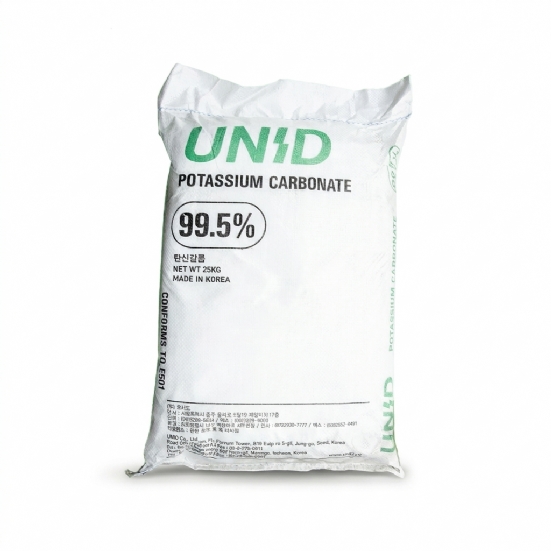
Across the inorganic raw material portfolios serving optical glassmaking, high-end ceramic glazes, food-grade cocoa alkalization, and concentrated potassium foliar fertilizers, R&D engineers and procurement teams consistently evaluate the exact physicochemical profile of Potassium Carbonate. Internationally designated as Potassium Carbonate (chemical formula K2CO3, CAS Registry Number 584-08-7), this high-purity alkaline salt is supplied commercially as a fine white crystalline powder (Potassium Carbonate 99.5% Min Powder) capable of rapid, 100% residue-free water dissolution. Boasting a minimum purity of ≥ 99.5%, an equivalent bioavailable potassium content of 68% K2O, and virtually zero chloride or sulfate impurities, Korean K2CO3 serves as a strategic raw material delivering superior value across high-precision industries.
Executive Summary
- Chemical Identification: Potassium Carbonate 99.5% Min Powder / Anhydrous Pearl Ash (Formula K2CO3, M = 138.205 g/mol, CAS 584-08-7, Food Additive Code INS 501i / E501), providing an available potassium equivalent of K2O ≥ 68.0%.
- Superior Physicochemical Profile: Exhibits exceptionally high aqueous solubility (1,120 g/L at 20°C – 5× higher than Na2CO3 and 10× higher than K2SO4); hydrolyzes in water to create a stable alkaline buffer (pH ~ 11.5 – 11.8).
- Three Core Application Pillars: Acts as a premier glass fluxing agent in crystal/optical glass and ceramic frits; serves as a chloride-free potassium fertilizer (68% K2O, 0% N); and functions as Food Additive E501 in cocoa alkalization, ramen noodles, and industrial CO2 scrubbing.
- Storage & Blending Precautions: Anhydrous K2CO3 crystalline powder is strongly hygroscopic and must have its inner PE liner tied tightly immediately after opening; add slowly during acid neutralization to prevent vigorous CO2 foaming overflow.
Table of Contents:
- 1. What is Potassium Carbonate? Manufacturing Process (K2CO3 99.5% Powder) & Specifications
- 2. Chemical Properties of K2CO3: High Water Solubility & Why K2CO3 Forms a Strong Base
- 3. Three Core Pillars: Glass & Ceramics, Chloride-Free Fertilizer & Food Additive E501
- 4. Korean Potassium Carbonate 99.5% (Code THP22) Distributed by Tan Hung Phu Chemical
- 5. Storage Guidelines for 25kg Bags Against Hygroscopic Caking & Operational Safety
- 6. Where to Buy K2CO3? Wholesale 25kg Bag Pricing in Ho Chi Minh City
- 7. Frequently Asked Questions (FAQ) on Potassium Carbonate – K2CO3 99.5%
- 8. Scientific References & International Standards
1. What is Potassium Carbonate? Manufacturing Process (K2CO3 99.5% Powder) & Specifications
In inorganic chemistry, Potassium Carbonate (IUPAC nomenclature: Potassium Carbonate, registered under CAS 584-08-7) is the inorganic salt of the alkali metal potassium and carbonic acid, carrying the chemical formula K2CO3 (molar mass M = 138.21 g/mol). Imported directly from South Korea by Tan Hung Phu Chemical, the commercial product presents as a fine white crystalline powder (Potassium Carbonate 99.5% Min Powder) that is free-flowing, odorless, and 100% soluble in water to form a crystal-clear alkaline solution.
Modern Carbonation Synthesis Achieving K2CO3 99.5% Min Purity
To achieve K2CO3 99.5% Min purity with iron and chloride impurities restricted to parts-per-million (ppm) thresholds required by optical glass and electronics manufacturing, modern South Korean plants utilize a closed-loop two-stage ion-exchange membrane KOH carbonation process:
- Stage 1 – Ion-Exchange Membrane Electrolysis for High-Purity KOH: Demineralized saturated Potassium Chloride (KCl) brine undergoes electrolysis across an ion-exchange membrane to yield ultra-pure Potassium Hydroxide (KOH) completely stripped of chloride ions:
2KCl + 2H2O → (Membrane Electrolysis) → 2KOH + Cl2↑ + H2↑ - Stage 2 – CO2 Carbonation & Anhydrous Calcination: Purified KOH solution is fed counter-currently through an absorption tower with high-purity Carbon Dioxide (CO2) gas. The resulting K2CO3 liquor is vacuum-evaporated, crystallized, and calcined at high temperature to drive off bound water, yielding anhydrous Potassium Carbonate 99.5% Min Powder:
2KOH + CO2 → K2CO3 + H2O
| Physicochemical & Technical Parameters (Test Item) | Standard Specifications for Korean Potassium Carbonate 99.5% (Code THP22) |
|---|---|
| Commercial Name & IUPAC Nomenclature | Potassium Carbonate 99.5% Min Powder (Anhydrous Pearl Ash) |
| Chemical Formula & Molar Mass | K2CO3 | M = 138.205 g/mol |
| CAS Number / HS Code / Food Additive Code | CAS 584-08-7 | HS Code: 2836.40.00 | Additive Code: INS 501(i) / E501 |
| Physical Appearance | Fine white crystalline powder, odorless, strongly hygroscopic in ambient air |
| Assay Purity (as K2CO3) | ≥ 99.5% Min (Equivalent to bioavailable potassium K2O ≥ 68.0%) |
| Loss on Drying / Moisture Content | ≤ 0.3% – 0.5% Max |
| Chloride Limit (as KCl) & Free Alkali (as KOH) | KCl: ≤ 0.01% – 0.02% Max | KOH: ≤ 0.05% – 0.10% Max |
| Iron Content (Fe) & Water-Insoluble Matter | Iron (Fe): ≤ 2.0 – 5.0 ppm Max | Water-insoluble: ≤ 0.01% – 0.02% Max |
| Melting Point, Density & Solution pH (10%) | Melting Point: 891°C | Density: 2.43 g/cm³ | pH: ~11.5 – 11.8 |
| Packaging & Country of Origin | 25 kg Net Bag (Woven PP bag with moisture-barrier PE inner liner) | Origin: South Korea |
2. Chemical Properties of K2CO3: High Water Solubility & Why K2CO3 Forms a Strong Base
2.1. Aqueous Solubility Five Times Higher Than Soda Ash (Na2CO3)
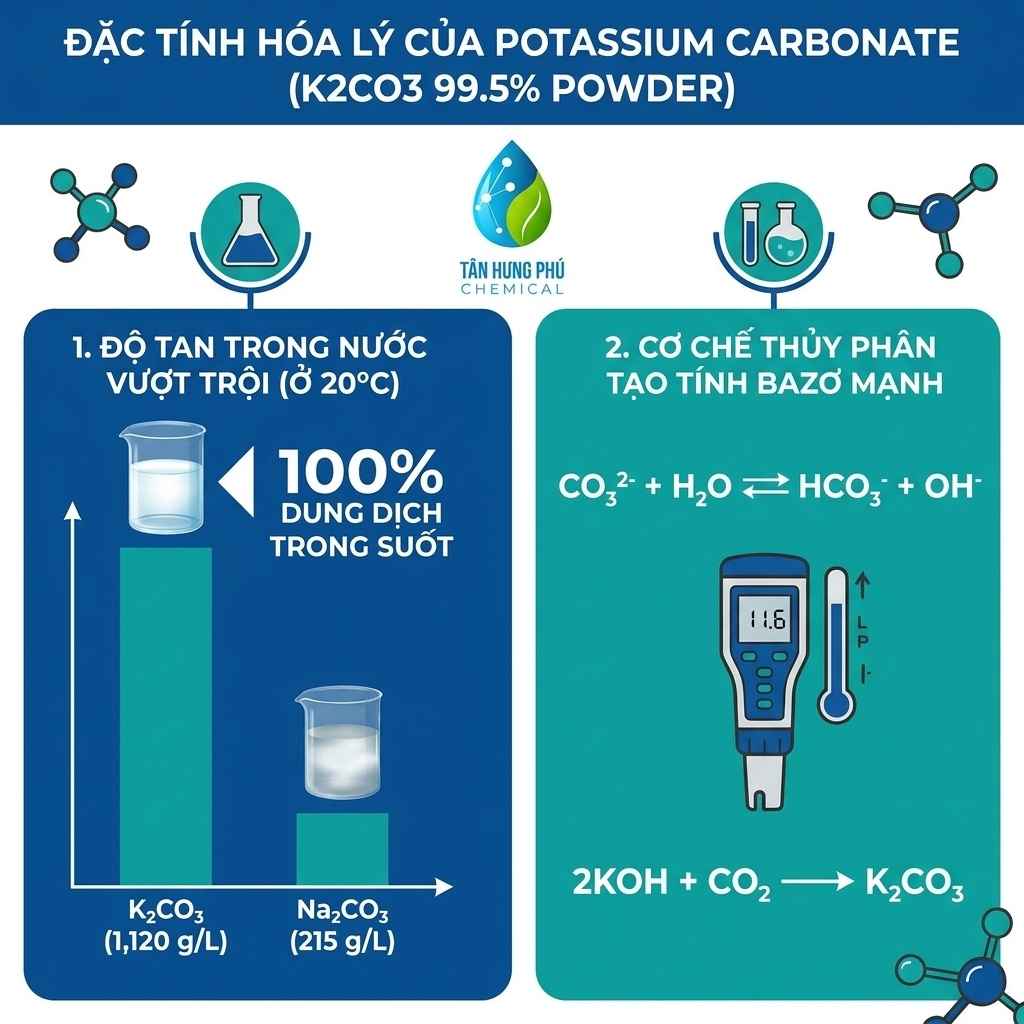
A pivotal physical advantage of Potassium Carbonate is its immense solubility in water even at ambient room temperature. At 20°C, K2CO3 dissolves up to 1,120 g/L (rising to 1,560 g/L at 100°C)—making it more than five times as soluble as Sodium Carbonate / Soda Ash Na2CO3 (which reaches only ~215 g/L at 20°C). Dissolving anhydrous K2CO3 powder in water is mildly exothermic (ΔH°sol = −31.1 kJ/mol), yielding a crystal-clear, sediment-free solution that resists crystallization even in cold storage environments.
2.2. Why Does K2CO3 Form a Strong Alkaline Solution? Core Chemical Reactions
Although classified stoichiometrically as a normal salt (lacking direct hydroxide OH− ions in its dry formula), dissolving K2CO3 in water produces a strongly alkaline solution with a pH of 11.5 – 11.8 (1% – 10% aqueous solution). This strong basicity arises because K2CO3 is formed from the cation of a strong base (K+ from KOH) and the anion of a very weak acid (CO32− from H2CO3). In aqueous media, carbonate anions undergo reversible salt hydrolysis to liberate free hydroxide ions (OH−):
K2CO3 → 2K+ + CO32− | CO32− + H2O ⇌ HCO3− + OH− (pH ≈ 11.6)
Alongside providing a gentle alkaline buffer (significantly less corrosive to process equipment than caustic KOH or NaOH), the chemical reactivity of K2CO3 drives three essential industrial reactions:
- 1. Acid Neutralization to Synthesize Pure Potassium Salts: Reacts briskly with mineral and organic acids (such as H3PO4, H3PO3, HNO3, Citric Acid, and Humic Acid) to manufacture high-purity potassium derivatives while liberating CO2 gas:
Example: K2CO3 + 2H3PO4 → 2KH2PO4 (MKP Fertilizer) + H2O + CO2↑. - 2. Reversible CO2 and H2S Gas Scrubbing (Benfield Process): Hot aqueous K2CO3 solutions absorb pressurized CO2 gas to form Potassium Bicarbonate (K2CO3 + CO2 + H2O ⇌ 2KHCO3) and release pure CO2 upon depressurization/boiling for continuous solvent regeneration in ammonia synthesis and petrochemical refineries.
- 3. High-Temperature Silicate Fusion: When fused with silica sand at 1,000°C – 1,400°C, K2CO3 reacts to yield optically transparent Potassium Silicate glass (K2CO3 + SiO2 → K2SiO3 + CO2↑).
3. Three Core Pillars: Glass & Ceramics, Chloride-Free Fertilizer & Food Additive E501
3.1. Glass & Ceramics: Premier Fluxing Agent for Crystal Glassware and Ceramic Frits
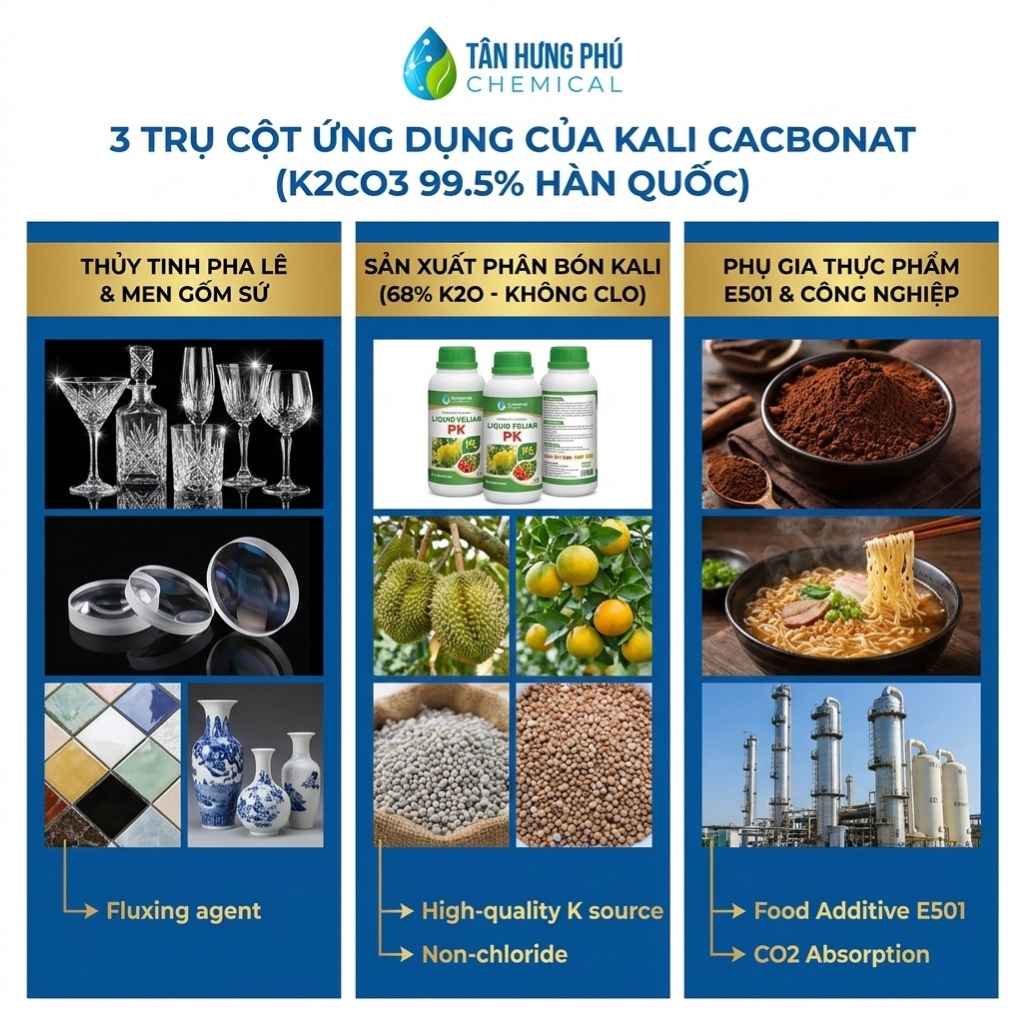
In glass melting and ceramic frit/glaze formulation, pure quartz sand (SiO2) requires extreme fusion temperatures (> 1,710°C). Incorporating K2CO3 in glass and ceramics provides an indispensable glass fluxing agent and network modifier:
- Lowering Melting Temperatures & Melt Viscosity: K2CO3 reacts with silica in the furnace batch to depress melting points, accelerate fining (gas bubble release), and lower fuel energy consumption.
- Enhancing Refractive Index & Optical Clarity in Crystal Glass: Unlike soda-lime glass made with Na2CO3 (which exhibits a faint greenish tint and lower brilliance), potash glass melted with Korean Potassium Carbonate 99.5% (featuring ultra-low iron Fe ≤ 2 – 5 ppm) achieves exceptional optical transparency, high refractive brilliance, acoustic resonance, and superior thermal shock resistance. It is essential for fine crystal stemware, optical lenses, laboratory glassware, electronic display panels, and specialty bulbs.
- Mirror-Smooth Gloss & Craze Resistance in Ceramic Glazes: In porcelain tile frits and sanitaryware glazes, K2CO3 matches glaze thermal expansion coefficients to the ceramic body, imparting deep gloss and vibrant pigment stability.
3.2. Agriculture & Foliar Fertilizers: Chloride-Free Potassium Source (68% K2O)
For foliar fertilizer formulators and precision agriculture operations, utilizing K2CO3 in fertilizers increasingly outperforms conventional potash salts across four agronomic dimensions:
- Highest Bioavailable Potassium Concentration (≥ 68.0% K2O): Per kilogram of raw material, K2CO3 99.5% supplies 68% K2O—surpassing Muriate of Potash MOP (60% K2O), Sulfate of Potash SOP (50% K2O), Potassium Nitrate KNO3 (46% K2O), and MKP (34% K2O).
- 100% Chloride-Free (Cl− ≤ 0.01%) and Nitrogen-Free (0% N): Ideal for late-stage fruit bulking, sugar accumulation (Brix), and coloration in chloride-sensitive crops such as durian, citrus, mango, coffee, black pepper, tobacco, and cantaloupe without inducing vegetative flushing or pulp hardening.
- Premier Feedstock for High-Analysis Liquid / Gel PK Fertilizers: With water solubility reaching 1,120 g/L (10× higher than Potassium Sulfate K2SO4 at ~110 g/L), K2CO3 enables formulators to produce liquid potassium fertilizers containing 30% – 50% K2O or neutralize organic acids (Citric, Humic/Fulvic, Amino Acids) into instant-absorption foliar chelates with zero bottom sludge.
- Soil Acidity Remediation & Foliar Pathogen Suppression: Carbonate hydrolysis neutralizes root-zone acidity in degraded soils while elevating leaf-surface pH to inhibit powdery mildew and anthracnose spore germination.
3.3. Food Additive E501 (Cocoa Alkalization) & Specialty Industrial Applications
- Food Additive E501 (INS 501i): When deployed in food processing, Food Additive E501 serves as the industry-standard alkalizing agent in Dutch-processed cocoa powder—neutralizing natural cocoa nib acidity, mellowing bitterness, developing a rich dark mahogany color, and improving dispersibility in dairy beverages and chocolate biscuits. E501 also imparts springy elasticity to alkaline ramen noodles and accelerates moisture evaporation during raisin drying.
- Fire Suppression Agents, Liquid Soaps & Gas Purification: Core active ingredient in Class K wet-chemical kitchen fire extinguishers and Purple-K dry powders; chemical precursor for Potassium Sorbate, Potassium Silicate, and industrial CO2 scrubbing solutions.
4. Korean Potassium Carbonate 99.5% (Code THP22) Distributed by Tan Hung Phu Chemical
To supply ultra-pure, brilliant-white Potassium Carbonate to glassmakers, ceramic frit plants, foliar fertilizer manufacturers, and chemical enterprises, Tan Hung Phu Chemical Co., Ltd. (THP Chemical) directly imports and distributes Korean Potassium Carbonate 99.5% Min Powder (Product Code: THP22):
- Product Code THP22 (Fine White Crystalline Powder – Made in South Korea): Potassium Carbonate K2CO3 99.5% Min Powder (South Korea) – 25kg Bag (Product Code: THP22)
Supplied as uniform white crystalline powder that dissolves 100% residue-free in water, each 25 kg Net bag is equipped with an airtight heat-sealed PE inner liner. Alongside Korean K2CO3 99.5% (THP22), manufacturers can source complementary potassium salts and industrial chemicals (such as Potassium Hydroxide KOH 90% Korea Code THP16, MKP 00-52-34 Code THP01, Potassium Nitrate KNO3 99% Code THP49, and Potassium Sulfate K2SO4 50% Code THP10) in our complete product portfolio.
5. Storage Guidelines for 25kg Bags Against Hygroscopic Caking & Operational Safety
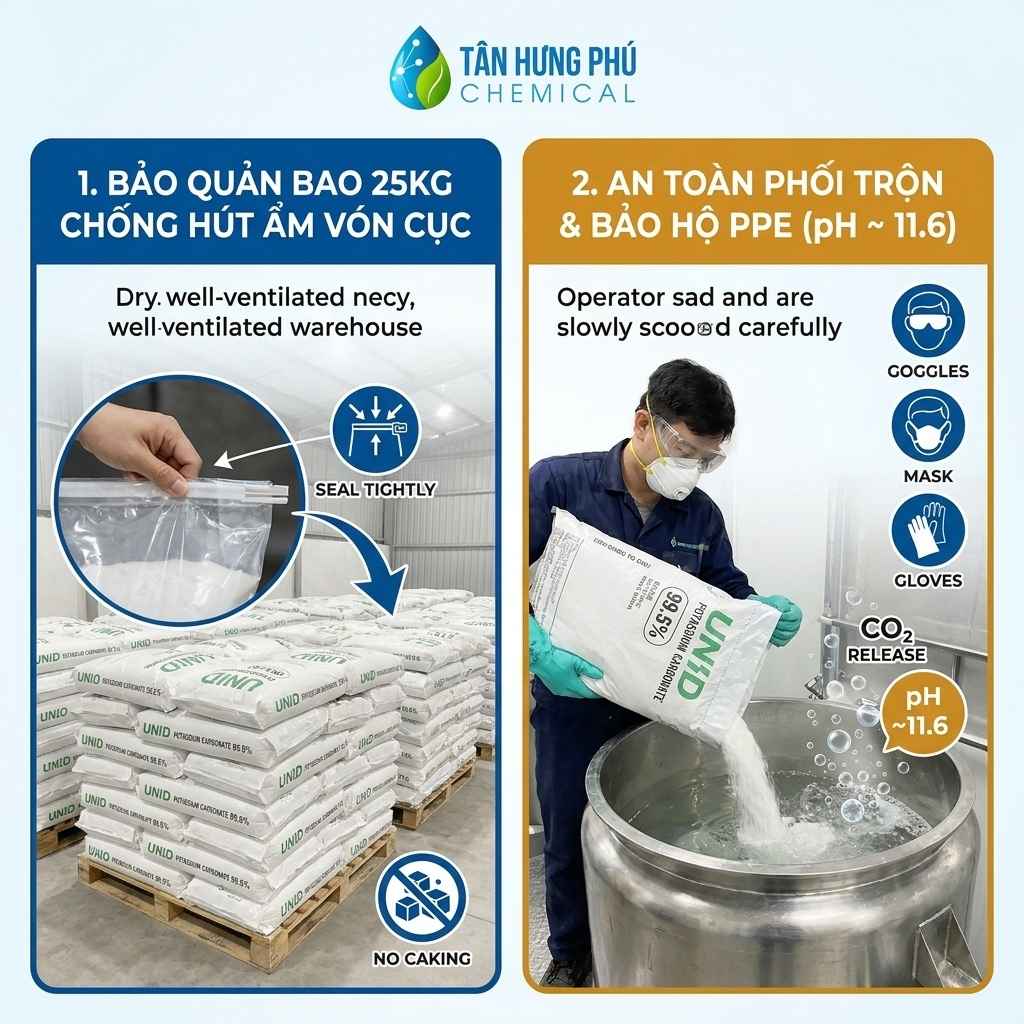
Anhydrous K2CO3 99.5% crystalline powder exhibits strong moisture affinity (so pronounced that it is routinely utilized as a laboratory desiccant for organic solvents). If left open in humid warehouse air, the free-flowing white powder rapidly absorbs atmospheric moisture to form hydrated cakes (K2CO3·1.5H2O) or liquefies into viscous brine while slowly absorbing CO2 to convert into KHCO3.
- Warehouse Storage Protocols: Stack 25 kg bags on elevated wooden or plastic pallets inside an enclosed, cool, dry, well-ventilated warehouse shielded from rain and direct sunlight. For partially scooped bags, squeeze out excess headspace air and tie off the inner PE liner tightly immediately after use.
- Controlled Acid Neutralization (Preventing CO2 Boilover): When neutralizing Potassium Carbonate with organic or mineral acids (Citric Acid, Humic Acid, H3PO4, H3PO3) during liquid fertilizer production, brisk effervescence of CO2 gas occurs. Feed K2CO3 powder gradually in small increments into agitated vessels with adequate freeboard height to prevent foam overflow.
- Personal Protective Equipment (PPE): While classified as Non-Dangerous Goods (Non-DG) for transport, concentrated K2CO3 solutions are strongly alkaline (pH ~ 11.6), and airborne crystalline dust can irritate skin, eyes, and respiratory passages (GHS H315, H319, H335). Operators should wear safety goggles, dust masks, and chemical-resistant gloves; flush eyes immediately with running water for 15 minutes upon accidental contact.
6. Where to Buy K2CO3? Wholesale 25kg Bag Pricing in Ho Chi Minh City
When procurement departments across glassworks, ceramic manufacturers, foliar fertilizer plants, and chemical distributors evaluate where to buy K2CO3, commercial 25kg bag pricing across the B2B market depends on three primary factors:
- Origin & Crystalline Purity: Authentic Korean Potassium Carbonate 99.5% (Product Code: THP22 – fine white crystalline powder) commands top industry preference due to its guaranteed ≥ 99.5% assay, ultra-low iron (≤ 2 – 5 ppm), and 100% sediment-free solubility.
- Order Volume (MOQ): Wholesale orders placed by the metric ton, full pallet (40 bags = 1 MT), or full 20’FCL container at Tan Hung Phu Chemical qualify for direct-importer tiered commercial discounts.
- Guaranteed Free-Flowing Condition & Audit Documentation: Every shipment dispatched from Tan Hung Phu is guaranteed factory-sealed with 100% dry, free-flowing white crystalline powder free of moisture caking, accompanied by original manufacturer COA, 16-section MSDS/SDS, Certificate of Origin, and valid VAT invoices.
REQUEST WHOLESALE QUOTE FOR POTASSIUM CARBONATE 99.5% SOUTH KOREA (CODE THP22) BY TON
To receive current wholesale pricing for Korean Potassium Carbonate 99.5% Min Powder (25kg Bag – Code THP22) along with batch COA, MSDS, and laboratory trial samples, please contact our B2B commercial division directly:
Tan Hung Phu Chemical Co., Ltd. (THP Chemical)
• Technical Support & Wholesale Hotline / Zalo: 0913 711 647
• Request for Quotation (RFQ) Email: tanhungphu@thpchemical.com
• Headquarters & Warehouse: 878B Ta Quang Buu Street, Binh Dong Ward, Ho Chi Minh City & regional distribution hubs (Fast nationwide delivery via dedicated trucks and container transport).
7. Frequently Asked Questions (FAQ) on Potassium Carbonate – K2CO3 99.5%
What is Potassium Carbonate, its chemical formula, and international CAS number?
Potassium Carbonate is the inorganic potassium salt of carbonic acid carrying the chemical formula K2CO3 (molar mass 138.21 g/mol) and registered under CAS 584-08-7. The premium South Korean import (Code THP22) is supplied as a fine white crystalline powder (99.5% Min Powder) guaranteed at ≥ 99.5% purity.
Why does an aqueous K₂CO₃ solution exhibit strong alkalinity despite having no OH⁻ in its formula?
When Potassium Carbonate dissolves in water, it dissociates completely into K+ ions (from the strong base KOH) and CO32− ions (from the weak acid H2CO3). Carbonate anions immediately hydrolyze with water (CO32− + H2O ⇌ HCO3− + OH−) to release free hydroxide ions, generating a strong alkaline solution with a pH of 11.5 – 11.8.
What agronomic advantages does K₂CO₃ offer in fertilizers over Potassium Chloride (KCl) and Potassium Sulfate (K₂SO₄)?
Using K2CO3 in fertilizers delivers three key advantages: (1) Supplies the highest bioavailable potassium content at 68% K2O; (2) Offers massive water solubility of 1,120 g/L (10× higher than K2SO4), enabling sludge-free high-analysis liquid/gel PK formulations; and (3) Is 100% chloride-free (Cl− ≤ 0.01%) and nitrogen-free, enhancing fruit sweetness and coloration in sensitive crops like durian and citrus while raising acidic soil pH.
How does K₂CO₃ differ from Soda Ash (Na₂CO₃) in glassmaking and ceramic glazes?
Acting as a premium glass fluxing agent, substituting K2CO3 for Na2CO3 produces potash glass with superior optical clarity, higher refractive index brilliance (crystal glassware), enhanced thermal shock resistance, higher electrical resistivity, and craze-free mirror-gloss ceramic glazes.
What is the role of Food Additive E501 (INS 501) in cocoa powder and alkaline noodles?
In food processing, Food Additive E501 (food-grade Potassium Carbonate) serves as the standard alkalizing regulator in Dutch-processed cocoa powder—neutralizing natural nib acidity to mellow bitterness, deepen dark brown color, and improve milk dispersibility—while imparting firm, elastic chewiness to alkaline ramen noodles.
Where can I buy wholesale Korean Potassium Carbonate 99.5% 25kg bags (Code THP22) in HCMC?
Commercial buyers looking to source authentic Korean Potassium Carbonate 99.5% Min Powder (Code: THP22) in Ho Chi Minh City with full batch COA and MSDS documentation can contact Tan Hung Phu Chemical Co., Ltd. directly via Hotline/Zalo at 0913 711 647.
8. Scientific References & International Standards
The physicochemical constants, aqueous solubility data, ion-exchange membrane carbonation protocols, and regulatory specifications for Potassium Carbonate (CAS 584-08-7) cited in this guide are referenced from authoritative international databases:
- U.S. National Library of Medicine (PubChem – NCBI): PubChem Compound Summary for CID 11430: Potassium Carbonate (K₂CO₃ – CAS 584-08-7) – Reference data for molar mass (138.21 g/mol), melting point (891°C), aqueous solubility (1,120 g/L at 20°C), and GHS classification.
- Joint FAO/WHO Expert Committee on Food Additives (JECFA): Monograph & Specifications for Potassium Carbonate (INS 501i) – JECFA Evaluations – Purity specifications and functional evaluation as an acidity regulator and stabilizer.
- International Plant Nutrition Institute (IPNI / Fertilizer Technical Reference): Technical Reference on Chloride-Free Potassium Salts (Potassium Carbonate – 68% K2O) in manufacturing concentrated liquid foliar fertilizers for chloride-sensitive crops.
- Technical Specifications & Manufacturer COA Profile: Technical Specification & Safety Data Sheet for Potassium Carbonate Anhydrous 99.5% Min Powder (Made in Korea).
Summary: Understanding the physicochemical profile of Potassium Carbonate (chemical formula K2CO3 – CAS 584-08-7) highlights its multi-industry versatility—from serving as an optical-grade fluxing agent in crystal glass and ceramic glazes to formulating 68% K2O chloride-free foliar fertilizers and alkalizing food-grade cocoa powder (E501). Sourcing authentic Korean Potassium Carbonate 99.5% Min Powder (Product Code: THP22) backed by full COA and MSDS documentation from Tan Hung Phu Chemical ensures peak manufacturing quality and optimized input costs.
Other News
View detail- What is Dextrose Monohydrate? Key Differences Between Crystalline Glucose and White Sugar (Sucrose) in Food Processing
- What is Acidity Regulator INS 260 (E260)? Discover Food Grade Acetic Acid 99.85% & Its Differences from Table Vinegar
- What is Potassium Hydroxide Flakes (KOH 90%)? Chemical Properties & Role in Humate Fertilizer and Liquid Soap
- What is Carrageenan Food Additive (INS 407 / E407)? Insights into Red Seaweed Extract for Texture & Elasticity in Jelly, Vietnamese Ham, and Sausages

