
News & Event
What is Dextrose Monohydrate? Key Differences Between Crystalline Glucose and White Sugar (Sucrose) in Food Processing
Compiled by Tan Hung Phu Technical Team · Updated:
In Research & Development (R&D) across the food processing, bakery, confectionery, frozen dessert, cured meat, and nutritional beverage industries, understanding what Dextrose Monohydrate is and how it behaves chemically is essential for controlling product texture, color, and flavor. Internationally designated as Dextrose Monohydrate (the crystalline monohydrate form of the monosaccharide D-Glucose), this functional carbohydrate possesses physicochemical properties fundamentally distinct from conventional white cane sugar (Sucrose). Featuring a mild, clean sweetness equal to 70% of sucrose, an endothermic heat of solution that creates a refreshing cooling sensation on the palate, potent Maillard browning reactivity, and strong freezing-point depression, Dextrose Monohydrate has become an indispensable functional sweetener in modern F&B manufacturing.
Executive Summary
- Chemical Identification: Dextrose Monohydrate / D-Glucose Monohydrate (Formula C6H12O6·H2O, M = 198.17 g/mol, CAS 5996-10-1), a high-purity monosaccharide (≥ 99.5% on dry basis, DE ≈ 100) produced via enzymatic hydrolysis of natural corn starch.
- Sweetness & Sensory Profile: Delivers a clean, mild sweetness rated at 70% – 74% relative to sucrose, accompanied by a strong negative heat of solution (ΔHsol ≈ −105 kJ/kg) that creates an immediate cooling sensation as crystals dissolve on the tongue.
- Technological Advantages Over Sucrose: Functions as an active reducing sugar that directly initiates Maillard browning for golden-brown crusts at 110°C – 140°C, and exhibits an anti-freezing index of PAC = 190 (1.9× sucrose) to keep ice cream smooth and free of ice crystals.
- Core Applications: Baked breads, cookies, and donut dusting sugar; fermentation substrate and pink color stabilizer in sausages, fermented pork rolls, and cured meats (3 – 15 g/kg meat); ice cream, compressed mints, instant beverage powders, and veterinary/aquaculture nutrition.
Table of Contents:
- 1. What is Dextrose Monohydrate? Monosaccharide Glucose Structure (C6H12O6·H2O)
- 2. Technical Comparison: Dextrose Monohydrate vs. White Sugar (Sucrose)
- 3. Core F&B Applications: Bakery (Maillard Reaction), Sausages, Ice Cream & Beverages
- 4. Food Safety Documentation & Dextrose Monohydrate (Code THP20) at Tan Hung Phu
- 5. Where to Buy Dextrose Monohydrate? Wholesale 25kg Bag Pricing in HCMC
- 6. Frequently Asked Questions (FAQ) on Dextrose Monohydrate
- 7. Scientific References & International Standards
1. What is Dextrose Monohydrate? Monosaccharide Glucose Structure (C6H12O6·H2O)
Biochemically, Dextrose Monohydrate is the standard commercial designation in the food and pharmaceutical industries for crystalline D-Glucose bound with one molecule of water of crystallization, carrying the chemical formula C6H12O6·H2O (molecular weight M = 198.17 g/mol, CAS Registry Number: 5996-10-1 or anhydrous 77938-63-7). The D-Glucose isomer earned the name “Dextrose” because in aqueous solution it optically rotates plane-polarized light to the right (dextrorotatory, specific optical rotation [α]D20 = +52.5° to +53.2°).
Dual-Enzyme Hydrolysis of Natural Corn Starch
Across global ingredient markets, this sweetener is commonly referred to as corn sugar or food-grade crystalline glucose because commercial Dextrose Monohydrate is manufactured from purified natural corn (maize) starch through a dual-enzyme hydrolysis process:
- Liquefaction & Saccharification (Achieving DE ≈ 99.5 – 100): Purified corn starch slurry is first thinned using bacterial α-amylase into intermediate maltodextrins, then completely saccharified with glucoamylase to cleave every glycosidic bond, converting 99.5% of the starch polymer into free D-glucose monosaccharide units.
- Refining & Monohydrate Crystallization: The resulting glucose syrup undergoes activated carbon decolorization, ion-exchange demineralization, vacuum evaporation, and controlled cooling crystallization below 50°C. Under these conditions, each D-Glucose molecule binds stoichiometrically with one water molecule (H2O), yielding free-flowing, non-caking white crystals of Dextrose Monohydrate.
| Physicochemical & Safety Parameters (GB/T 20880 / FCC / USP) | Standard Specifications for Dextrose Monohydrate (Code THP20) |
|---|---|
| Product Name & Chemical Nomenclature | Dextrose Monohydrate / D-Glucose Monohydrate (Crystalline Glucose) |
| Molecular Formula & CAS Number | C6H12O6·H2O (M = 198.17 g/mol) | CAS: 5996-10-1 (Anhydrous: 50-99-7) |
| Appearance & Organoleptic Profile | Fine white crystalline powder, odorless, clean refreshing sweet taste |
| D-Glucose Content (Assay on dry basis) | ≥ 99.5% Min (Dextrose Equivalent DE ≈ 99.5 – 100) |
| Specific Optical Rotation ([α]D20) | +52.0° to +53.5° |
| Water of Crystallization / Loss on Drying | 7.5% – 9.5% (Theoretical stoichiometry for 1 H2O molecule is 9.09%) |
| Sulfated Ash & Sulfur Dioxide (SO2) | Sulfated Ash: ≤ 0.1% Max | Residual SO2: ≤ 10 mg/kg (ppm) |
| Heavy Metals Limits (Lead – Pb, Arsenic – As) | Lead (Pb): ≤ 0.5 mg/kg | Arsenic (As): ≤ 0.5 mg/kg |
| Commercial Packaging & Shelf Life | 25 kg Net Bag (Multi-ply Kraft/PP bag with moisture-barrier PE inner liner) | Shelf life: 24 months |
2. Technical Comparison: Dextrose Monohydrate vs. White Sugar (Sucrose)
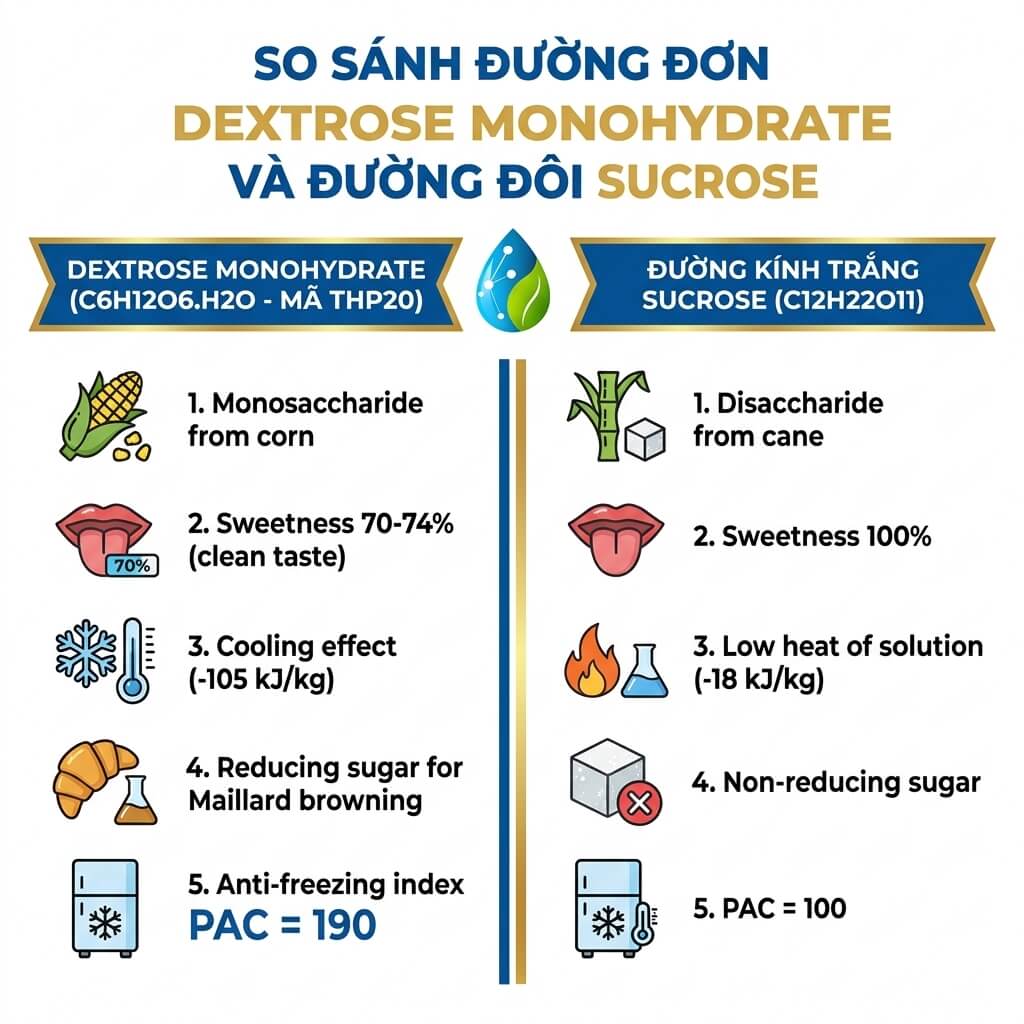
Why do commercial bakeries, ice cream plants, mint manufacturers, and meat processors replace a portion or all of refined cane sugar (Sucrose) with Dextrose Monohydrate? Comparing Dextrose vs. Sucrose reveals five decisive technological differences:
| F&B Technical Criteria | Dextrose Monohydrate (Code THP20) (Corn-derived Glucose Monosaccharide) |
Refined White Sugar / Sucrose (Cane or Beet Disaccharide) |
|---|---|---|
| 1. Molecular Structure & Formula | Monosaccharide: C6H12O6·H2O (Low molar mass: M = 198.17 g/mol; anhydrous M = 180.16 g/mol). | Disaccharide: C12H22O11 composed of 1 Glucose + 1 Fructose bonded tightly (High molar mass: M = 342.30 g/mol). |
| 2. Relative Sweetness (POD) | Sweetness rated at ~70% – 74% relative to Sucrose. Clean, crisp sweetness with rapid flavor release that enhances natural fruit or savory notes without cloying. | Reference Sweetness = 100%. Intense, lingering sweetness; using high levels to build dry-matter solids can create overly sweet, cloying flavor profiles. |
| 3. Heat of Solution (Cooling Effect) | Strongly endothermic (ΔHsol ≈ −105 kJ/kg or −25.2 kcal/kg). Absorbs heat rapidly when dissolving on the tongue, imparting an immediate refreshing cooling sensation. | Weakly endothermic (ΔHsol ≈ −18 kJ/kg, roughly 1/6th of Dextrose). Dissolves in the mouth with a neutral-to-warm sweet perception and zero cooling sensation. |
| 4. Reducing Sugar & Baking Coloration | Potent Reducing Sugar featuring a free aldehyde group (–CHO). Directly drives Maillard browning for rich golden-brown crusts and roasted aromas at 110°C – 140°C. | Non-Reducing Sugar. Cannot participate directly in Maillard reactions; requires high oven temperatures (> 160°C – 180°C) for thermal caramelization. |
| 5. Osmotic Pressure & Anti-Freezing (PAC) | Anti-Freezing Index PAC = 190 (1.9× Sucrose). Strongly depresses freezing points to keep ice cream scoopable without ice crystals while exerting high osmotic preservation. | Reference Anti-Freezing Index PAC = 100. Formulating ice cream solely with Sucrose yields rock-hard texture and coarse ice crystallization at −18°C. |
3. Core F&B Applications: Bakery (Maillard Reaction), Sausages, Ice Cream & Beverages
3.1. Dextrose in Commercial Baking & Maillard Crust Browning
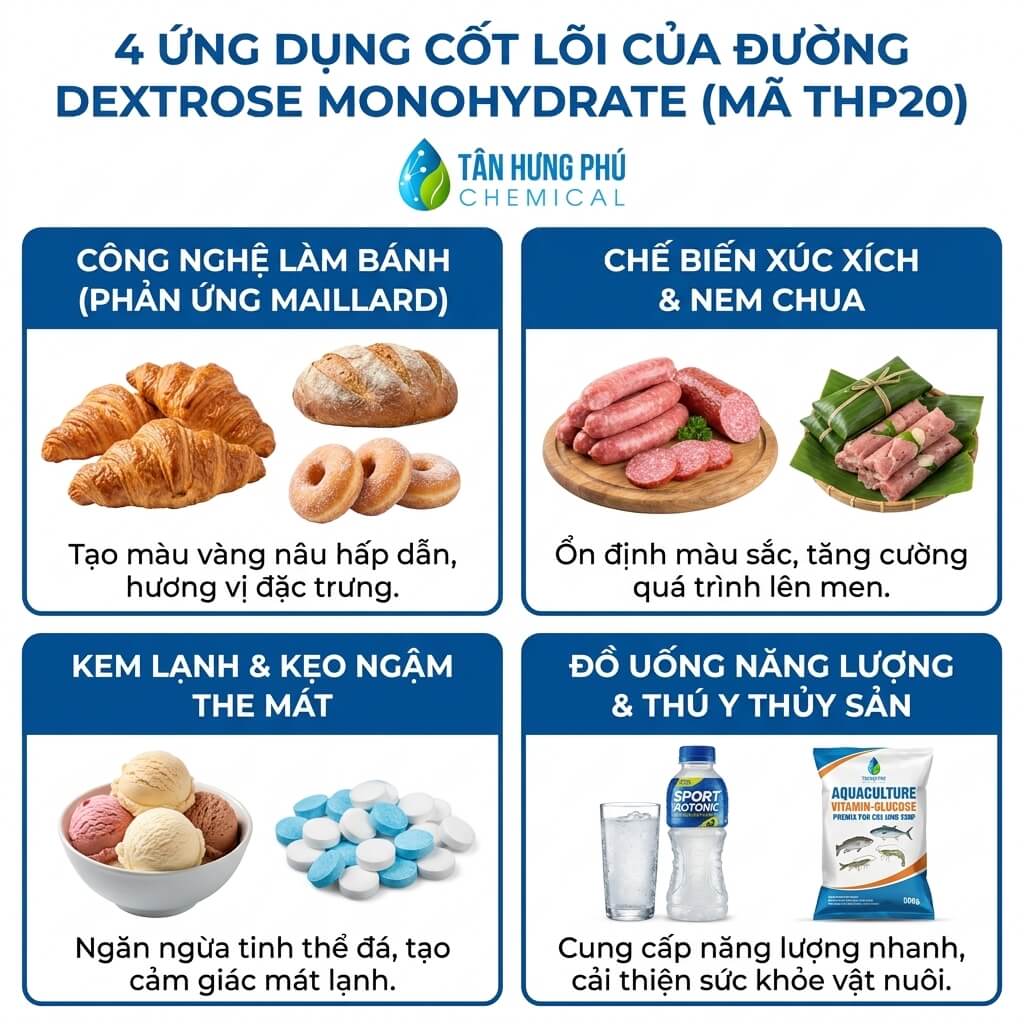
In commercial bread, cake, cookie, sponge cake, and donut production, incorporating Dextrose Monohydrate (typically replacing 15% – 30% of sucrose in the recipe, or dosed at 2% – 5% based on flour weight) delivers three technical advantages:
- Triggering Maillard Browning for Uniform Golden Crusts: Inside the baking oven, the free aldehyde group (–CHO) of D-glucose reacts rapidly with amino groups (–NH2) from wheat, egg, and milk proteins. This Maillard reaction synthesizes golden-brown melanoidin pigments at lower baking temperatures and shorter dwell times (preventing crumb dryness) while generating complex toasted bakery aromatics.
- Direct Fermentable Substrate for Baker’s Yeast: Baker’s yeast (Saccharomyces cerevisiae) metabolizes D-glucose immediately to generate CO2 gas without first secreting invertase enzymes to hydrolyze sucrose, accelerating dough proofing and producing a fine, uniform crumb structure.
- Non-Weeping Donut Dusting Sugar: Combining bright white crystal clarity with a refreshing cooling mouthfeel, Dextrose Monohydrate is the core ingredient in non-melting snow-white dusting powders for donuts, cream puffs, and pastries.
3.2. Role of Dextrose in Sausages, Fermented Meats & Cured Delicatessen
Across meat processing (emulsified sausages, smoked frankfurters, salami, fermented pork rolls, cured ham, and meat loaves), meat technologists formulate with Dextrose Monohydrate (typically dosed at 0.3% – 1.5%, or 3 – 15 g/kg of meat) rather than table sugar for three specialized functions:
- Rapid Lactic Acid Fermentation Substrate: In fermented sausages (salami) and traditional fermented pork rolls, starter lactic acid bacteria (Lactobacillus, Pediococcus) directly ferment corn dextrose into lactic acid. Controlled carbohydrate dosing drives pH down to 4.6 – 5.0 right on schedule, firming meat protein gels and inhibiting spoilage pathogens like Staphylococcus and Salmonella.
- Reductive Pink Cure Color Stabilization: Acting as a mild reducing sugar, Dextrose promotes the reduction of curing nitrites into nitric oxide (NO), which binds stably to meat myoglobin to form vibrant pink nitrosomyoglobin while preventing oxidative greying on sliced deli meats.
- Rounding Harsh Saltiness Without Over-Sweetening: Because Dextrose sweetness is only 70% that of sucrose with a clean finish, adding Dextrose to silent cutters mellows the sharp metallic bite of sodium chloride and phosphates while preserving natural savory meat flavor and preventing charring during pan-frying or grilling.
3.3. Ice Cream (Anti-Crystallization), Compressed Lozenges, Sports Drinks & Animal Nutrition
- Ice Cream, Gelato & Sorbet Manufacturing: With an anti-freezing index of PAC = 190 and low relative sweetness (POD = 70), substituting 20% – 30% of sucrose with Dextrose Monohydrate depresses the mix freezing point, keeping ice cream pliable and scoopable at −18°C without coarse ice crystals or excessive sweetness.
- Cooling Lozenges, Effervescent Powders & 3-in-1 Instant Coffee: Leverages its negative heat of solution (−105 kJ/kg) to provide a crisp cooling sensation in mint tablets and vitamin C chewables, while serving as a fast-dissolving bulking carrier in instant tea mixes, cereal powders, and savory seasoning packets.
- Isotonic Sports Beverages & Veterinary / Aquaculture Nutrition: As a pure monosaccharide absorbed directly across intestinal walls into the bloodstream within minutes without enzymatic digestion, Dextrose powers isotonic electrolyte drinks, oral rehydration salts (ORS), and anti-stress energy supplements for shrimp, fish, and livestock.
4. Food Safety Documentation & Dextrose Monohydrate (Code THP20) at Tan Hung Phu
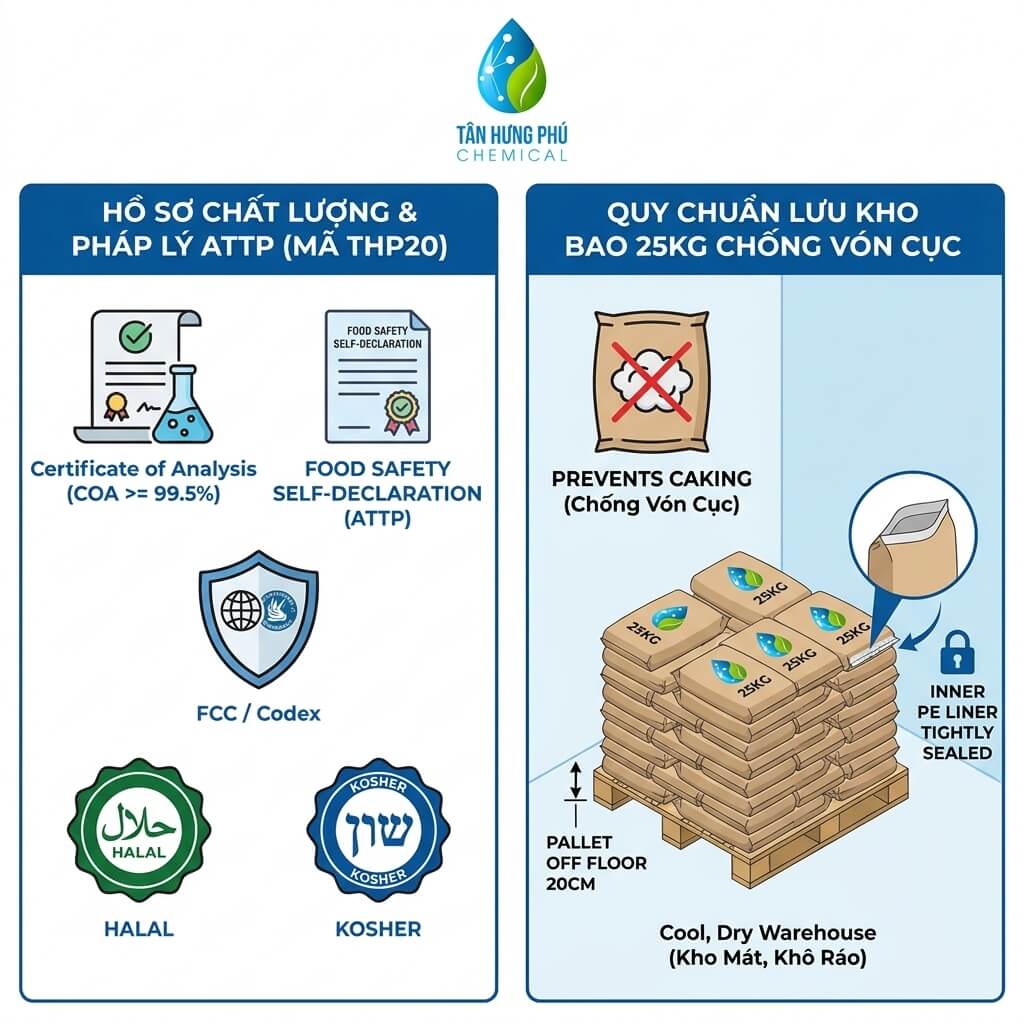
To meet the rigorous quality assurance audits of food, bakery, meat processing, and veterinary pharmaceutical plants operating under ISO 22000, FSSC 22000, and HACCP, Tan Hung Phu Chemical directly imports and distributes certified Food Grade Dextrose Monohydrate (Product Code: THP20):
- Verified Product Details (Product Code: THP20): Dextrose Monohydrate Powder (Crystalline Glucose) – Food Grade & Aquaculture/Veterinary Nutrition – 25kg Bag (Code: THP20)
• International Food Grade Standards (GB/T 20880-2018 / FCC / Codex): Dry-basis D-Glucose assay ≥ 99.5% Min, uniform fine white crystals, and 100% residue-free cold-water solubility.
• Complete Audit Documentation: Supplied with manufacturer Certificate of Analysis (COA) matching bag batch/lot numbers, 16-section Safety Data Sheet (MSDS), Statutory Food Safety Compliance Filings, plus Halal, Kosher, and Non-GMO declarations.
• Moisture-Controlled Warehouse Storage: All 25 kg Net bags (multi-ply Kraft/PP outer bags with airtight PE inner liners) are stored on elevated pallets in dry, cool warehouses to ensure 100% free-flowing powder upon delivery.
Alongside Dextrose Monohydrate (THP20), food processors can source complementary carbohydrates and functional hydrocolloids (including Maltodextrin DE 10–15 Code THP43, Marcel Carrageenan for sausages Code THP2, Citric Acid E330 Code THP18, and Xanthan Gum F200 Code THP45) in our complete product catalog.
5. Where to Buy Dextrose Monohydrate? Wholesale 25kg Bag Pricing in HCMC
When procurement teams at bakeries, meat processors, beverage plants, and animal nutrition manufacturers evaluate where to buy Dextrose Monohydrate, wholesale 25kg bag pricing across the B2B market is influenced by three key factors:
- Food Grade Purity & Global Corn Market Trends: High-purity Dextrose Monohydrate meeting GB/T 20880-2018 / FCC standards exhibits superior whiteness and particle uniformity; import pricing fluctuates seasonally with global maize harvests and ocean freight rates.
- Order Volume (MOQ): Bulk orders placed by the metric ton, full pallet (40 bags = 1 MT), or full 20’FCL container (25 MT) at Tan Hung Phu Chemical receive direct-importer tiered commercial discounts.
- R&D Sample Support & Rapid Logistics: We supply complimentary trial samples accompanied by batch COAs for pilot-line testing, valid commercial VAT invoices, and prompt delivery across Ho Chi Minh City, Binh Duong, Dong Nai, Long An, and nationwide.
REQUEST WHOLESALE QUOTE FOR DEXTROSE MONOHYDRATE 25KG BAGS (CODE THP20) BY TON / CONTAINER
To obtain current wholesale pricing for Food Grade Dextrose Monohydrate 25kg bags (Product Code: THP20) along with complete COA, MSDS, and food safety compliance files, please contact our B2B commercial team directly:
Tan Hung Phu Chemical Co., Ltd. (THP Chemical)
• Technical Support & Wholesale Hotline / Zalo: 0913 711 647
• Request for Quotation (RFQ) Email: tanhungphu@thpchemical.com
• Headquarters & Warehouse: 878B Ta Quang Buu Street, Binh Dong Ward, Ho Chi Minh City & regional distribution hubs (Fast nationwide delivery via dedicated trucks and containers).
6. Frequently Asked Questions (FAQ) on Dextrose Monohydrate
What is Dextrose Monohydrate, and how does it differ from Glucose?
Chemically, Dextrose and D-Glucose are the exact same monosaccharide molecule (C6H12O6). The commercial term Dextrose Monohydrate (C6H12O6·H2O) specifically refers to the purified crystalline powder form of D-Glucose crystallized with one bound molecule of water, manufactured industrially via enzymatic hydrolysis of natural corn starch.
How sweet is Dextrose Monohydrate compared to refined white cane sugar (Sucrose)?
On a relative sweetness scale where refined white Sucrose is rated at 100%, Dextrose Monohydrate delivers a sweetness of approximately 70% – 74%. Paired with its clean flavor release and endothermic cooling sensation on the tongue, Dextrose allows food technologists to build body and solids without making products overly sweet.
Why does using Dextrose in baking produce richer golden-brown crusts than regular sugar?
Unlike Sucrose (a non-reducing disaccharide), Dextrose is an active reducing sugar possessing a free aldehyde group. At baking temperatures between 110°C and 140°C, this aldehyde group reacts directly with amino acids in wheat flour and dairy proteins to drive Maillard browning, producing an even golden-brown crust and rich toasted aroma.
What functions does Dextrose serve in sausages and fermented meats?
Dosed at 3 – 15 g/kg of meat, Dextrose Monohydrate performs three roles: (1) Serves as an immediate fermentation substrate for lactic acid bacteria to lower pH and preserve fermented sausages; (2) Acts as a reducing agent to stabilize cured pink nitrosomyoglobin pigments; and (3) Rounds off harsh salt and phosphate notes without creating excessive sweetness.
How does Dextrose Monohydrate (DE ~ 100) differ from Maltodextrin (DE 10 – 15)?
Both are derived from corn starch hydrolysis but differ in degree of hydrolysis (Dextrose Equivalent – DE). Maltodextrin (DE 10 – 15) consists of partially hydrolyzed polysaccharide chains with virtually zero sweetness, ideal as a spray-drying carrier and bulking agent. In contrast, Dextrose Monohydrate (DE ≈ 100) is completely hydrolyzed into pure D-glucose monosaccharides (≥ 99.5%), providing 70% sweetness, strong reducing reactivity, and instant metabolic energy.
Where can I buy wholesale Food Grade Dextrose Monohydrate 25kg bags (Code THP20) in HCMC?
Commercial buyers looking to source verified Food Grade Dextrose Monohydrate 25kg bags in Ho Chi Minh City with complete batch COA, MSDS, and statutory food safety filings can contact Tan Hung Phu Chemical Co., Ltd. directly via Hotline/Zalo at 0913 711 647.
7. Scientific References & International Standards
The physicochemical constants, endothermic heat of solution, freezing-point depression values (PAC), and food safety specifications for Dextrose Monohydrate (C6H12O6·H2O) cited in this guide are referenced from international scientific institutions:
- Codex Alimentarius International Food Standards: Codex Standard for Sugars (CXS 212-1999) – Dextrose Monohydrate Specifications – International standards for D-glucose assay (≥ 99.5% on dry basis), total solids (≥ 90.0%), heavy metals, and SO2 thresholds.
- U.S. National Library of Medicine (PubChem – NCBI): PubChem Compound Summary for CID 71309042: D-Glucose monohydrate (C₆H₁₂O₆·H₂O – CAS 5996-10-1) – Molecular structure data, specific optical rotation, and thermodynamic dissolution parameters.
- U.S. Food and Drug Administration (FDA): Code of Federal Regulations Title 21 (21 CFR § 168.111 & 21 CFR § 184.1857 – Dextrose Monohydrate) – Standard of identity for dextrose monohydrate and GRAS affirmation in food manufacturing.
- National & Pharmacopeial Standards for Crystalline Glucose: National Standard GB/T 20880-2018 (Edible Glucose) and United States / European / British Pharmacopeia (USP / EP / BP) monographs for Dextrose Monohydrate.
Summary: Understanding the physicochemical structure of Dextrose Monohydrate (C6H12O6·H2O) and its five key advantages over white cane Sucrose empowers R&D teams to optimize product formulations. Whether accelerating golden Maillard crust browning in baked goods, stabilizing cured pink color and fermentation in sausages, preventing ice crystallization in gelato, or formulating cooling confections, sourcing certified Food Grade Dextrose Monohydrate (Product Code: THP20) complete with COA and food safety compliance from Tan Hung Phu Chemical ensures superior sensory quality and cost efficiency.
Other News
View detail- What is Potassium Carbonate (K2CO3 99.5%)? Origin, Properties and Applications from Glass Manufacturing to Agriculture
- What is Acidity Regulator INS 260 (E260)? Discover Food Grade Acetic Acid 99.85% & Its Differences from Table Vinegar
- What is Potassium Hydroxide Flakes (KOH 90%)? Chemical Properties & Role in Humate Fertilizer and Liquid Soap
- What is Carrageenan Food Additive (INS 407 / E407)? Insights into Red Seaweed Extract for Texture & Elasticity in Jelly, Vietnamese Ham, and Sausages

