
News & Event
What is Potassium Hydroxide Flakes (KOH 90%)? Chemical Properties & Role in Humate Fertilizer and Liquid Soap
Compiled by Tan Hung Phu Technical Team · Updated:
In the manufacturing of bio-organic fertilizers, personal care and liquid detergents (body washes, liquid soaps), high-purity potassium salts, and alkaline batteries, potassium hydroxide (common industrial name: Caustic Potash, chemical formula KOH) holds a specialized technical role that caustic soda (NaOH) cannot replace. Across the B2B chemical supply chain, this compound is most widely distributed in the form of white opaque solid flakes known as KOH 90% flakes (Potassium Hydroxide Flakes 90% Min). Featuring a large K+ ionic radius and exceptional aqueous solubility, KOH 90% serves as the primary alkaline reagent for hydrolyzing raw Leonardite ore into 100% water-soluble Potassium Humate fertilizers that will not clog drip irrigation emitters, while also imparting crystal-clear viscosity to premium liquid soap formulations.
Executive Summary
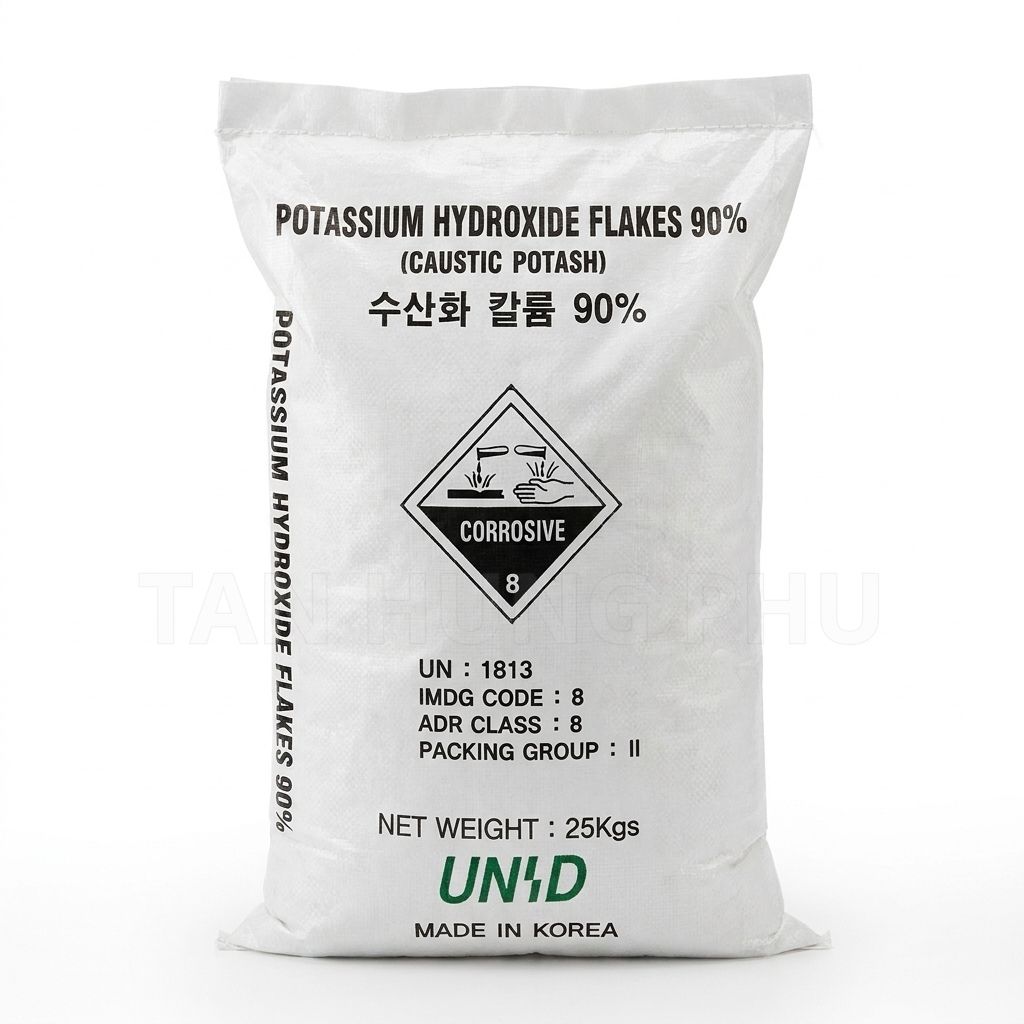
- Chemical Identification: Potassium Hydroxide / Caustic Potash (KOH 90% Min, M = 56.11 g/mol, CAS 1310-58-3, UN 1813), providing an equivalent available potassium oxide content of K2O ≥ 75.5%.
- Key Physicochemical Properties: Exhibits stronger alkalinity and higher water solubility (~1,120 – 1,210 g/L at 20°C) than NaOH; strongly deliquescent in air and highly exothermic upon dissolution (ΔH°sol = −57.61 kJ/mol).
- Core Industrial Applications: Alkaline extraction of Leonardite ore to manufacture 100% water-soluble Potassium Humate; neutralizing phosphorous acid for systemic Potassium Phosphite fungicides/fertilizers; saponifying vegetable oils for liquid soaps and body washes; alkaline battery electrolytes and Biodiesel catalysis.
- Safety Directive: Always add KOH flakes slowly into pre-filled cold water under continuous agitation (never pour water directly onto dry KOH) and tightly reseal the inner PE liner immediately after opening.
Table of Contents:
- 1. What is Potassium Hydroxide KOH 90% (KOH Flakes)? Technical Specifications
- 2. Alkalinity, Exothermic Deliquescence, and Solubility Comparison: KOH vs. NaOH
- 3. Role of KOH in Agriculture: Humic Acid Hydrolysis for 100% Soluble Potassium Humate
- 4. Liquid Soap Manufacturing (SAP KOH Value) & Industrial Chemical Applications
- 5. KOH 90% Flakes 25kg Bag (Code THP16) Distributed by Tan Hung Phu Chemical
- 6. Occupational Safety Standards (PPE) for Dissolving and Storing Caustic Potash
- 7. Where to Buy KOH 90%? Wholesale 25kg Bag Pricing in Ho Chi Minh City
- 8. Frequently Asked Questions (FAQ) on Potassium Hydroxide KOH 90%
- 9. Scientific References & International Standards
1. What is Potassium Hydroxide KOH 90% (KOH Flakes)? Technical Specifications
In inorganic chemistry, potassium hydroxide (traditionally traded as Caustic Potash, molecular formula KOH, CAS Registry Number: 1310-58-3) is a strong inorganic base of potassium metal. In modern chemical engineering, KOH is manufactured via the electrolysis of purified Potassium Chloride (KCl) brine utilizing advanced Ion-Exchange Membrane technology:
2KCl + 2H2O → (Ion-Exchange Membrane Electrolysis) → 2KOH + Cl2↑ + H2↑
Why is commercial solid Caustic Potash standardized at 90% purity (rather than 98% – 99% like NaOH)?
The answer lies in the exceptionally strong hydration affinity of the K+ ion for water molecules. When evaporating liquid KOH from electrolytic cells to form solid flakes, driving off 100% of the bound water requires molten fusion temperatures exceeding 380°C – 400°C, causing severe equipment corrosion and excessive energy consumption. Consequently, global industrial standards specify concentrating potassium hydroxide flakes 90 to a guaranteed concentration of KOH ≥ 90.0% Min (with the remaining ~9% – 9.5% consisting of stable bound hydration water KOH·xH2O, which keeps the flakes smooth, non-brittle, and rapidly soluble).
| Physicochemical & Technical Parameters | Standard Specifications for Potassium Hydroxide Flakes 90% (Code THP16) |
|---|---|
| Chemical Name & Molecular Formula | Potassium Hydroxide (Caustic Potash) – KOH (M = 56.11 g/mol) |
| CAS Number / UN Number / Grade | CAS: 1310-58-3 | UN 1813 (Class 8, PG II) | Grade: Fertilizer & Industrial Technical Grade |
| Physical Appearance | White opaque solid flakes, odorless, strongly deliquescent in ambient air |
| Total Alkalinity (Purity as KOH) | ≥ 90.0% Min (Equivalent to available potassium oxide K2O ≥ 75.5%) |
| Potassium Carbonate (K2CO3) | ≤ 0.4% – 0.5% Max (Strictly controlled to prevent foaming or insoluble turbidity) |
| Chloride (KCl / Cl−) & Iron (Fe) | Chloride (Cl−): ≤ 0.01% – 0.03% Max | Iron (Fe): ≤ 2.0 – 5.0 ppm Max |
| Solubility in Water (at 20°C / 25°C) | ~1,120 – 1,210 g/L (Freely soluble in water, ethanol, methanol, and glycerol) |
| Enthalpy of Solution (ΔH°sol) & pH | Heat of solution: −57.61 kJ/mol (Highly exothermic) | pH (1% solution): ~13.5 |
| Packaging & Origins | 25 kg Net Bag (Multi-layer moisture-barrier PP/PE bag) | Origins: South Korea, China |
2. Alkalinity, Exothermic Deliquescence, and Solubility Comparison: KOH vs. NaOH
2.1. Basicity of KOH, Hygroscopic Deliquescence, and Exothermic Dissolution
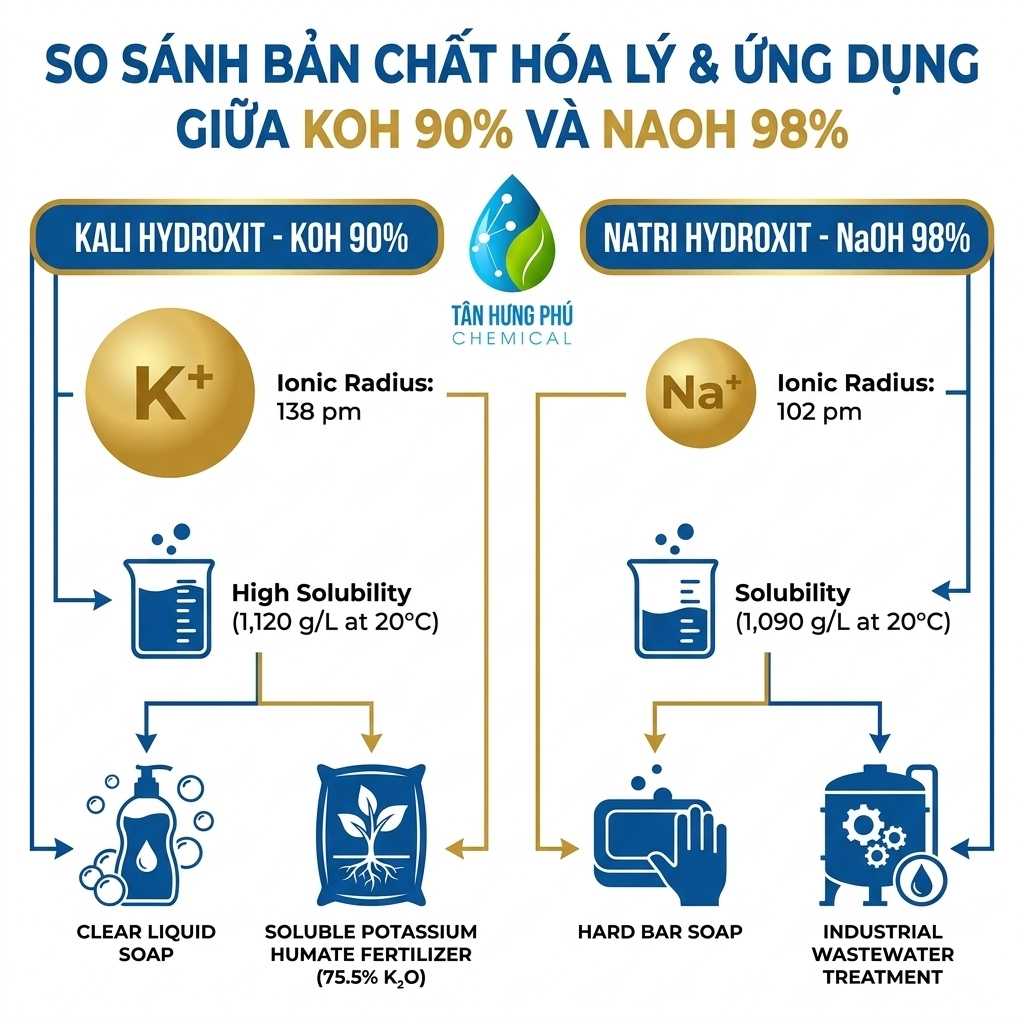
In Group IA (alkali metals) of the periodic table, Potassium (K, Period 4) sits directly below Sodium (Na, Period 3). Because the potassium cation possesses a significantly larger ionic radius (rK+ = 138 pm compared to rNa+ = 102 pm), the interionic bond distance between K+ and the hydroxide group (OH−) is longer, resulting in weaker electrostatic lattice attraction. Consequently, from a physical chemistry standpoint, the alkalinity of KOH (base dissociation constant pKb ≈ −0.7) is even stronger than that of NaOH:
- Strong Hygroscopic Deliquescence: When exposed to open air, the surface of KOH 90% flakes rapidly absorbs atmospheric moisture within minutes, liquefying into a viscous alkaline puddle while simultaneously absorbing atmospheric CO2 to form Potassium Carbonate (2KOH + CO2 → K2CO3 + H2O).
- Intense Exothermic Heat of Dissolution (ΔH°sol = −57.61 kJ/mol): Hydrating K+ and OH− ions liberates approximately 1,026 kJ of thermal energy per kilogram of pure KOH. When preparing a 30% – 45% KOH solution in plant mixing vessels, the batch temperature can surge past 80°C – 90°C, accelerating organic hydrolysis reactions without requiring external steam heating.
2.2. Technical Comparison: KOH vs. NaOH Solubility and Reaction Salt Behavior
Industrial buyers often ask: “Why do fertilizer and personal care plants insist on using KOH despite its higher cost per ton compared to NaOH?” The technical comparison of KOH vs. NaOH solubility below explains why:
| Technical Criteria | Caustic Potash Flakes – KOH 90% (Potassium Hydroxide) |
Caustic Soda Flakes – NaOH 98% / 99% (Sodium Hydroxide) |
|---|---|---|
| Molar Mass & Cationic Radius | M = 56.11 g/mol | K+ radius = 138 pm (Larger ion, lower surface charge density, less rigid crystal packing). | M = 40.00 g/mol | Na+ radius = 102 pm (Smaller ion, tightly packed rigid crystal lattice). |
| Aqueous Solubility at 20°C | Higher: ~1,120 – 1,210 g/L. Resulting potassium salts (K2CO3, K2HPO4, K-Humate) exhibit exceptionally high solubility without cold-weather crystallization. | Reaches ~1,090 g/L. Corresponding sodium salts (Na2CO3, Na2HPO4) have much lower solubility and readily precipitate in cool conditions. |
| Fat Saponification End-Product | Forms Potassium Carboxylate (RCOOK) with bulky molecular packing; soft, highly soluble, producing crystal-clear Liquid Soaps & Body Washes. | Forms Sodium Carboxylate (RCOONa) that crystallizes tightly into Hard Bar Soap; turns slimy, opaque, and phase-separates if diluted into liquid. |
| Agronomic Value for Crops & Soil | Supplies 75.5% K2O (Essential Macronutrient Potassium) promoting fruit enlargement, sugar accumulation, and stalk strength. | Introduces Sodium ions (Na+) that cause soil salinization, destroy soil colloid structure, and induce root toxicity. |
3. Role of KOH in Agriculture: Humic Acid Hydrolysis for 100% Soluble Potassium Humate
3.1. Mechanism of Humic Acid Hydrolysis with KOH to Manufacture Potassium Humate
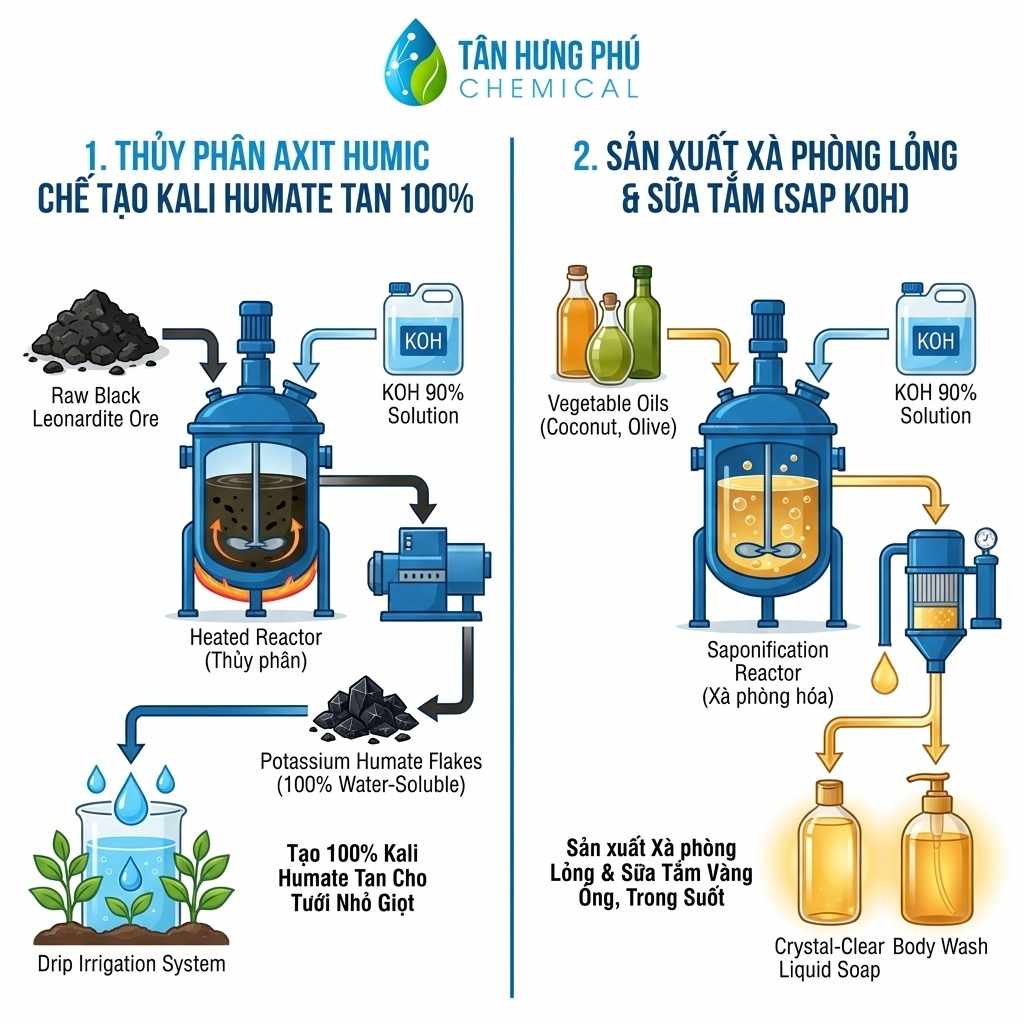
In bio-organic fertilizer production, the primary raw material is Leonardite ore (oxidized lignite coal containing 60% – 80% natural Humic and Fulvic Acids). However, in its raw mined state, humic acid macromolecules exist in an undissociated protonated form (H-Humic) tightly bound to clay minerals, making them completely insoluble in water. If applied directly to soil, plant roots cannot absorb them instantly, and the insoluble particles will clog drip irrigation systems.
To convert raw Leonardite ore into a high-grade water-soluble organic fertilizer, fertilizer plants perform alkaline humic acid hydrolysis using KOH to synthesize Potassium Humate:
R-(COOH)x(OH)y (Insoluble Raw Humic Acid) + (x+y) KOH → R-(COOK)x(OK)y (100% Soluble Potassium Humate) + (x+y) H2O
- Chain Unfolding & Functional Group Neutralization: When finely milled Leonardite powder is reacted with an aqueous solution of KOH 90% flakes at 60°C – 85°C (typically dosed at 120 – 160 kg of KOH 90% per metric ton of Leonardite ore depending on acid value), OH− ions cleave mineral bridges and neutralize the carboxylic (–COOH) and phenolic (–OH) functional groups along the humic backbone, substituting K+ cations to form highly polar Potassium Humate salts.
- Dual Agronomic Benefit (100% Solubility + 10%–12% K2O): After centrifugal decantation to remove insoluble ash and drum-flaking or spray-drying, the finished Potassium Humate dissolves 100% in cold water (> 98% – 99% solubility) while supplying 10% – 12% available Potassium (K2O) to stimulate rapid white root development, detoxify acidic soils, and pass effortlessly through drip fertigation emitters.
3.2. Additional Applications of KOH in Agriculture (Systemic Potassium Phosphite & Liquid PK)
Beyond Humate synthesis, KOH in agriculture serves as the foundational alkali for manufacturing specialty liquid foliar fertilizers and crop disease control agents:
- Two-Way Systemic Phosphorus Fertilizer – Potassium Phosphite (K2HPO3 / KH2PO3): Neutralizing crystalline Phosphorous Acid (H3PO3 98.5%) with KOH 90% solution yields Potassium Phosphite—a dual-action systemic compound that delivers high P–K nutrition while activating plant phytoalexin immunity against Phytophthora trunk gummosis, root rot, and fruit rot in durian, citrus, and black pepper.
- Chloride-Free Organic Potassium, Potassium Silicate & Hydroponic pH Up: Reacted with Citric Acid (E330) to produce chloride-free Potassium Citrate for fruit sweetening; reacted with amorphous silica to form Potassium Silicate for stem fortification; and diluted as a standard pH Up adjuster in hydroponic nutrient reservoirs.
4. Liquid Soap Manufacturing (SAP KOH Value) & Industrial Chemical Applications
4.1. Why is KOH 90% Mandatory for Manufacturing Liquid Soap, Body Wash, and Shaving Cream?
In cosmetic and detergent formulation, saponifying triglycerides (from coconut oil, olive oil, palm oil, or castor oil) with NaOH yields sodium fatty acid salts (RCOONa) whose tight crystalline packing forms hard bar soaps. Conversely, in liquid soap manufacturing (Liquid Castile Soap, natural body washes, herbal shampoos, hand cleansers, and shaving creams), formulators must use KOH 90% flakes:
(RCOO)3C3H5 (Vegetable Oil) + 3KOH → 3RCOOK (Translucent Soluble Potassium Soap Paste) + C3H5(OH)3 (Glycerin)
Because the larger K+ ion prevents fatty acid chains (such as Potassium Cocoate and Potassium Oleate) from packing into a rigid crystal lattice, the reaction forms a pliable, translucent gel paste (Soap Paste). When diluted with deionized water, this paste dissolves into a honey-clear liquid soap that produces rich, velvety lather without solidifying or separating into cloudy layers.
4.2. Saponification Value (SAP KOH) Formula Adjusted for 90% Commercial Purity
When calculating batch recipes, formulators must account for the SAP KOH value (milligrams or grams of 100% pure KOH required to saponify 1 gram of oil; where SAPKOH = SAPNaOH × 1.4027). Because commercial potassium hydroxide flakes 90 contains 90% active KOH (~10% bound hydration moisture), the theoretical pure KOH weight must be divided by 0.90:
Actual KOH 90% Flakes Weight (g) = [ Oil Weight (g) × Standard SAPKOH (100%) × (1 − % Superfat) ] / 0.90
| Common Vegetable Base Oil | Standard SAPKOH (100%) Value (g pure KOH / 1 g oil) |
Actual KOH 90% Flakes Required (Per 1,000 g oil at 0% Superfat) |
|---|---|---|
| Coconut Oil (High foaming & cleansing) | 0.257 g KOH / g oil (257 mg/g) | ~285.5 g KOH 90% Flakes / 1 kg coconut oil |
| Palm Oil (Body & viscosity builder) | 0.199 g KOH / g oil (199 mg/g) | ~221.1 g KOH 90% Flakes / 1 kg palm oil |
| Olive Oil (Mildness & skin conditioning) | 0.190 g KOH / g oil (190 mg/g) | ~211.1 g KOH 90% Flakes / 1 kg olive oil |
| Castor Oil (Optical clarity & foam stability) | 0.180 g KOH / g oil (180 mg/g) | ~200.0 g KOH 90% Flakes / 1 kg castor oil |
4.3. Industrial Chemical Synthesis, Alkaline Batteries & Biodiesel Catalysis
Beyond agriculture and personal care, KOH in industrial chemistry plays a critical role in energy and chemical synthesis:
- Electrolyte in Alkaline Batteries & Green Hydrogen Electrolysis: Aqueous KOH solutions exhibit significantly higher ionic conductivity than NaOH and resist freezing down to −20°C, serving as the standard electrolyte in Zn-MnO2 alkaline batteries, Nickel-Cadmium (Ni-Cd) accumulators, and alkaline water electrolyzers for green hydrogen production.
- Biodiesel Catalyst & Potassium Salt Precursor: Acts as a homogeneous alkaline catalyst in the transesterification of vegetable oils and animal fats into Biodiesel; serves as the chemical precursor for synthesizing K2CO3, KH2PO4 (MKP), KMnO4 (Potassium Permanganate), and other industrial potassium derivatives.
5. KOH 90% Flakes 25kg Bag (Code THP16) Distributed by Tan Hung Phu Chemical
To supply consistent, high-purity potassium alkali for Potassium Humate fertilizer plants, liquid detergent formulators, and metal surface treatment facilities, Tan Hung Phu Chemical Co., Ltd. (THP Chemical) directly imports and distributes Potassium Hydroxide Flakes KOH 90% (Product Code: THP16):
- Product Code THP16 (Potassium Hydroxide Flakes 90% Min): Potassium Hydroxide Flakes KOH 90% (Caustic Potash Flakes) – 25kg Bag (Product Code: THP16)
The product is supplied in standard 25 kg Net moisture-barrier multi-ply PP/PE bags (heat-sealed airtight), featuring dry, free-flowing white flakes with ultra-low carbonate (K2CO3 ≤ 0.4%) and iron (Fe ≤ 5 ppm) impurities. Alongside KOH 90% (THP16), manufacturers can explore our complementary portfolio of fertilizer raw materials and basic industrial alkalis (including Potassium Carbonate K2CO3 99.5%, MKP 00-52-34 Fertilizer, Potassium Nitrate KNO3 99% Code THP49, and Caustic Soda Flakes NaOH 98%–99%) in our fertilizer raw materials catalog.
6. Occupational Safety Standards (PPE) for Dissolving and Storing Caustic Potash
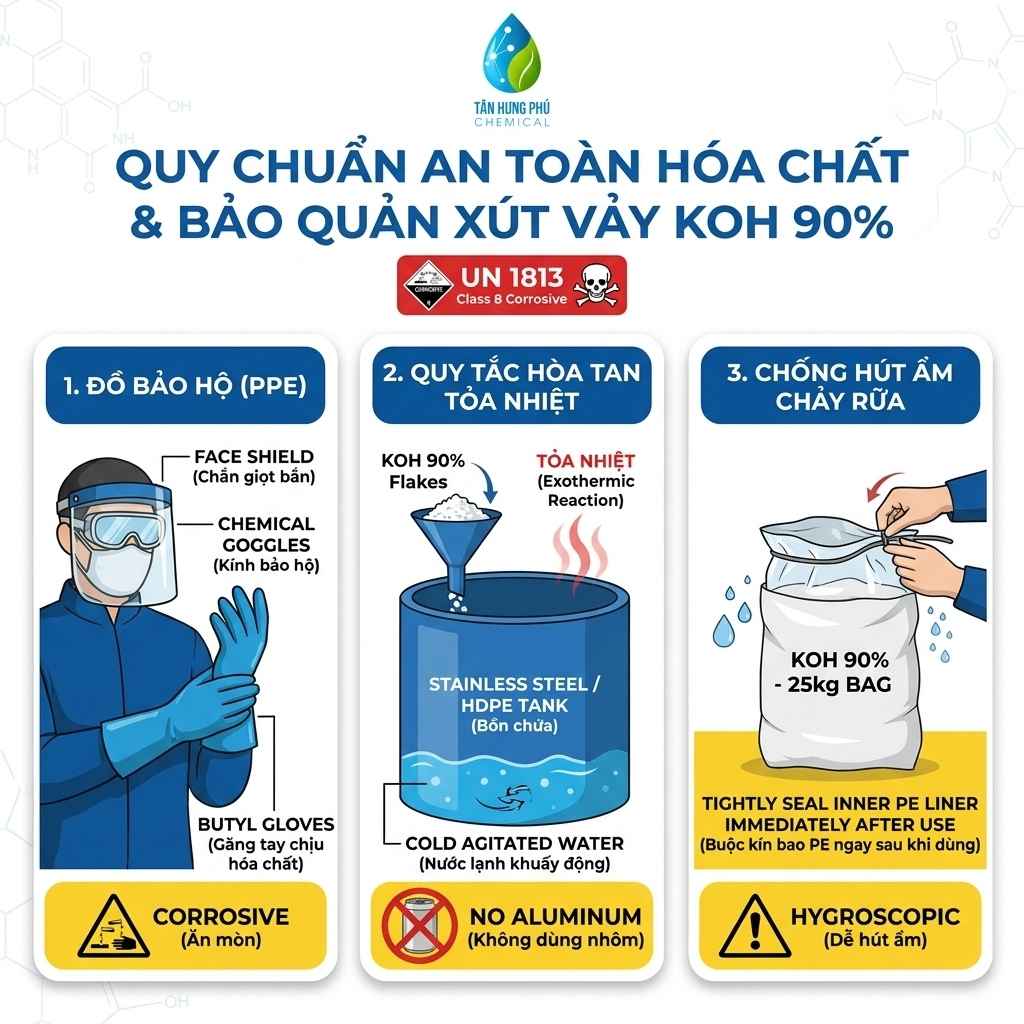
Caustic Potash (KOH) exhibits even stronger tissue corrosivity and exothermic heat release than NaOH (GHS Hazard Statements: H290 – May be corrosive to metals; H302 – Harmful if swallowed; H314 – Causes severe skin burns and eye damage).
• Anti-Boilover Dissolution Rule: Always fill the alkali- and heat-resistant mixing tank (SUS 304/316 stainless steel, thick PP, or HDPE) with cold water first, turn on the agitator, and gradually feed small increments of KOH 90% flakes into the water. Never pour water directly into a bag or drum containing dry KOH.
• Prohibition of Aluminum, Zinc, and Tin Vessels: Aqueous KOH rapidly corrodes Aluminum (Al) and Zinc (Zn), liberating flammable Hydrogen gas (H2) and creating explosion risks.
- Personal Protective Equipment (PPE): Operators must wear sealed chemical splash goggles paired with a full face shield, alkali-resistant gauntlet gloves (Butyl, Neoprene, or thick Nitrile), a PVC apron, rubber boots, and an alkaline dust/mist respirator.
- Medical First Aid: In the event of skin or eye contact with KOH flakes or solution, flush immediately with copious running water or an emergency eyewash station for at least 20 – 30 minutes until the slippery sensation disappears (never apply acid or vinegar to neutralize skin burns), and seek immediate medical care.
- Preventing Deliquescence in Storage: Because KOH is intensely hygroscopic, 25kg KOH flake bags must be stored on elevated pallets inside a cool, dry, draft-free warehouse. Partially used bags must have excess air squeezed out and the inner PE liner tied off tightly immediately after scooping.
7. Where to Buy KOH 90%? Wholesale 25kg Bag Pricing in Ho Chi Minh City
When procurement teams at fertilizer plants, detergent factories, and chemical enterprises source wholesale KOH 90%, commercial KOH 90% flake pricing across the B2B market depends on three primary factors:
- Selected Country of Origin: High-purity potassium hydroxide flakes 90 imported from South Korea and industrial-grade material from China carry different import tariff schedules and ocean freight rates depending on market cycles.
- Order Volume (MOQ): Wholesale orders placed by metric ton, full pallet (40 bags = 1 MT), or full container load (20’FCL) at Tan Hung Phu Chemical receive direct-importer tiered volume discounts.
- Physical Condition & Complete Documentation: Every shipment of KOH 90% 25kg bags (Product Code: THP16) dispatched from Tan Hung Phu is guaranteed factory-sealed with 100% dry, free-flowing white flakes free from moisture liquefication or hard caking, accompanied by batch-specific COA, 16-section MSDS, and valid VAT invoices.
REQUEST WHOLESALE QUOTE FOR KOH 90% FLAKES (POTASSIUM HYDROXIDE – CODE THP16) BY TON / PALLET
To obtain the latest wholesale pricing for KOH 90% Flakes (25kg Bag – Product Code: THP16) along with batch COA and MSDS documentation for Potassium Humate fertilizer or liquid soap production, please contact our B2B sales department directly:
Tan Hung Phu Chemical Co., Ltd. (THP Chemical)
• Technical Support & Wholesale Hotline / Zalo: 0913 711 647
• Request for Quotation (RFQ) Email: tanhungphu@thpchemical.com
• Headquarters & Warehouse: 878B Ta Quang Buu Street, Binh Dong Ward, Ho Chi Minh City & regional logistics hubs (Fast nationwide delivery via dedicated trucks and containers).
8. Frequently Asked Questions (FAQ) on Potassium Hydroxide KOH 90%
Why is commercial Caustic Potash flake always standardized at KOH 90% instead of 98% – 99% like NaOH flakes?
Because the Potassium ion (K+) holds hydration water molecules with much greater affinity than the Sodium ion (Na+), during vacuum evaporation and drum flaking, potassium hydroxide flakes 90 retains approximately 9% – 10% bound water of crystallization within its lattice to form stable, rapidly soluble flakes without thermal decomposition. Consequently, KOH 90% Min is the universal commercial standard across global manufacturers (South Korea, China, USA, and Europe).
Why must fertilizer plants use KOH 90% instead of NaOH when manufacturing Potassium Humate from Leonardite ore?
Raw Leonardite ore contains water-insoluble Humic Acid. Performing alkaline humic acid hydrolysis with KOH breaks mineral bonds to yield 100% water-soluble Potassium Humate that will not clog drip irrigation nozzles, while directly enriching the fertilizer with 10% – 12% available Potassium (K2O) essential for crop growth. Conversely, using NaOH produces Sodium Humate containing high levels of Sodium ions (Na+) that cause soil salinization and root toxicity in crops (Sodium Humate is restricted to aquaculture pond shading or ceramic deflocculation).
Why is KOH required instead of NaOH for manufacturing liquid soaps and body washes?
In vegetable oil saponification, NaOH produces sodium fatty acid salts with a compact crystal lattice that solidifies into hard bar soap (which turns slimy and phase-separates if diluted with water). Thanks to the larger K+ ionic radius and superior solubility of KOH compared to NaOH, using KOH in liquid soap production yields highly soluble potassium fatty acid salts that remain in a clear, smooth liquid gel state with rich, creamy lather.
How do you convert the SAP KOH saponification value when weighing commercial KOH 90% flakes?
Standard reference tables list the SAP KOH saponification value based on 100% pure KOH (where SAPKOH = SAPNaOH × 1.4027). When weighing commercial KOH 90% flakes on the production floor, simply take the calculated pure KOH weight and divide by 0.90 (or multiply by 1.111) to compensate for the 10% bound hydration moisture in the flakes.
What safety precautions are required when dissolving and storing Caustic Potash KOH 90% bags?
When dissolving caustic potash KOH, operators must wear a full face shield and alkali-resistant gloves, and slowly feed KOH flakes into pre-filled cold water under continuous stirring (never pour water onto dry KOH, as the intense −57.61 kJ/mol heat of solution will cause violent boiling and spattering). Because KOH is strongly hygroscopic, reseal the inner PE liner tightly immediately after opening any 25 kg bag to prevent deliquescence.
What is the wholesale price of KOH 90% 25kg bags (Code THP16) and where can I buy authentic KOH in HCMC?
Wholesale KOH 90% flake pricing (in standard 25kg bags) depends on the selected origin (South Korea or China) and order quantity by pallet, metric ton, or full container. Enterprises looking to buy KOH 90% in Ho Chi Minh City with full batch COA and MSDS documentation can contact Tan Hung Phu Chemical directly via Hotline/Zalo at 0913 711 647.
9. Scientific References & International Standards
The physicochemical constants, enthalpy of solution, alkaline extraction protocols for Potassium Humate from Leonardite ore, and occupational safety standards for Potassium Hydroxide (CAS 1310-58-3) presented in this article are referenced from international scientific databases:
- U.S. National Library of Medicine (PubChem – NCBI): PubChem Compound Summary for CID 14797: Potassium Hydroxide (KOH – CAS 1310-58-3) – Reference data for molar mass (56.11 g/mol), aqueous solubility, enthalpy of solution (−57.61 kJ/mol), and GHS hazard classification (UN 1813).
- U.S. National Institute for Occupational Safety and Health (CDC / NIOSH): NIOSH Pocket Guide to Chemical Hazards – Potassium Hydroxide – Recommended exposure limit (REL Ceiling: 2 mg/m³), chemical incompatibilities, and personal protective equipment (PPE) standards.
- International Humic Substances Society (IHSS): IHSS Standard Methods for Isolation of Humic Substances – Standard methodology for alkaline extraction and activation of Humic and Fulvic Acids from Leonardite ore into soluble Humate salts.
- Industrial Technical Standard for Potassium Hydroxide: Industrial Standard HG/T 3688-2020 and Korean Industrial Standards (KS M) for Potassium Hydroxide Flakes 90% Min.
Summary: Combining strong alkalinity, superior aqueous solubility, and essential potassium macronutrient value, potassium hydroxide (chemical formula KOH) in its commercial KOH 90% form (caustic potash flakes 90) is an irreplaceable raw material for manufacturing 100% water-soluble Potassium Humate fertilizers, systemic liquid PK foliar sprays, and crystal-clear liquid soaps. Sourcing genuine imported KOH 90% (Product Code: THP16) in airtight 25 kg bags complete with batch COA and MSDS from Tan Hung Phu Chemical ensures maximum reaction efficiency and optimized manufacturing costs.
Other News
View detail- What is Carrageenan Food Additive (INS 407 / E407)? Insights into Red Seaweed Extract for Texture & Elasticity in Jelly, Vietnamese Ham, and Sausages
- What Is PAC 31% Flocculant (Poly Aluminium Chloride)? Electrostatic Attraction & Rapid Flocculation Mechanism in Turbid Water
- What Is TCCA 90% (Trichloroisocyanuric Acid)? High-Available Chlorine & Applications of Powder, Granular, 20g Tablets, and 200g Tablets
- What Is Sodium Alginate (E401)? Brown Seaweed Origin & Calcium Gelation Mechanism

