
News & Event
What is Acidity Regulator INS 260 (E260)? Discover Food Grade Acetic Acid 99.85% & Its Differences from Table Vinegar
Compiled by Tan Hung Phu Technical Team · Updated:
When examining the ingredient panels on chili sauces, ketchup, mayonnaise dressings, instant noodle seasoning sachets, or pickled canned vegetables, food technologists and R&D formulation engineers routinely encounter the functional designation INS 260 or E260. This is the international identification code for acidity regulator E260—specifically high-purity Food Grade Glacial Acetic Acid (chemical formula CH3COOH) guaranteed at a minimum assay of 99.85 wt%. Although sharing the identical sour-tasting chemical molecule as common household table vinegar, concentrated industrial-grade E260 utilized in commercial food processing facilities adheres to profoundly different heavy metal purity thresholds, dilution protocols, and microbial inhibition mechanisms that technical teams must master.
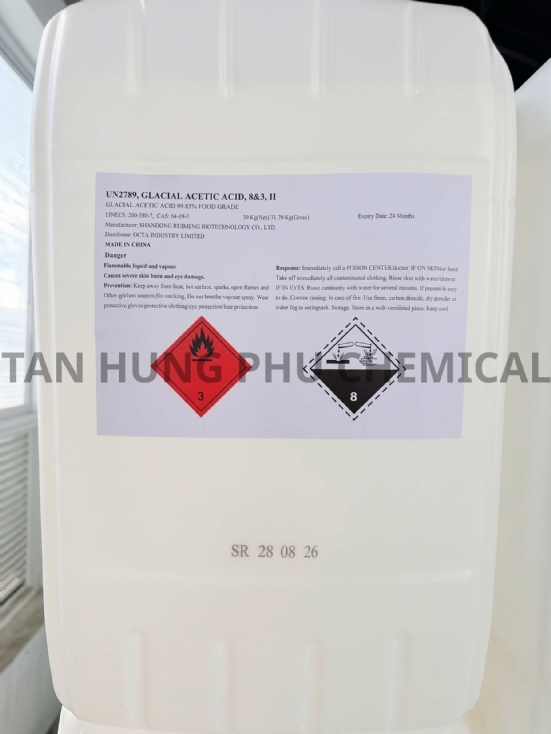
Executive Summary
- Additive Identification: Food Grade Glacial Acetic Acid (International code: INS 260 / E260, formula CH3COOH, CAS 64-19-7), offering an active purity assay of ≥ 99.85 wt% Min, permanganate retention time ≥ 120 minutes, and heavy metals ≤ 0.5 – 2.0 ppm.
- Comparison with Table Vinegar: Table vinegar is an aqueous acetic acid solution diluted to 2% – 5%; concentrated E260 (99.85%) is 20 to 50 times more concentrated, designed specifically for industrial manufacturing (chili sauces, mayonnaise, vegetable pickling) and standardized vinegar blending.
- Dual Functional Mode: Imparts a sharp, refreshing acidic tang paired with characteristic volatile vinegar aroma, while freely crossing bacterial cell walls (pKa = 4.76) to inhibit ropy bread spoilage (Bacillus subtilis), Salmonella, and E. coli.
- Safe Handling & Freezing Behavior: Always pour concentrated acid slowly into agitated cold water under ventilation; when ambient storage drops below 16.6°C, anhydrous glacial acid naturally freezes into crystalline solid ice, requiring gentle water-bath re-liquefaction at ≤ 30°C – 35°C (safely below its 39°C flash point).
Table of Contents:
- 1. Decoding INS 260 / E260 (Acidity Regulator E260) & Technical Specifications Table
- 2. What is the Concentration of Table Vinegar? Differentiating E260, Vinegar & Technical Grade
- 3. Dual Mechanism in F&B: Flavor Acidulant in Sauces & Natural Antimicrobial Preservative
- 4. Food Grade Glacial Acetic Acid 99.85% (Code THP6 Lotte Ineos & THP47) at Tan Hung Phu
- 5. Safety Dilution Directives for 99.85% Acid & Physical Freezing Phenomenon at 16.6°C
- 6. Where to Buy Food Grade Acetic Acid? Wholesale 30kg Jerrycan Pricing with COA in HCMC
- 7. Frequently Asked Questions (FAQ) on Food Additive INS 260 / E260
- 8. References & International Regulatory Standards
1. Decoding INS 260 / E260 (Acidity Regulator E260) & Technical Specifications Table
Within the International Numbering System for Food Additives of the Codex Alimentarius Commission, the designation INS 260 (harmonized as E260 across the European Union) officially designates Acetic Acid, Glacial – Food Grade. Evaluated comprehensively by the Joint FAO/WHO Expert Committee on Food Additives (JECFA) and regulated under Ministry of Health frameworks, acidity regulator E260 is recognized as a safe food additive with an Acceptable Daily Intake (ADI) of “Not Limited” (authorized under Good Manufacturing Practice – GMP).
As an industrial raw material delivered to F&B plants, food grade acetic acid presents as an anhydrous, clear, colorless liquid possessing a sharp, pungent vinegar aroma with an assay purity of ≥ 99.85% CH3COOH. To qualify for INS 260 / E260 compliance, the chemical feed must undergo multi-column fractional distillation to strip out trace organic reducing impurities (such as acetaldehyde and formic acid) while controlling toxic heavy metals (lead, arsenic) down to parts-per-million (ppm) levels.
| Inspection Parameters & Identity (Test Item) | Guaranteed Quality Specifications (INS 260 / E260) |
|---|---|
| Additive Name & Formula | Acetic Acid, Glacial (Food Grade) – CH3COOH (M = 60.05 g/mol) |
| International Codes / CAS / UN Number | INS 260 / E260 | CAS No.: 64-19-7 | UN 2789 (Class 8 + 3, PG II) |
| Assay Purity (as CH3COOH) | ≥ 99.85 wt% Min (Typical batch COA ranges from 99.88% to 99.90%) |
| Water Content & Color Scale (Pt-Co) | Water: ≤ 0.10% – 0.15 wt% Max | Color (Pt-Co / APHA): ≤ 10 Max (Crystal-clear liquid) |
| Crystallization / Freezing Point | ≥ 16.20°C – 16.35°C (High-purity anhydrous state freezes at 16.6°C) |
| Permanganate Time Test (Oxidizable Impurities) | ≥ 120 minutes (≥ 2 hours) (Benchmark test proving absence of reducing contaminants) |
| Aldehydes (as Acetaldehyde) & Formic Acid | Acetaldehyde: ≤ 0.05 wt% (50 ppm) | Formic Acid: ≤ 0.05 wt% |
| Heavy Metals (as Pb) & Arsenic (As) Limits | Heavy metals (as Pb): ≤ 0.5 ppm (Lotte Ineos) / ≤ 2.0 mg/kg | Arsenic: ≤ 1.0 mg/kg |
| Commercial Packaging | Heavy-duty HDPE 30 kg Net Jerrycans (Factory-sealed tamper-evident caps) |
2. What is the Concentration of Table Vinegar? Differentiating E260, Vinegar & Technical Grade
2.1. Core Fact: What is the Acetic Acid Concentration of Table Vinegar?
A frequent culinary and chemical inquiry is: “What is the concentration of acetic acid in table vinegar?” According to food regulatory standards, table vinegar is a dilute aqueous solution of acetic acid ranging from 2% to 5% by weight (specialty pickling vinegars may reach 4% to 7% CH3COOH, with the remaining 93% – 98% consisting of water and volatile aromatics). At this diluted 2% – 5% concentration, table vinegar displays a mild pH of 2.4 – 3.0, delivering a gentle, palatable tartness safe for direct culinary consumption in dressings and soups.
In stark contrast, industrial food grade glacial acetic acid 99.85% (INS 260) is 20 to 50 times more concentrated than table vinegar. Consequently, commercial condiment, sauce, and canning facilities never purchase bottled 5% vinegar (which entails paying freight on 95% water and creates batch-to-batch acidity variance). Instead, plant operators utilize concentrated 99.85% food-grade feedstocks to meter precise micro-dosages into industrial batch cookers or execute controlled in-house vinegar blending with demineralized RO water.
2.2. Industrial vs. Food Grade: Never Confuse Food Additive E260 with Technical Acid
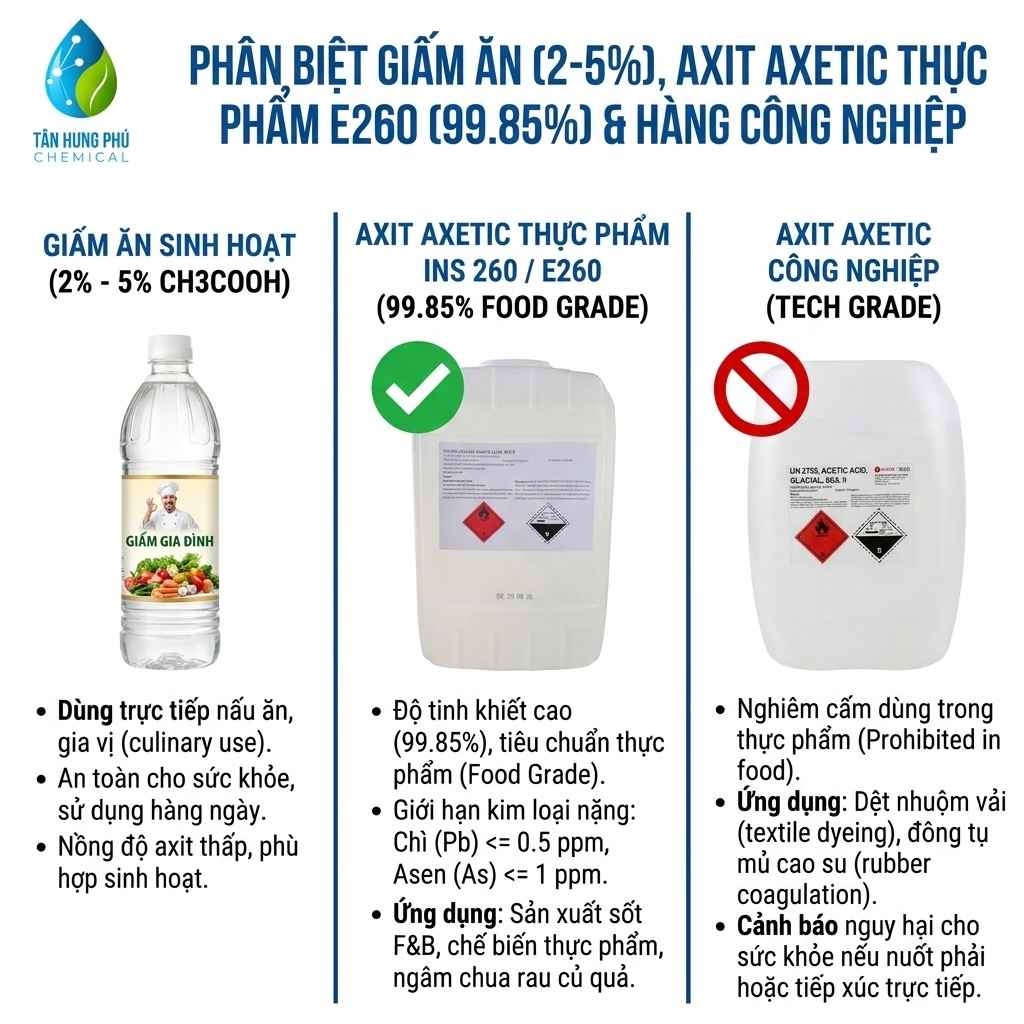
Public discussion occasionally confuses industrial vinegar with culinary vinegar. From a regulatory food compliance perspective, manufacturing plants must draw a rigorous boundary across these three distinct categories:
| Technical Criteria | 1. Household Table Vinegar (2% – 5% CH3COOH) |
2. Food Grade Acetic Acid 99.85% (Additive INS 260 / E260 – Food Grade) |
3. Technical Grade Acetic Acid (Tech Grade – PROHIBITED in Food) |
|---|---|---|---|
| CH3COOH Concentration | Dilute: 2.0% – 5.0% (Contains 95%–98% water). | High-purity anhydrous: ≥ 99.85% Min (Glacial state). | Concentrated: 99.0% – 99.85% (Industrial technical grade). |
| Heavy Metals & Organic Toxins | Compliant with retail table condiment standards. | Refined to eliminate Arsenic (≤ 1 ppm), Lead (≤ 0.5 ppm), and Aldehydes; permanganate test ≥ 2 hours. | Unregulated for food consumption; contains heavy metal catalyst residues, formic acid, and petro-chemical traces. |
| Food Safety Regulatory Status | Registered commercial retail condiment. | Authorized Food Additive INS 260 / E260 with statutory food safety compliance certificates. | Accompanied only by technical industrial MSDS; illegal if introduced into food processing. |
| Primary Intended Use | Direct culinary seasoning in food service and domestic kitchens. | Used as acidity regulator E260 in sauces, condiments, canning, or industrial vinegar dilution. | Textile dyeing mordant, natural rubber coagulation, industrial solvent, and adhesive synthesis. |
3. Dual Mechanism in F&B: Flavor Acidulant in Sauces & Natural Antimicrobial Preservative
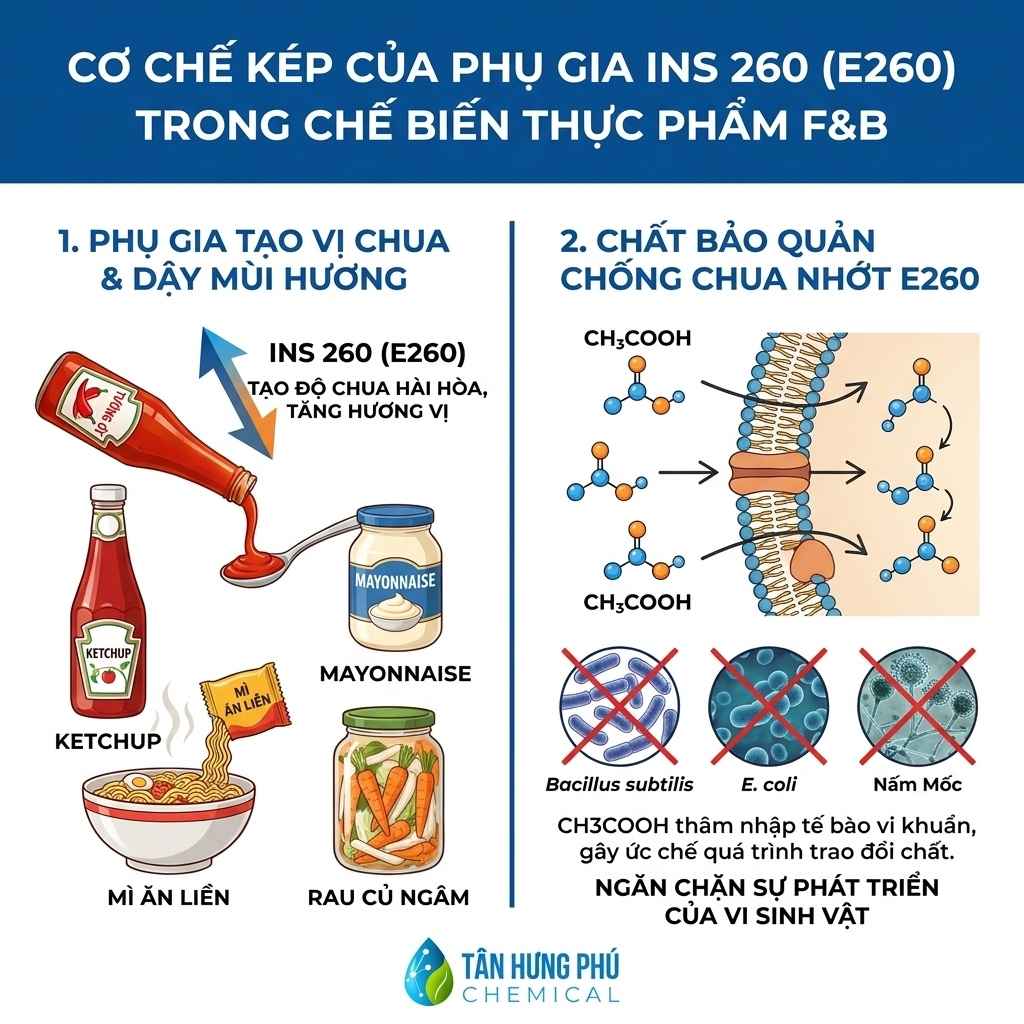
3.1. Volatile Flavor Architecture: Acetic Acid in Condiments & Vegetable Pickling
In commercial ketchup, hot sauce, and salad dressing recipes, R&D formulators never rely solely on citric acid (E330); they consistently incorporate acidity regulator E260. This necessity is driven by the unique volatile aromatic profile of the acetate molecule:
- Volatile Flavor Dynamics in Sauces (Chili Sauce, Ketchup, Mayonnaise): Unlike non-volatile solid organic acids (such as citric or malic acid) which stimulate only tastebuds on the tongue, CH3COOH possesses a noticeable vapor pressure that releases a stimulating, pungent vinegar aroma as soon as the container is uncapped. Dosing acetic acid in sauces (typically 0.2% – 1.5% depending on product specifications) balances rich egg lipids in mayonnaise, tempers raw chili pungency, and amplifies garlic aromatics.
- Export-Grade Vegetable Pickling: In canned gherkins, baby cucumbers, pickled shallots, bamboo shoots, and kimchi, formulating pickling brines with food additive INS 260 (0.5% – 2.5% working brine concentration balanced with salt, sucrose, and CaCl2) enables rapid acid penetration into core vegetable tissues, maintaining cellular crispness without clouding the liquor like raw brewed vinegars.
3.2. Microbial Action of E260 as a Natural Preservative (More Potent Than Inorganic Acids)
A cornerstone observation in food microbiology is that at an identical pH level (e.g., pH = 4.2), food grade acetic acid (E260) demonstrates significantly stronger bacterial and fungal inhibition than citric or lactic acid. Its role as an effective antimicrobial preservative is driven by a transmembrane transport mechanism:
- Transmembrane Diffusion of Undissociated Molecules (pKa = 4.76): Because of its relatively high pKa constant (4.76), in acidic food matrixes (pH 3.5 – 4.5), a substantial proportion of acetic acid exists as neutral, uncharged molecules (CH3COOH). Exhibiting lipophilic affinity, these uncharged molecules freely cross the hydrophobic cytoplasmic lipid bilayer of bacterial and mold cells into the interior cytoplasm (where pH is maintained near neutral ~7.0).
- Disrupting Intracellular Bacterial Homeostasis: Upon entering the neutral cytoplasm, the molecule dissociates spontaneously into H+ and CH3COO− ions, rapidly acidifying the internal cell matrix. The microorganism is forced to exhaust metabolic ATP energy powering proton efflux pumps, inducing metabolic starvation, structural collapse, and cell death.
- Eradicating Ropy Spoilage and Pathogenic Outbreaks: This physiological mechanism allows INS 260 to effectively inhibit spore-forming Bacillus subtilis (the causative agent of viscous “rope spoilage” in starch noodles, wrappers, and bakery products), while eradicating Salmonella, E. coli, Listeria, and wild fermentative yeasts in sauces.
4. Food Grade Glacial Acetic Acid 99.85% (Code THP6 Lotte Ineos & THP47) at Tan Hung Phu
To satisfy both high-compliance audits of multinational food corporations and cost-optimization goals of large condiment manufacturers, Tan Hung Phu Chemical directly imports and distributes two verified lines of Food Grade Glacial Acetic Acid 99.85% (INS 260 / E260) in standard 30kg jerrycans:
- Product Code THP6 – Lotte Ineos Korea Acetic Acid (30kg Jerrycan): Food Grade Glacial Acetic Acid 99.85% Lotte Ineos Korea (Food Grade E260) – 30kg Jerrycan (Product Code: THP6) – Manufactured by Lotte Ineos Chemical Co., Ltd. (South Korea), Asia’s premier producer; boasting purity ≥ 99.88%, lead thresholds < 0.1 ppm, and a crisp, pristine aroma free of foreign off-notes.
- Product Code THP47 – Food Grade Glacial Acetic Acid 99.85% (30kg Jerrycan): Food Grade Glacial Acetic Acid 99.85% (E260 Vinegar Grade) – 30kg Jerrycan (Product Code: THP47) – Fully compliant with international INS 260 / E260 food additive purity standards and verified food safety documentation, offering exceptional cost efficiency for large-scale condiment and pickling operations.
Commercial clients and procurement specialists can access the product links above for comprehensive COA data. In addition to Food Grade Acetic Acid E260, manufacturers can source our complementary line of food additives (including Xanthan Gum F200 Code THP45 for sauce stabilization, Citric Acid E330 Code THP18, and Potassium Sorbate E202 Code THP19) in our online food additives catalog.
5. Safety Dilution Directives for 99.85% Acid & Physical Freezing Phenomenon at 16.6°C
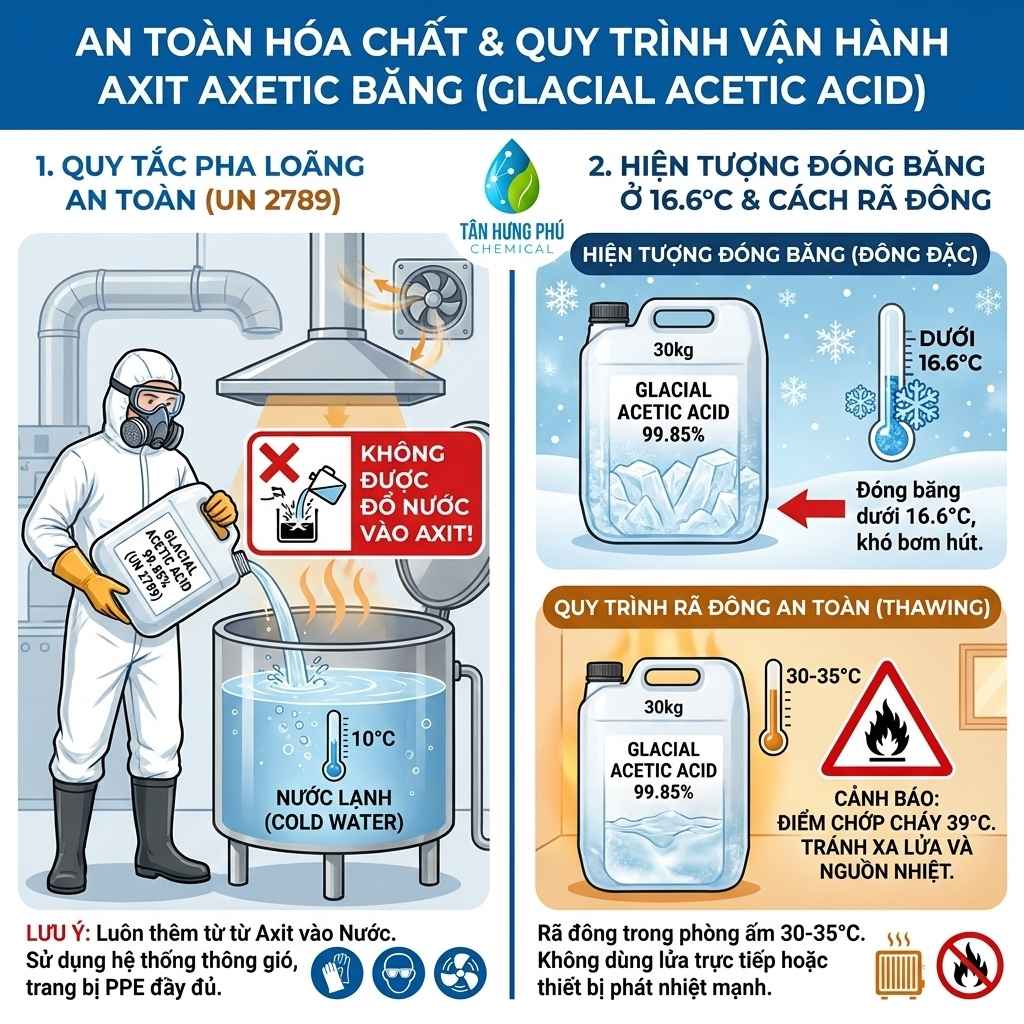
While safely edible once diluted into food formulations, in its concentrated 99.85% raw state inside 30kg jerrycans, glacial acetic acid is a corrosive substance causing severe chemical skin and eye burns (GHS H314), emits pungent vapors irritating to respiratory membranes, and possesses a closed-cup flash point of ~39°C (GHS H226 – Flammable liquid and vapor).
• Mandatory Dilution Protocol: When performing vinegar blending or preparing batch stock solutions, plant workers must pre-fill the mixing tank (SUS 304/316 or HDPE) with purified RO water, activate the mechanical agitator and exhaust ventilation, and slowly pour the concentrated Acetic Acid into the water. Never pour water into concentrated acid.
- Personal Protective Equipment (PPE): Operators in batching areas must wear sealed chemical splash goggles paired with a face shield, butyl or heavy neoprene gloves, an acid-resistant apron, rubber boots, and an organic vapor respirator. In case of accidental contact, flush skin or eyes immediately under emergency running water for at least 15 – 20 minutes.
- Natural Freezing at 16.6°C and Safe Re-liquefaction: The designation “Glacial” Acetic Acid originates from the fact that anhydrous 99.85% CH3COOH naturally crystallizes into solid ice-like sheets when warehouse temperatures drop below 16.6°C. If crystalline freezing occurs during cold transport, place the 30kg jerrycan in a warm room or circulate a warm water bath controlled strictly at ≤ 30°C – 35°C (safely below the 39°C flash point; open flames or electric heaters are prohibited) until fully liquefied, then invert to mix before use.
6. Where to Buy Food Grade Acetic Acid? Wholesale 30kg Jerrycan Pricing with COA in HCMC
When procurement departments at commercial sauce, noodle, and food processing facilities assess where to buy food grade acetic acid, wholesale pricing across the B2B chemical sector is governed by three factors:
- Origin Selection (Lotte Ineos Korea vs. Food Grade THP47): The Korean Lotte Ineos brand (Product Code: THP6) represents the premier quality benchmark in the Asian region, while Code THP47 delivers exceptional commercial cost optimization while upholding full 99.85% Food Grade compliance.
- Order Volume (MOQ): Wholesale orders by the pallet (typically 24 to 32 jerrycans = 720 – 960 kg), metric ton, or full container lot at Tan Hung Phu Chemical benefit from competitive direct-importer tiered pricing.
- Audit-Ready Documentation: Every dispatch is accompanied by genuine manufacturer batch analysis certificates (COA) matching container lot stamps, standard 16-section Safety Data Sheets (MSDS), valid Statutory Food Safety Compliance Filings, and legal VAT invoices.
REQUEST WHOLESALE QUOTE FOR FOOD GRADE ACETIC ACID 99.85% (CODES THP6 & THP47)
To receive the latest wholesale pricing for Lotte Ineos Korea Acetic Acid (Code THP6) or Food Grade E260 (Code THP47) along with comprehensive COA, MSDS, and statutory food compliance files, please contact our B2B commercial division:
Tan Hung Phu Chemical Co., Ltd. (THP Chemical)
• Technical Support & Wholesale Hotline / Zalo: 0913 711 647
• Request for Quotation (RFQ) Email: tanhungphu@thpchemical.com
• Headquarters & Warehouse: 878B Ta Quang Buu Street, Binh Dong Ward, Ho Chi Minh City & regional distribution hubs (Fast nationwide delivery via specialized trucks and container transport).
7. Frequently Asked Questions (FAQ) on Food Additive INS 260 / E260
Is acidity regulator INS 260 (E260) listed on instant noodles and sauce bottles safe for consumption?
Completely safe. The code INS 260 (or E260) is the international designation for food grade acetic acid—the identical organic acid responsible for the natural acidity of culinary vinegar. This additive is approved as safe under Good Manufacturing Practice (GMP) by the Joint FAO/WHO Expert Committee on Food Additives (JECFA), the U.S. FDA (21 CFR § 184.1005), and global food safety authorities.
What is the acetic acid concentration in table vinegar, and how is it prepared from 99.85% acid?
Table vinegar is an aqueous solution of acetic acid ranging from 2% to 5% by weight. When commercial facilities blend table vinegar from 99.85% Food Grade Acetic Acid (INS 260), blending 1 kg of 99.85% Food Grade Acetic Acid into 19 to 24 liters of demineralized RO water yields 20 to 25 liters of standardized vinegar at an exact 4% – 5% concentration.
Why is Technical Grade Acetic Acid strictly prohibited in food and beverage processing?
Technical Grade Acetic Acid is formulated exclusively for textile dyeing, rubber coagulation, and chemical synthesis. It bypasses the refined fractionation required to strip heavy metals (lead, arsenic, mercury) and contains residual aldehydes and formic acid hazardous to health. Processing plants must exclusively utilize certified Food Grade Glacial Acetic Acid (E260 – Codes THP6 & THP47) accompanied by statutory food safety compliance.
How does acidity regulator E260 prevent chili sauce and fresh noodles from spoiling and turning ropy?
Beyond serving as an acidulant, undissociated CH3COOH molecules freely penetrate the cellular membranes of spoilage microorganisms (including Bacillus subtilis, which causes ropy bread and noodle spoilage, as well as Salmonella and yeasts). Inside the cell, the acid dissociates to depress intracellular pH, neutralizing pathogenic survival and extending shelf life.
Why do 99.85% Glacial Acetic Acid jerrycans freeze solid into ice during cold weather?
This is a purely physical property confirming high chemical purity. Anhydrous acetic acid 99.85 has a sharp freezing point of 16.35°C – 16.6°C. When stored or transported in ambient temperatures below 16°C, it crystallizes into solid ice sheets. Simply relocating the jerrycan to a warm area (25°C – 35°C) fully liquefies the acid back to its clear fluid state with zero impact on chemical quality.
Where can manufacturers purchase authentic Korean Lotte Ineos 30kg jerrycans in HCMC?
Manufacturers seeking verified materials can order directly from Tan Hung Phu Chemical Co., Ltd. We maintain ready stock of Lotte Ineos Korea Acetic Acid 30kg jerrycans (Product Code: THP6) and cost-effective Food Grade 99.85% (Product Code: THP47) backed by complete COA, MSDS, and statutory food filings. Contact our commercial team via Hotline/Zalo at 0913 711 647.
8. References & International Regulatory Standards
The technical parameters, heavy metal limits, microbial diffusion dynamics, and food safety regulations for Glacial Acetic Acid (INS 260 / E260) cited in this document are referenced from international authorities:
- Joint FAO/WHO Expert Committee on Food Additives (JECFA): Monograph & Specifications for Acetic Acid, Glacial (INS 260) – JECFA Evaluations – Specifications on chemical purity, permanganate time (≥ 2 hours), heavy metal thresholds, and ADI “Not limited”.
- U.S. Food and Drug Administration (FDA): Code of Federal Regulations Title 21 (21 CFR § 184.1005 – Acetic Acid) – Affirmation of Generally Recognized as Safe (GRAS) status as an acidulant, flavoring agent, and antimicrobial texturizer in foods.
- Manufacturer Technical Datasheet from Lotte Ineos Chemical: Lotte Ineos Chemical Co., Ltd. – Glacial Acetic Acid Food Grade Specifications & Safety Data Sheet (UN 2789).
- Vietnam Ministry of Health Regulatory Framework: Circular No. 24/2019/TT-BYT (and amending Circular No. 17/2023/TT-BYT) on the management and use of food additives (Authorized Additives Schedule under GMP – Glacial Acetic Acid INS 260).
Summary: Mastering the technical differences between retail 2%–5% table vinegar and concentrated food grade glacial acetic acid (INS 260 / E260 – 99.85%) is vital for industrial F&B production. Serving as both a volatile flavor acidulant in dressings and a proven antimicrobial barrier against spoilage, sourcing verified Food Grade material (Product Code: THP6 Lotte Ineos Korea and Product Code: THP47) from Tan Hung Phu Chemical guarantees full regulatory food safety compliance and optimized batch economics.
Other News
View detail- What is Potassium Hydroxide Flakes (KOH 90%)? Chemical Properties & Role in Humate Fertilizer and Liquid Soap
- What is Carrageenan Food Additive (INS 407 / E407)? Insights into Red Seaweed Extract for Texture & Elasticity in Jelly, Vietnamese Ham, and Sausages
- What Is PAC 31% Flocculant (Poly Aluminium Chloride)? Electrostatic Attraction & Rapid Flocculation Mechanism in Turbid Water
- What Is TCCA 90% (Trichloroisocyanuric Acid)? High-Available Chlorine & Applications of Powder, Granular, 20g Tablets, and 200g Tablets

