
News & Event
What Is PAC 31% Flocculant (Poly Aluminium Chloride)? Electrostatic Attraction & Rapid Flocculation Mechanism in Turbid Water
Compiled by Tan Hung Phu Technical Team · Updated:
In municipal drinking water treatment, aquaculture reservoir management, and industrial wastewater treatment plants (ETP), rapid separation of suspended solids (TSS), organic color bodies, and sub-micron colloidal impurities serves as the pivotal first physicochemical processing step. When investigating what is PAC, environmental engineers and plant operators frequently encounter Poly Aluminium Chloride (commonly known as PAC chemical or PAC 31 based on its active Al2O3 concentration ≥ 31%). Representing an advanced pre-polymerized inorganic coagulant chemical designed to supersede conventional aluminum sulfate, PAC 31% features high-charge polynuclear aluminum clusters that instantaneously neutralize negative colloidal surface charges and form dense, high-settling flocs within minutes.
Executive Summary
- Chemical Identity: Poly Aluminium Chloride (PAC 31%, formula [Al2(OH)nCl6−n]m, CAS 1327-41-9), a pre-hydrolyzed polymeric inorganic coagulant featuring active Al2O3 ≥ 31.0% Min and basicity ranging from 60% ∼ 90%.
- Dual Coagulation Mechanism: Supplies Keggin Al137+ polynuclear cations that electrostatically neutralize negative colloid Zeta potential (ζ ≈ 0 mV), followed by polymer adsorption bridging to form massive, rapid-settling flocs within 3 – 5 minutes.
- Advantages over Conventional Alum: Saves 50% – 70% in operational dosage, functions effectively across a broad pH spectrum (5.0 – 8.5), minimizes pH depression, and reduces dewatered sludge volume by 30% – 50%.
- Preparation & Standard Dosing: Dilute into a 5% – 10% stock solution in clean water prior to dosing; typical inclusion rates span 1 – 15 g/m³ for raw surface/potable water and 20 – 200 g/m³ for industrial wastewater.
Table of Contents:
- 1. What Is PAC? Chemical Nature of Poly Aluminium Chloride (PAC 31%) & Technical Specifications
- 2. Coagulation & Flocculation Principles: Electrostatic Charge Neutralization and Rapid Settling
- 3. Technical Performance: PAC 31% vs. Traditional Aluminum Sulfate Al2(SO4)3
- 4. Industrial Dissolution Protocol (5%–10% Stock Solution) & Operational Dosing Table
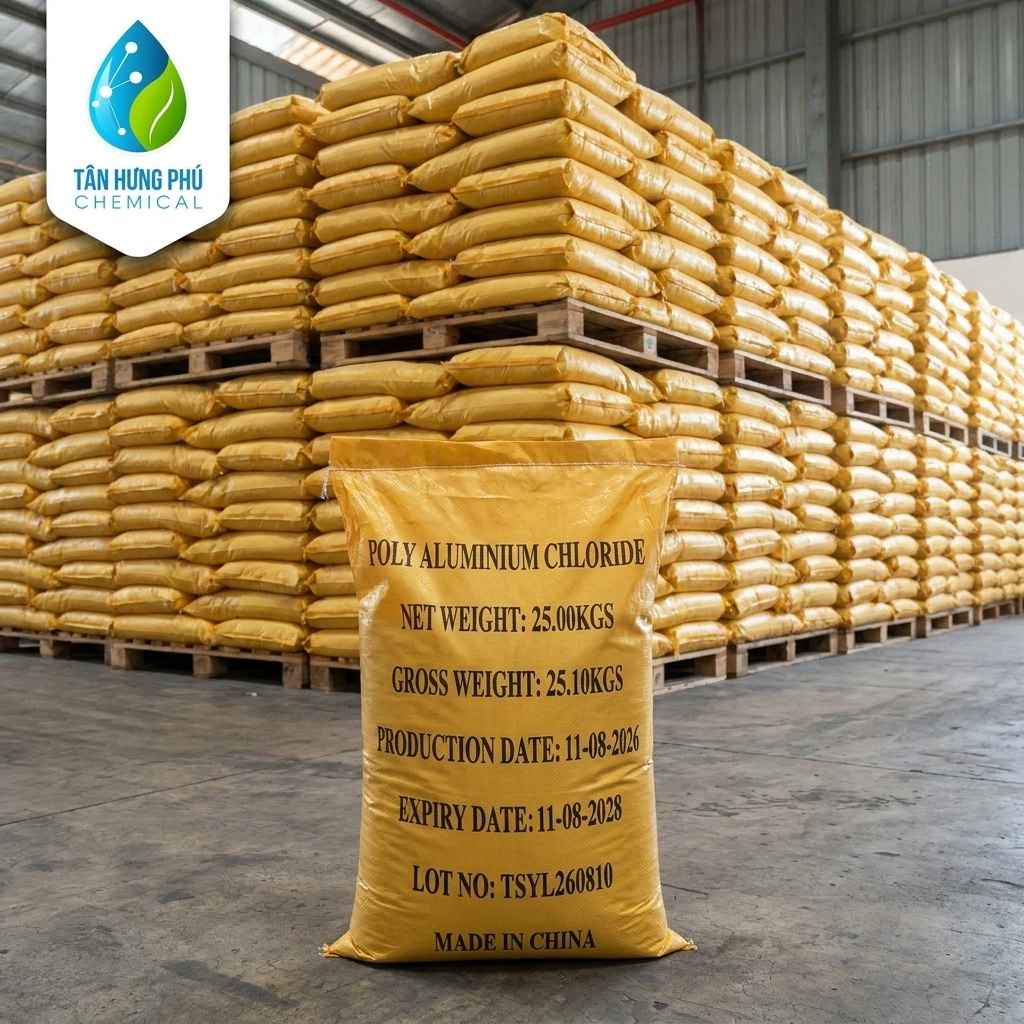
- 5. PAC 31% Golden Yellow 25kg Bag (Code THP21) Distributed by Tan Hung Phu Chemical
- 6. Moisture-Proof Storage Guidelines for 25kg Bags & Operational Safety Measures
- 7. Where to Buy PAC Chemical? B2B Wholesale Pricing for 25kg Bags in HCMC
- 8. Frequently Asked Questions (FAQ) on PAC 31% Coagulant
- 9. References & International Standards
1. What Is PAC? Chemical Nature of Poly Aluminium Chloride (PAC 31%) & Technical Specifications
Answering what is PAC from an inorganic chemistry standpoint: PAC is the standardized abbreviation for Poly Aluminium Chloride (CAS Registry Number: 1327-41-9, HS Code: 3824.99), described by the general molecular formula [Al2(OH)nCl6−n]m (where n = 1 ∼ 5 and m ≤ 10). It is fundamentally a pre-hydrolyzed inorganic polymer coagulant produced via advanced spray-drying technology into a uniform, free-flowing golden-yellow powder that dissolves rapidly in water without leaving gritty residue.
The Power of Keggin Al13 Complexes ([Al13O4(OH)24(H2O)12]7+) and High Basicity (60%–90%)
The superior coagulating power of PAC chemical over monomeric aluminum salts stems from two primary structural properties:
- Polynuclear Keggin Al13 Clusters Bearing +7 Charge: Upon dissolution, rather than releasing basic Al3+ trivalent ions (+3 charge) like traditional alum, PAC 31 delivers pre-formed, stable polynuclear polycations such as [Al2(OH)2]4+, [Al3(OH)4]5+, and notably the cage-like Keggin polycation [Al13O4(OH)24(H2O)12]7+ carrying a massive +7 positive charge. This immense charge density neutralizes negatively charged suspended particles at vastly accelerated rates.
- Elevated Basicity (Basicity 60% ∼ 90%): Basicity represents the percentage ratio of coordinated hydroxyl groups (–OH) bound to aluminum atoms during synthesis. Because it is already 60% to 90% pre-neutralized, dosing PAC water treatment chemical consumes minimal alkalinity from the raw water matrix, preventing severe process pH drops.
| Identification & Technical Analysis Items | Guaranteed Technical Standards (GB/T 22627-2014) |
|---|---|
| Product Name & Tariff Classification | POLY ALUMINIUM CHLORIDE | HS Code: 382499 | CAS: 1327-41-9 |
| General Chemical Formula | [Al2(OH)nCl6−n]m (where n = 1 ∼ 5, m ≤ 10) |
| Appearance | Fine powder, Golden Yellow (Yellow Powder) |
| Active Aluminium Oxide Content (Al2O3) | ≥ 31% (≥ 31.0% Min) |
| Basicity (%) | 60% ∼ 90% |
| pH of 1% Aqueous Solution | 3.5 ∼ 5.0 |
| Water Insoluble Matter | ≤ 1.5% |
| Iron Content (Fe) | ≤ 5.0% |
| Heavy Metal Limits: Arsenic (As) & Lead (Pb) | Arsenic (As): ≤ 0.0015% | Lead (Pb): ≤ 0.005% |
| Packaging Specification & Shelf Life | 25 kg Net Bag (Double layer: woven PP outer, moisture-barrier PE inner) | Shelf life: 24 months |
2. Coagulation & Flocculation Principles: Electrostatic Charge Neutralization and Rapid Settling
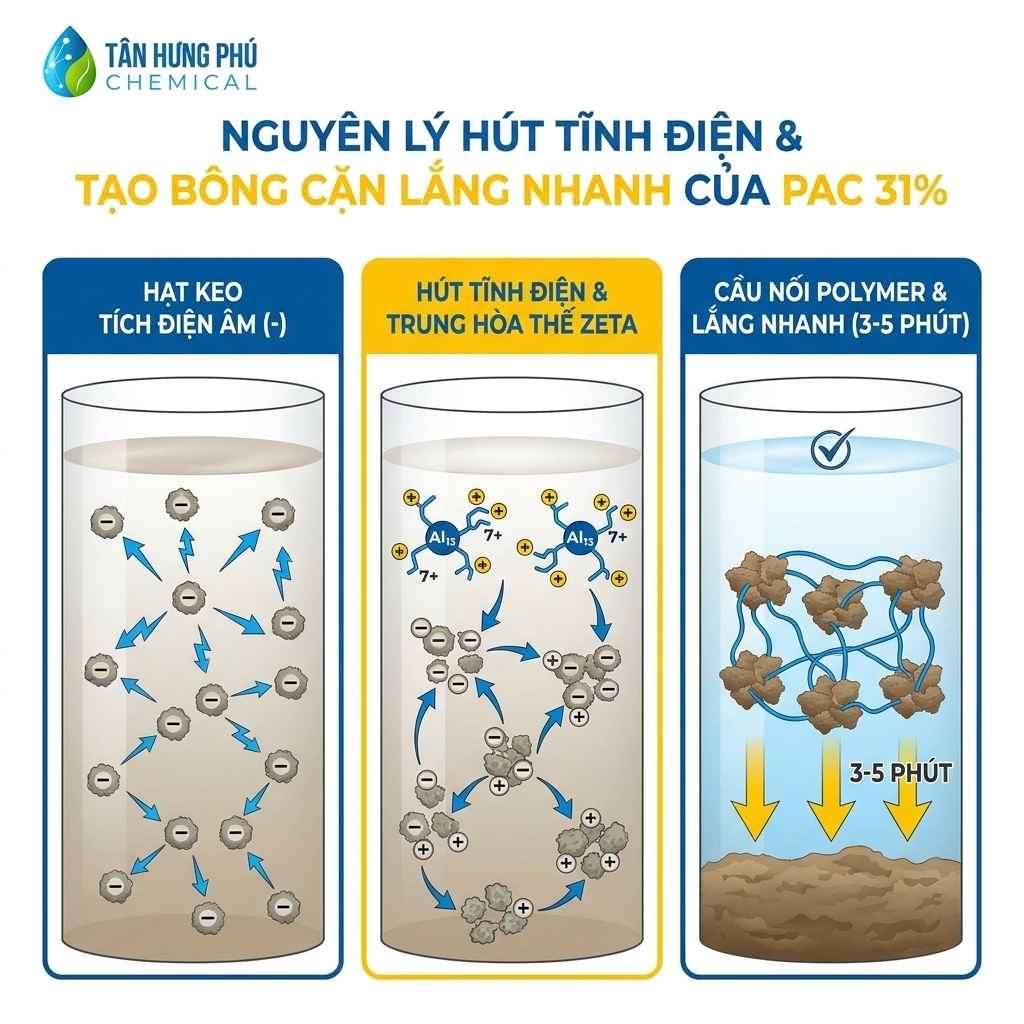
Why do turbid river waters or raw industrial effluents fail to settle spontaneously even after prolonged quiescent holding? Sub-micron clay particles, organic humic matter, microalgae, and bacteria (0.001 – 10 μm) possess negative surface charges (Zeta potentials ranging from −15 mV to −40 mV). Because mutually repulsive electrical forces dominate, these colloids undergo continuous Brownian motion, remaining permanently suspended. When dosing PAC 31% coagulant chemical, the dual-action coagulation and flocculation mechanism proceeds rapidly through two consecutive stages:
2.1. Stage 1: Electrostatic Attraction & Colloid Charge Neutralization (Rapid Mixing for 1–2 Minutes)
The instant PAC 31 solution is injected into the rapid-mix chamber, high-charge aluminum polycations (primarily [Al13O4(OH)24]7+) migrate instantly to the surfaces of negatively charged colloids via electrostatic attraction. This robust electrostatic force compresses the electrical double layer and achieves charge neutralization, collapsing the Zeta potential from high negative values toward the isoelectric point (ζ ≈ 0 mV). Once repulsive forces are suppressed, the colloidal suspension destabilizes, allowing particles to collide and agglomerate into micro-flocs within 30 to 60 seconds.
2.2. Stage 2: Polymer Adsorption Bridging & Sweep Flocculation (Slow Mixing for 10–15 Minutes)
Transitioning into the flocculation basin with moderate, low-shear agitation, extended aluminum hydroxyl polymers [Al2(OH)nCl6−n]m act as molecular bridges (Adsorption Bridging), linking thousands of micro-flocs into dense macroscopic aggregates. Simultaneously, forming amorphous Al(OH)3 precipitates entrap remaining fine particulates via sweep flocculation. The resulting heavy flocs settle rapidly out of the liquid column within 3 to 5 minutes of quiescent settling, yielding clarified supernatant above.
3. Technical Performance: PAC 31% vs. Traditional Aluminum Sulfate Al2(SO4)3
Historically, water plants and wastewater facilities relied on alum or Aluminum Sulfate Al2(SO4)3·18H2O. Transitioning to PAC 31 coagulant chemical provides transformative technical and economic advantages:
| Operational Parameter | Aluminum Sulfate Alum (Al2(SO4)3·18H2O – Conventional Alum) |
PAC 31% Golden Yellow Coagulant (Poly Aluminium Chloride – Code: THP21) |
|---|---|---|
| Active Aluminium Content (Al2O3) | Low: Typically only 15% – 17% Al2O3 (Simple monomeric Al3+). | Double potency: ≥ 31% Al2O3 (Polynuclear Al13 polymer clusters). |
| Actual Consumption / Dosage | Requires high volumetric dosage to initiate destabilization. | Reduced to 1/3 – 1/2 of alum dosage, drastically lowering transport and warehouse overhead. |
| Impact on Raw Water pH | Generates free sulfuric acid during hydrolysis, drastically depressing pH and consuming excessive Caustic Soda (NaOH) or Lime. | Pre-hydrolyzed basicity (60%–90%) minimizes pH fluctuation, minimizing alkali chemical costs. |
| Effective Operational pH Range | Narrow: Limited to pH 6.5 – 7.2. | Broad: Performs consistently across pH 5.0 – 8.5 (Optimal peak at pH 6.5 – 7.8). |
| Floc Dimension & Settling Velocity | Fragile, loose, slow-settling flocs (15 – 30 minutes); produces voluminous, loose sludge. | Flocs are 3 – 5 times larger and denser, settling in 3 – 5 minutes; reduces sludge volume by 30%–50%. |
| High-Turbidity / Flood-Water Performance | Poor performance under high turbidity; overdosing easily causes colloidal restabilization and elevated residual Al3+. | Outstanding efficacy during seasonal high-turbidity events; broad operational dosage window with low residual dissolved aluminum. |
4. Industrial Dissolution Protocol (5%–10% Stock Solution) & Operational Dosing Table
4.1. Standard Industrial Dissolution Protocol for PAC at Treatment Facilities
To disperse aluminum polymer chains uniformly throughout the reaction zone without clumping, operators should avoid broadcasting dry powder directly into wastewater streams. Instead, prepare a concentrated stock solution according to standard procedures:
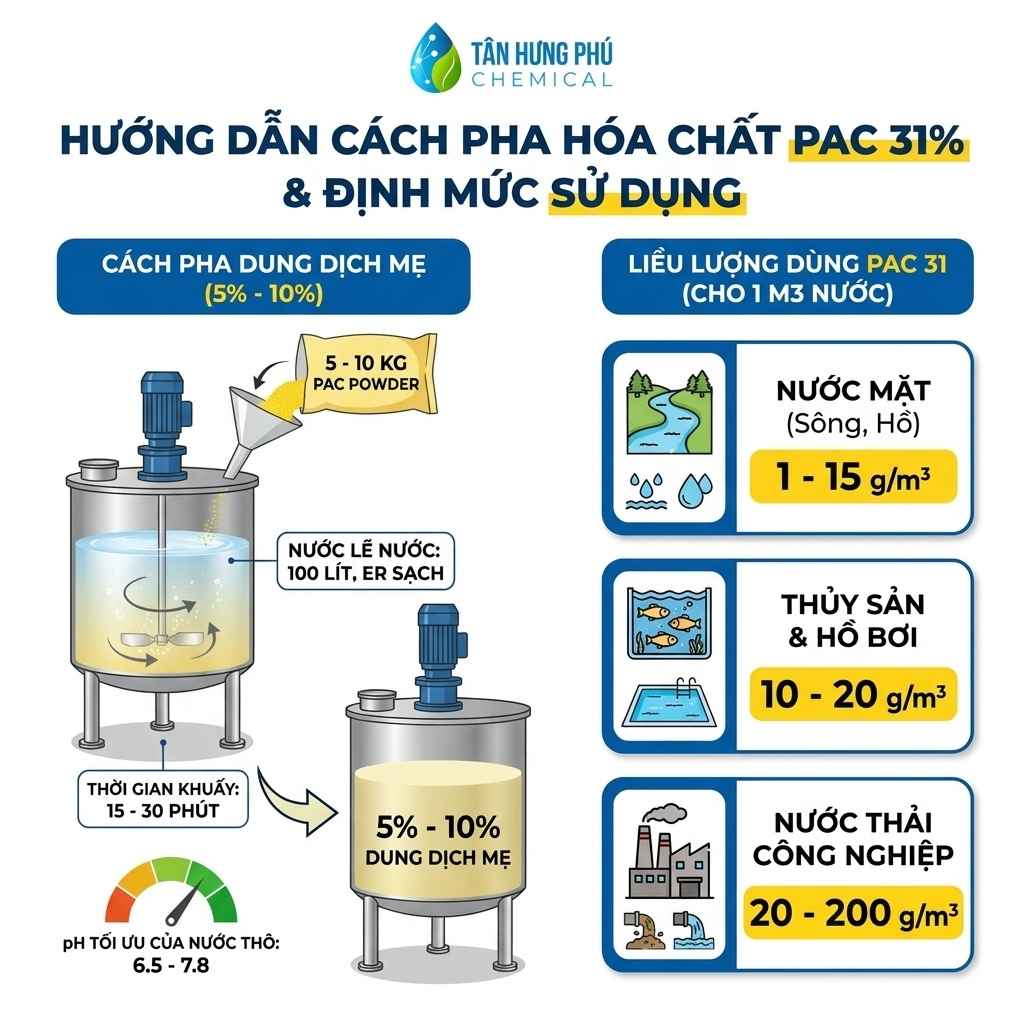
- Step 1 – Prepare 5% – 10% (w/v) Stock Solution: Fill the chemical preparation tank (PE, HDPE, or FRP composite) with clean water, start mechanical agitation, and gradually add 5 kg to 10 kg of PAC 31% golden yellow powder per 100 liters of water (50 – 100 kg per 1,000-liter batch). Mix for 10 – 15 minutes until completely dissolved into a clear, amber-yellow liquid. (Note: Avoid pre-diluting stock solutions below 1% for extended storage, as hyper-dilute PAC undergoes premature aging and auto-hydrolysis, degrading its coagulating capacity).
- Step 2 – Verify Incoming Water pH (Target: 6.5 – 7.8): Prior to dosing PAC water treatment chemical, verify the influent raw water pH. If acidic (pH < 6.0), adjust using Sodium Hydroxide (NaOH flakes) or Soda Ash to reach the optimum window of 6.5 – 7.8.
- Step 3 – Metered Dosing Combined with Flocculant Aid: Meter the dissolved PAC solution into the rapid-mix chamber (100 – 150 rpm for 1 – 2 minutes) for charge neutralization. Follow this by transferring flow to the slow flocculation chamber (20 – 40 rpm) while co-dosing 0.5 – 2.0 ppm of Anionic (or Cationic) Polyacrylamide to agglomerate pin-flocs into heavy flocs that settle immediately.
4.2. Recommended Dosage Rates of PAC 31 for Water Supply, Aquaculture & Industrial Wastewater
In practical operations, PAC 31 dosage correlates directly with raw water turbidity (NTU) and total suspended solids (TSS). Plant operators should conduct standard laboratory Jar-Tests to establish the precise dosage using the reference framework below:
| Water Source & Application Sector | PAC 31% Powder Dosage (Grams / m³ – equivalent to ppm) |
Standard Consumption per 1,000 m³ (Kg PAC 31% / 1,000 m³ water) |
|---|---|---|
| Potable Water Treatment (Low Turbidity: 50 – 400 mg/L) | 1.0 – 4.0 g / m³ (1 – 4 ppm) | 1.0 – 4.0 kg / 1,000 m³ |
| Potable Water Treatment (Moderate Turbidity: 500 – 1,500 mg/L) | 5.0 – 7.0 g / m³ (5 – 7 ppm) | 5.0 – 7.0 kg / 1,000 m³ |
| Surface Water During Rainy/Flood Season (High Turbidity: > 1,500 mg/L) | 7.0 – 15.0 g / m³ (7 – 15 ppm) | 7.0 – 15.0 kg / 1,000 m³ |
| Aquaculture Settling Reservoirs & Swimming Pool Flocculation | 10.0 – 20.0 g / m³ (10 – 20 ppm) | 10.0 – 20.0 kg / 1,000 m³ |
| Industrial Wastewater (Food Processing, Seafood, Livestock, Municipal) | 20.0 – 50.0 g / m³ (20 – 50 ppm) | 20.0 – 50.0 kg / 1,000 m³ |
| High-Color & High-TSS Wastewater (Textile Dyeing, Paper Mills, Ceramics) | 50.0 – 200.0 g / m³ (50 – 200 ppm) | 50.0 – 200.0 kg / 1,000 m³ |
5. PAC 31% Golden Yellow 25kg Bag (Code THP21) Distributed by Tan Hung Phu Chemical
To ensure consistent chemical supply for municipal water authorities, centralized industrial parks, and aquaculture operations, Tan Hung Phu Chemical imports and distributes PAC 31% Golden Yellow (Item Code: THP21) tested in accordance with standard GB/T 22627-2014:
- Product Code THP21 (Al2O3 Content ≥ 31% Min): PAC 31% Flocculant (Poly Aluminium Chloride Yellow Powder) – Water Treatment Coagulant (25kg Bag – Code: THP21)
The product is packed in standard 25kg net multi-wall bags (heavy-duty woven PP exterior with an impermeable polyethylene PE inner liner). Procurement teams can access the product link above to view full technical data sheets or request complimentary Jar-Test evaluation samples. Facilities can also source complementary treatment chemicals—including Sodium Hydroxide Flakes NaOH (THP12 & THP9), Chlorine 70% (THP4 & THP5), TCCA 90% (THP8 & THP13), and Citric Acid for RO membrane descaling (THP18)—directly via our online product catalog.
6. Moisture-Proof Storage Guidelines for 25kg Bags & Operational Safety Measures
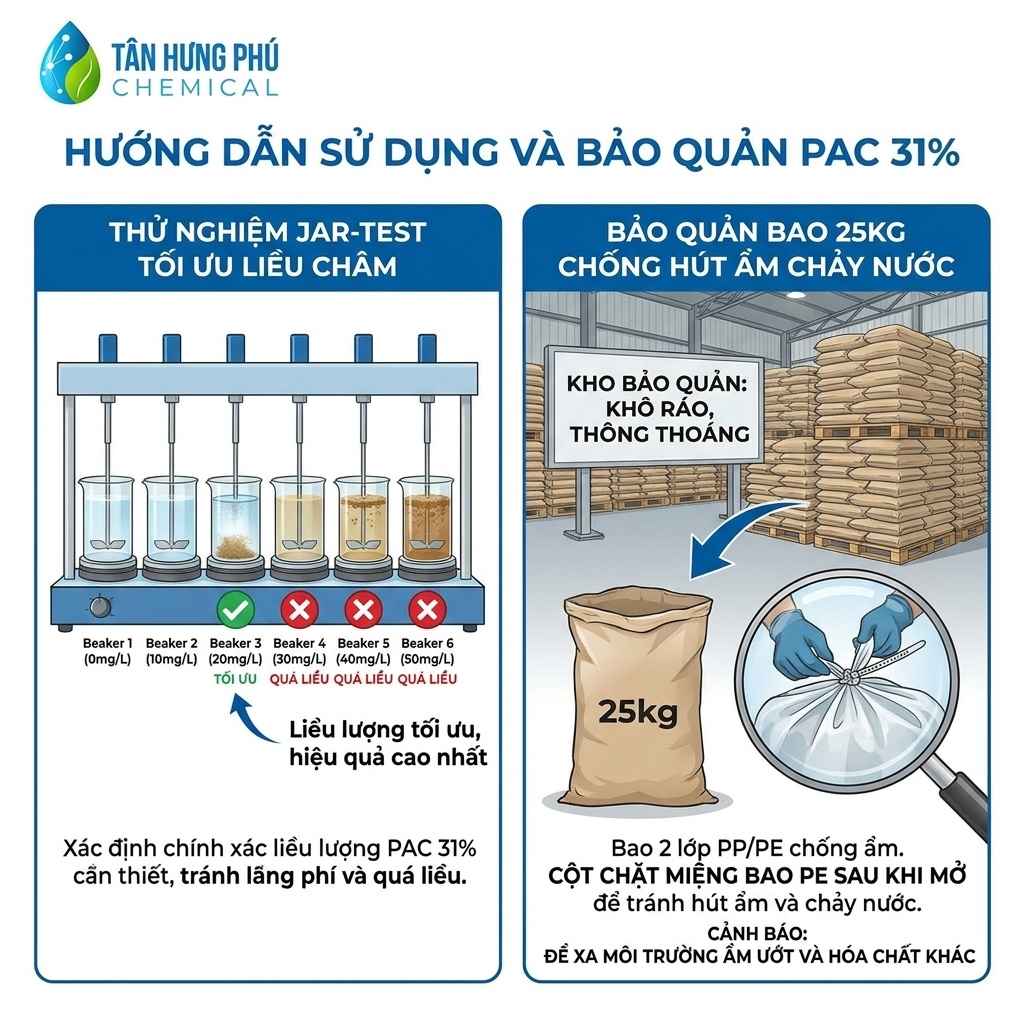
Manufactured via spray-drying into high-surface-area porous micro-granules, Poly Aluminium Chloride is hygroscopic. If 25kg PAC bags suffer liner punctures or remain unsealed in humid ambient conditions, the exposed powder absorbs atmospheric moisture, transforming into a sticky gel paste that hardens into unworkable blocks.
- Warehouse Storage Protocol (24-Month Shelf Life): Store sealed bags on pallets in dry, well-ventilated indoor facilities protected from rainwater, high temperatures, and direct sunlight. For partially used bags, expel excess air and tie the inner PE liner tightly immediately after dispensing.
- Avoid Direct Mixing with Strong Alkalis or Chlorine Sanitizers: Never pour dry PAC powder into tanks holding concentrated Caustic Soda (causes immediate precipitation and severe scaling) and do not combine within shared preparation tanks with Chlorine, TCCA, or Sodium Hypochlorite.
- Personal Protective Equipment (PPE): A 1% aqueous PAC solution is mildly acidic (pH 3.5 ∼ 5.0), and airborne powder can irritate eyes and the respiratory tract. Operators must wear dust respirators, safety goggles, rubber gloves, and protective footwear during dissolution handling.
7. Where to Buy PAC Chemical? B2B Wholesale Pricing for 25kg Bags in HCMC
When procurement departments at textile dyehouses, paper mills, food processing plants, industrial zones, and water utilities evaluate suppliers to purchase PAC chemical, commercial B2B pricing is determined by three factors:
- Active Al2O3 Content & Insoluble Residue: Certified PAC 31% Golden Yellow (Al2O3 ≥ 31%, insolubles ≤ 1.5%) provides higher flocculation performance than secondary 28% – 29% grades burdened with high grit, reducing net treatment cost per cubic meter of water.
- Procurement Volume (MOQ): Tiered wholesale pricing applies for ton-scale purchases, full pallets (40 bags = 1 metric ton), or 20’FCL container shipments (up to 27 metric tons) directly through Tan Hung Phu Chemical.
- Product Integrity & Customer Support: Shipments from Tan Hung Phu are guaranteed factory-sealed, 100% dry and free-flowing without caking or leakage, supported by authentic batch Certificates of Analysis (COA), Safety Data Sheets (MSDS), VAT invoices, and nationwide logistics.
REQUEST WHOLESALE QUOTATION FOR PAC 31% GOLDEN YELLOW 25KG BAGS (CODE THP21) BY TON / CONTAINER
To obtain the best B2B wholesale pricing for PAC 31% Golden Yellow (25kg bags – Item Code: THP21) matched to your operational requirements, contact Tan Hung Phu Chemical sales support directly:
Tan Hung Phu Chemical Co., Ltd. (THP Chemical)
• Technical Support & Wholesale Hotline / Zalo: 0913 711 647
• Request for Quotation (RFQ) Email: tanhungphu@thpchemical.com
• Head Office & Warehousing: 878B Ta Quang Buu, Binh Dong Ward, Ho Chi Minh City, Vietnam & regional transit hubs (Rapid nationwide transport via dedicated trucks and container logistics).
8. Frequently Asked Questions (FAQ) on PAC 31% Coagulant
What is PAC chemical, and why does PAC 31% form rapid-settling flocs faster than conventional alum?
PAC (Poly Aluminium Chloride) is a pre-hydrolyzed polymeric inorganic coagulant represented by [Al2(OH)nCl6−n]m with Al2O3 ≥ 31%. Unlike monomeric alum containing only simple Al3+ ions, PAC utilizes polynuclear Al13 clusters bearing charges up to +7 along with extended polymer backbones. This neutralizes negative colloidal surface charges instantaneously and bridges particles into dense flocs that settle within 3 – 5 minutes while using roughly one-third the dosage of traditional alum.
What is the standard stock solution concentration for PAC dissolution, and what pH conditions are required?
Under standard industrial protocols, operators dissolve dry PAC 31 powder into clean water to prepare a 5% – 10% stock solution (5 – 10 kg of powder per 100 liters of water, agitated for 10 – 15 minutes) before metered injection. For optimal hydrolysis and floc formation, raw water pH should reside between 6.5 and 7.8 (if raw water is acidic below 6.0, pre-adjust using Caustic Soda NaOH).
What is the typical dosage of PAC 31 per cubic meter of turbid river water versus industrial wastewater?
For potable water treatment (river water, surface water, and aquaculture settling basins), typical dosages span 1 – 15 g/m³ (1 – 15 ppm) depending on seasonal turbidity. For industrial wastewater applications (food processing, seafood, textiles, paper, ceramics), dosages range between 20 – 200 g/m³ (20 – 200 ppm), accurately determined via standard Jar-Tests.
Why does overdosing PAC into a clarifier cause water to turn cloudy again with floating pin-flocs?
Under colloidal coagulation theory, PAC aims to neutralize negative particle charges toward 0 mV so particles agglomerate. Overdosing PAC far beyond the optimum point causes destabilized particles to readsorb excess positive polycations, reversing their net electrical charge to positive. These like-charged particles repel one another (colloidal restabilization), creating persistent haze and poorly settling pin-flocs.
What is the technical difference between PAC 31% Golden Yellow and PAC White (30% - 31%)?
PAC 31% Golden Yellow (Code THP21) contains trace natural Iron (Fe ≤ 5.0%) acting as a co-coagulant that yields larger, denser flocs with rapid settling velocities at an economical cost—making it the preferred choice for industrial wastewater, raw water intake, aquaculture, and pools. Conversely, PAC White is an iron-free specialty grade used in color-sensitive applications such as premium paper surface sizing and cosmetics.
What is the wholesale price for 25kg bags of PAC chemical (Code THP21), and where can it be sourced in HCMC?
Wholesale pricing for PAC 31% in 25kg bags is structured based on volume (per ton, full pallet, or 27-ton container loads). Facilities requiring genuine stock in Ho Chi Minh City complete with verified batch COAs and MSDS documentation can contact Tan Hung Phu Chemical directly via Hotline/Zalo at 0913 711 647.
9. References & International Standards
Technical parameters, Keggin Al13 polycation coordination dynamics, Zeta potential destabilization, and analytical testing standards cited herein are derived from established scientific bodies and national/international standards:
- Standard Technical Specifications for Poly Aluminium Chloride: Standard GB/T 22627-2014 (Water treatment chemicals – Polyaluminium chloride: Test methods and technical requirements for solid PAC Al2O3 ≥ 31%, Basicity 60%∼90%, Water Insoluble ≤ 1.5%).
- European Chemicals Agency (ECHA) & PubChem Database: ECHA Substance Information: Aluminum chloride, basic / Polyaluminium chloride (CAS 1327-41-9) – Physicochemical characterization and environmental safety.
- American Water Works Association (AWWA): AWWA Standard B408 – Liquid and Solid Polyaluminum Chloride – Guidelines on coagulation-flocculation protocols, Jar-Test methodology, and Zeta potential management in municipal water works.
- Vietnam National Technical Regulations on Water Quality: National Technical Regulation on Domestic Water Quality QCVN 01-1:2024/BYT (promulgated under Circular 52/2024/TT-BYT, superseding QCVN 01-1:2018/BYT) and National Technical Regulation on Industrial Wastewater QCVN 40:2025/BTNMT (superseding QCVN 40:2011/BTNMT).
Summary: This technical review provides plant managers and wastewater engineers with an understanding of what is PAC and the electrostatic charge neutralization dynamics of PAC 31 (Poly Aluminium Chloride). By producing dense flocs that settle rapidly within minutes, maintaining system pH stability, and saving 50% – 70% in chemical volume compared to traditional alum, certified PAC 31% Golden Yellow (Item Code: THP21) from Tan Hung Phu Chemical delivers high-efficiency, cost-effective water clarification across all four seasons.
Other News
View detail- What Is TCCA 90% (Trichloroisocyanuric Acid)? High-Available Chlorine & Applications of Powder, Granular, 20g Tablets, and 200g Tablets
- What Is Sodium Alginate (E401)? Brown Seaweed Origin & Calcium Gelation Mechanism
- What is Food Additive Xanthan Gum (INS 415 / E415)? Why is Xanthan Gum F200 Dubbed the "King of Anti-Separation" in Sauces and Beverages?
- Caustic Soda Flakes 98% (NaOH 98% Min & China): Wastewater pH Neutralizer, Textile Scouring, Pulp Digestion & Detergent Manufacturing

