
News & Event
What Is TCCA 90% (Trichloroisocyanuric Acid)? High-Available Chlorine & Applications of Powder, Granular, 20g Tablets, and 200g Tablets
Compiled by Tan Hung Phu Technical Team · Updated:
In the operation of commercial swimming pool systems, high-tech shrimp aquaculture, and industrial recirculating water sterilization, understanding what is TCCA and selecting the proper physical form plays a pivotal role in stabilizing free available chlorine residual in water. Internationally designated as Trichloroisocyanuric Acid (commonly abbreviated as TCCA 90 or TCCA 90% chemical), this compound represents an advanced class of organic chlorine featuring a minimum available active chlorine content of 90.0% Min. Unlike inorganic chlorine sources that degrade rapidly under intense sunlight, TCCA 90% is manufactured into 4 specialized physical forms—Fine Powder, Granular, 20g Tablets, and 200g Tablets—engineered to address precise operational demands ranging from immediate shock chlorination and algaecide treatment to prolonged, automated maintenance disinfection.
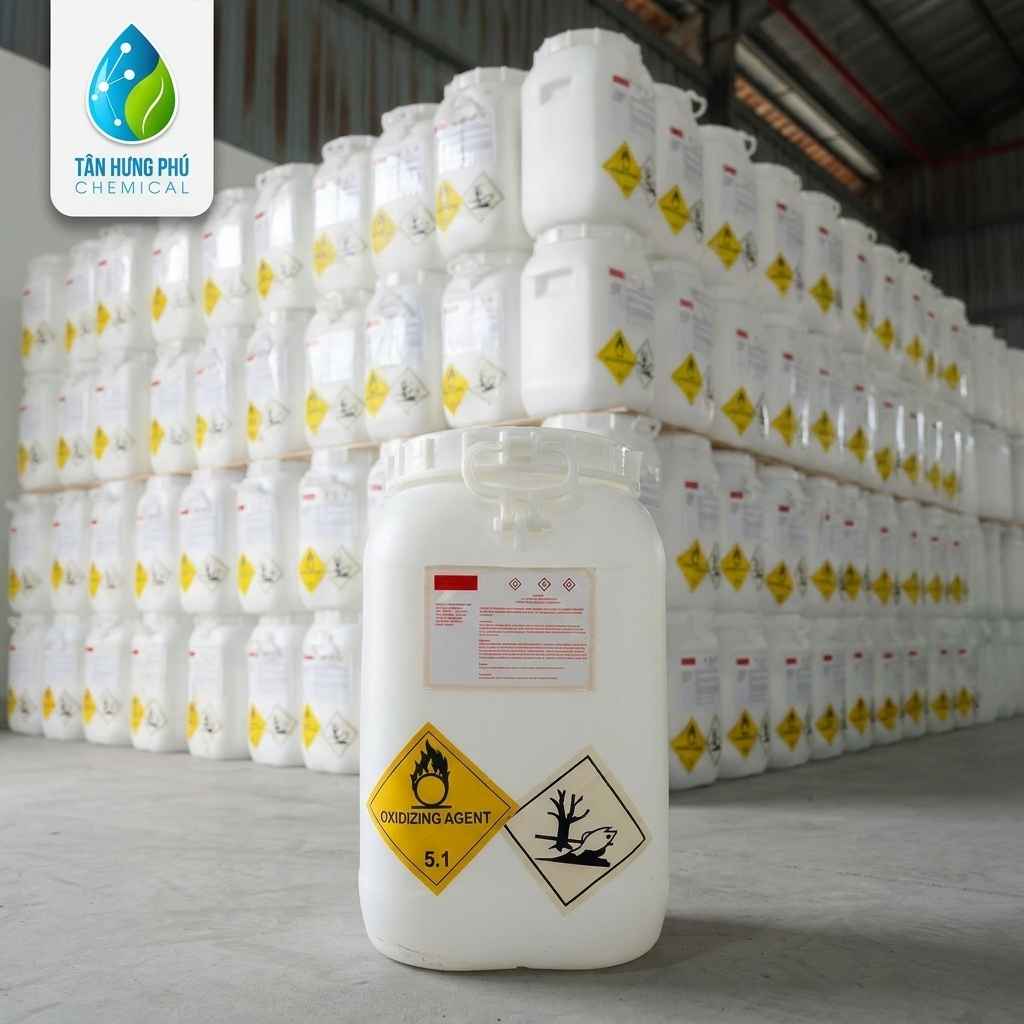
Executive Summary
- Chemical Identity: Trichloroisocyanuric Acid (TCCA 90%, formula C3Cl3N3O3, CAS 87-90-1, UN 2468), an organic chlorine compound with an available chlorine content of ≥ 90.0% Min.
- Superior Advantages over Inorganic Chlorine: Hydrolyzes into germicidal HOCl and Cyanuric Acid (CYA), which protects active chlorine against photodegradation from solar ultraviolet (UV) radiation, without containing calcium/lime that clouds water.
- 4 Commercial Forms Classified: Powder (THP8) for rapid dissolution and surface shock treatment; Granular (THP13) for deep sinking to disinfect pond bottoms; 20g Effervescent Tablets (THP38) for small-volume dosing and siphon pits; 200g Slow-Dissolving Tablets (THP15) for sustained chlorine release over 5 – 7 days.
- Critical Safety Warning: Never mix TCCA 90% with inorganic Calcium Hypochlorite Ca(ClO)2 or acids, as this triggers violent exothermic reactions releasing toxic Cl2 gas and explosive NCl3.
Table of Contents:
- 1. What Is TCCA? Organic Chlorine Nature (C3Cl3N3O3) & Technical Specifications (COA)
- 2. Engineering Differences Among 4 TCCA 90% Forms: Powder, Granular, 20g, and 200g Tablets
- 3. Standard Dosage Protocols for Swimming Pool Sanitation & Shrimp Aquaculture
- 4. TCCA 90% Product Lines Officially Distributed by Tan Hung Phu Chemical
- 5. Chemical Safety Standards (UN 2468) for Dissolution, Dosing, and Storage
- 6. Where to Buy TCCA 90? B2B Wholesale Pricing for 50kg Drums in HCMC
- 7. Frequently Asked Questions (FAQ) on TCCA 90% Chemical
- 8. References & International Standards
1. What Is TCCA? Organic Chlorine Nature (C3Cl3N3O3) & Technical Specifications (COA)
To define what is TCCA from a chemical perspective: TCCA is the acronym for the organic compound Trichloroisocyanuric Acid (IUPAC name: 1,3,5-trichloro-1,3,5-triazinane-2,4,6-trione, molecular formula C3Cl3N3O3, CAS Registry Number: 87-90-1). Its molecular structure consists of a symmetrical triazine ring bonded to three electropositive chlorine atoms, delivering an Available Chlorine content of ≥ 90.0% Min – the highest active concentration among all solid chlorine sanitizers commercially available.
Why Is Organic Chlorine TCCA 90% More Photostable Than Inorganic Chlorine Ca(ClO)2?
When TCCA 90% chemical dissolves in water, this organic chlorine compound undergoes reversible hydrolysis, concurrently releasing two essential components:
C3Cl3N3O3 (TCCA) + 3H2O ⇌ 3HOCl (Germicidal Hypochlorous Acid) + C3H3N3O3 (UV-Stabilizing Cyanuric Acid)
- Controlled Release of Hypochlorous Acid (HOCl): HOCl is a small, uncharged molecule that rapidly penetrates the phospholipid bilayers of bacteria, viruses, fungi, and algae to oxidize intracellular enzymatic systems, providing 80 – 100 times stronger biocidal efficacy than the hypochlorite ion (OCl−).
- Intrinsic UV Protection via Cyanuric Acid (CYA): When using inorganic Calcium Hypochlorite Ca(ClO)2 70% in outdoor pools, solar ultraviolet (UV) radiation breaks down 75% – 90% of free chlorine within just 2 hours of sunlight exposure. Conversely, the Cyanuric Acid (C3H3N3O3) byproduct from TCCA 90 acts as a chemical shield, maintaining a dynamic reservoir that releases HOCl gradually as free chlorine is depleted, providing multi-day sanitizing persistence.
- Zero Water Cloudiness and No Scaling: Unlike Ca(ClO)2, which introduces lime that elevates pH and precipitates hardness scaling, a 1% aqueous solution of TCCA is mildly acidic (pH = 2.6 – 3.2) and 100% calcium-free, preserving crystal-clear pool clarity.
| Analysis Items & Identification | Standard Specifications (COA Commitments) |
|---|---|
| Name of the Product | TRICHLOROISOCYANURIC ACID (TCCA 90%) |
| Applicable Quality Standard | Industrial Standard HG/T 3263 (Officially imported with batch COA) |
| Molecular Formula & Molecular Weight | C3Cl3N3O3 | M = 232.41 g/mol |
| CAS Number & UN Dangerous Goods Class | CAS: 87-90-1 | UN 2468 (Class 5.1 – Strong Oxidizer, Packing Group II) |
| Appearance & Physical Forms (Description) | White (White powder / White granule / White tablet 20g & 200g) |
| Available Chlorine Content | 90% min (≥ 90.0% Min) |
| Solution pH (1% aqueous solution) | 2.6 – 3.2 |
| Moisture & Water Solubility (at 25°C) | Moisture: 0.5% max (≤ 0.5%) | Water solubility: ~1.2 g / 100 mL (12 g/L) |
| Standard Packaging & Shelf Life | 50 kg Net HDPE Round Drum / Bag | Shelf life: 24 months (2 years) |
2. Engineering Differences Among 4 TCCA 90% Forms: Powder, Granular, 20g, and 200g Tablets
While sharing the identical molecular formula C3Cl3N3O3 and 90% Min available chlorine, specialized screening and hydraulic compression at varying pressures allow TCCA to be engineered into 4 distinct physical forms with contrasting dissolution kinetics and operational purposes:
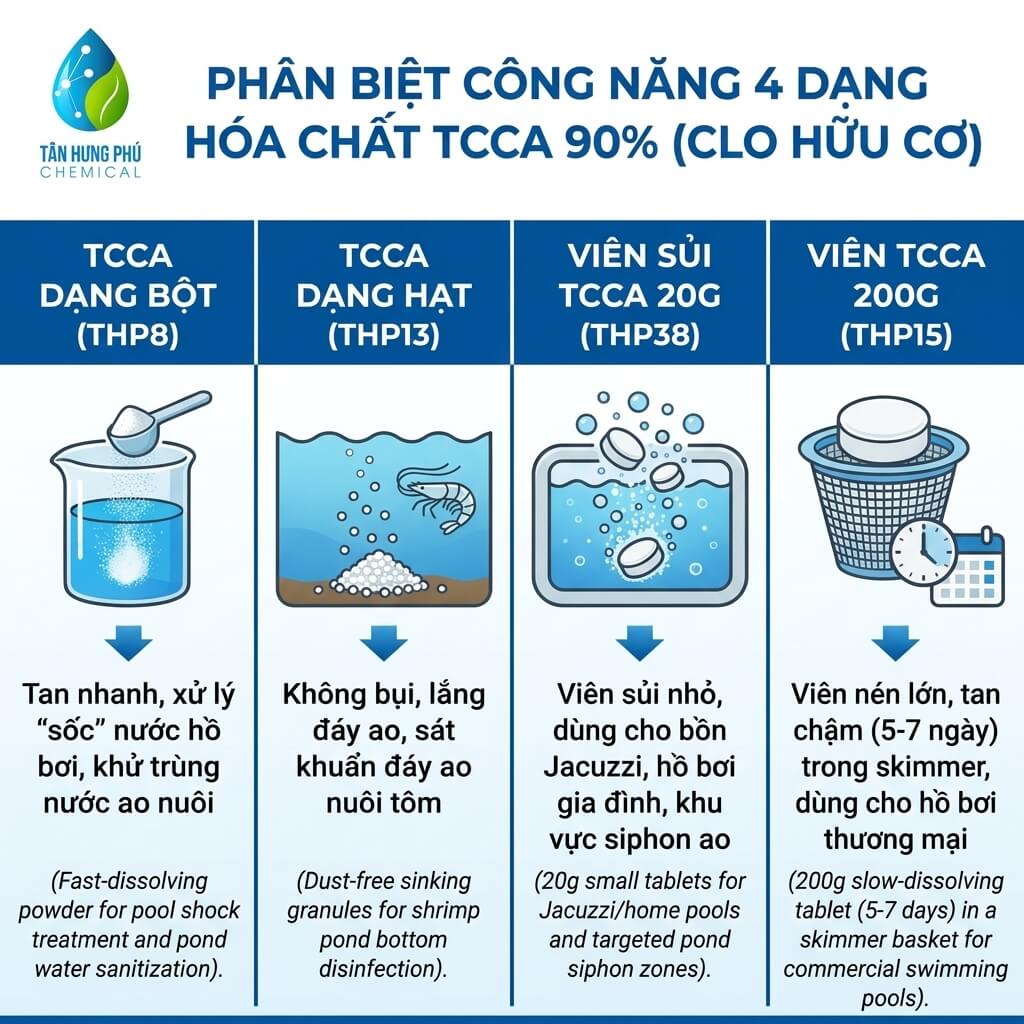
2.1. TCCA Powder (Code THP8): Ultra-Fast Dissolution for Shocking and Full-Column Sterilization
TCCA Powder provides the largest surface area, yielding the fastest dissolution rate among all forms. Pre-dissolved in a clean bucket and broadcast across swimming pool surfaces or aeration-assisted reservoir ponds, it delivers an instantaneous peak of HOCl throughout upper and middle water layers. It is the premier choice for algae treatment with TCCA (eradicating post-rain green algae blooms), treating severe pool turbidity, sanitizing reservoir water prior to shrimp stocking, and formulating surface disinfectant sprays for poultry sheds and seafood processing facilities.
2.2. TCCA Granular (8–30 mesh – Code THP13): Fast Sinking for Pond Bottom Sanitation with Low Dust
TCCA Granular (designated as White granule on COAs, typical particle size 8 – 30 mesh or 10 – 30 mesh) features dense, compacted granules that eliminate airborne dust irritation during windy outdoor applications. Broadcast directly or pre-slurried into aquaculture ponds, the heavy granules sink rapidly to the benthic layer before fully dissolving. This profile enables TCCA Granular to directly eliminate Vibrio pathogen colonies, protozoan parasites, benthic algae, and black spot deposits within shrimp pond mud and storage basin floors.
2.3. TCCA 20g Tablets (Code THP38): Convenient Low-Dose Units for Residential Pools & Pond Siphons
TCCA 20g Tablets (standard weight 20 grams/tablet, ~3 cm diameter) are designed for small-to-medium water systems requiring precise unit dosing without weighing scales. In residential pools, jacuzzi spas, and ornamental fountains, adding 1 – 2 tablets daily into a floating dispenser reliably maintains clear, sanitized water. In intensive shrimp farming, growers broadcast 20g TCCA tablets directly over bottom siphon pits to disinfect localized sludge accumulations without disturbing active shrimp populations in the upper column.
2.4. TCCA 200g Tablets (Code THP15): Slow-Release Chlorine Tablets Lasting 5 – 7 Days
TCCA 200g Tablets (large tablets weighing 200 grams, ~7.5 – 8 cm diameter) are specialized slow-dissolving chlorine tablets compressed under extreme hydraulic tonnage to achieve maximum density. Placed inside skimmer baskets, large floating dispensers, or inline automated erosion feeders, recirculating water steadily erodes the tablet surface over 5 to 7 days. This allows commercial aquatic venues (resorts, hotels, water parks) and industrial cooling towers to effortlessly maintain the standard 1.0 – 3.0 ppm free chlorine residual without daily manual dosing.
| Evaluation Parameter | TCCA Powder (Powder – THP8) |
TCCA Granular (Granular – THP13) |
TCCA 20g Tablet (Tablet 20g – THP38) |
TCCA 200g Tablet (Tablet 200g – THP15) |
|---|---|---|---|---|
| Physical Form | Free-flowing white fine powder | White granules (8–30 mesh), low dust | Small compressed tablet (2,500 pcs / 50kg drum) | Large dense tablet (250 pcs / 50kg drum) |
| Dissolution Rate | Fastest dissolution (Immediate HOCl spike in surface/middle layers) | Fast-sinking & Fast-dissolving at pond benthic zone | Moderate dissolution / bottom action (30 min – several hours based on flow) | Slow-release erosion (Continuous dissolution over 5 – 7 days) |
| Standard Dosing Method | Pre-dissolve in water bucket, broadcast evenly over water surface | Slurry broadcast or distribute evenly under aerator agitation | Place in small floating dispenser or spot-dose pond bottom pits | Place in skimmer basket, large floating chlorinator, or inline erosion feeder |
| Optimized Applications | Pool shock chlorination, algae eradication, reservoir sanitation, biosecurity spraying | Shrimp pond bottom disinfection, benthic algae control, outdoor pool shock | Residential pools, Jacuzzis/Spas, localized spot disinfection in active shrimp ponds | Maintaining 1–3 ppm free chlorine in resort pools, water parks, and cooling towers |
3. Standard Dosage Protocols for Swimming Pool Sanitation & Shrimp Aquaculture
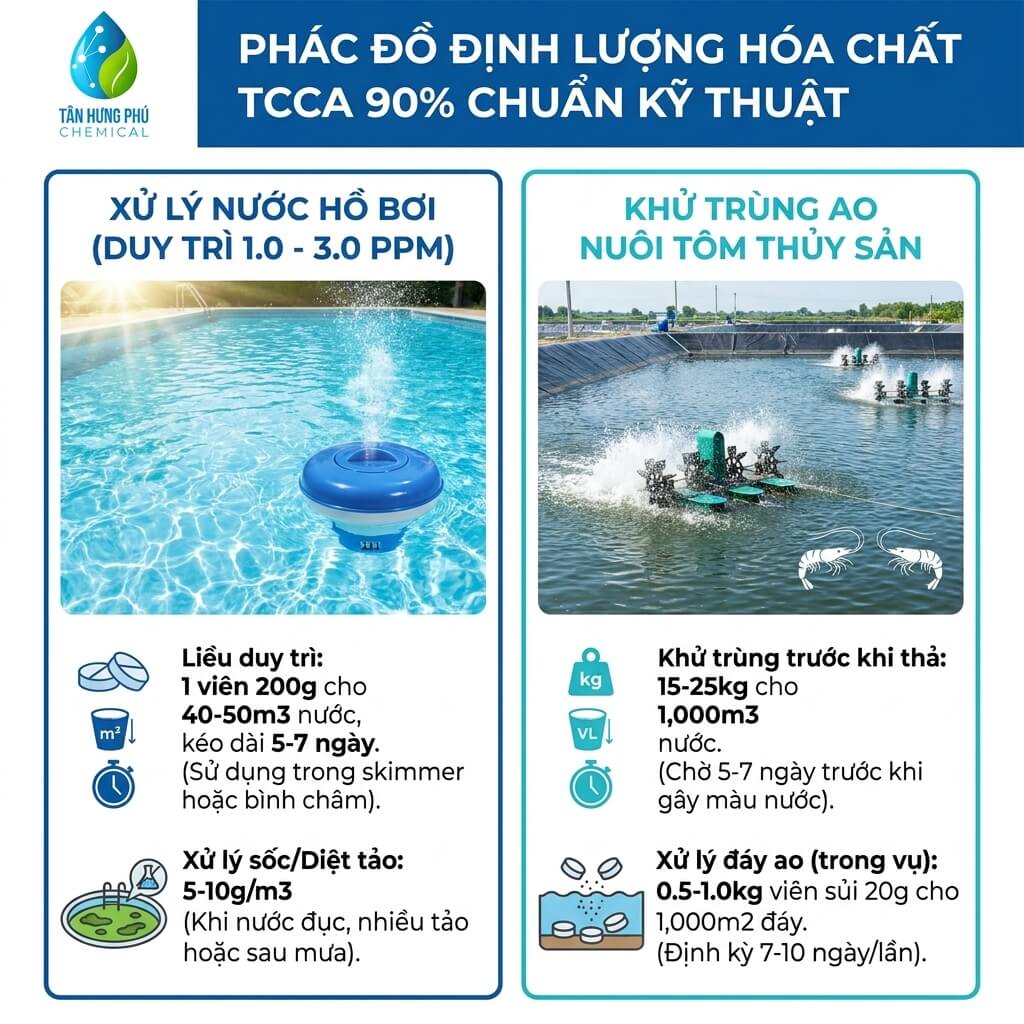
3.1. Swimming Pool Sanitation & Algae Eradication with TCCA
In swimming pool water treatment with TCCA, the primary operational benchmark is maintaining Free Available Chlorine strictly within 1.0 – 3.0 ppm (mg/L) alongside a balanced water pH of 7.2 – 7.6:
- Routine Weekly Maintenance Dosing (Using 200g or 20g Tablets): Deploy one 200g TCCA tablet (or ten 20g tablets) per 40 – 50 m³ of pool water every 5 – 7 days within skimmer baskets or erosion chlorinators. To elevate pool free chlorine by 1.0 ppm, dose approximately 1.15 g of TCCA 90% per 1 m³ of water (115 g per 100 m³ pool volume).
- Shock Chlorination & Algae Remediation (Using Powder / Granular): When pool water turns cloudy after heavy storms, generates chloramine odors, or exhibits green algae on walls, perform an evening shock treatment using 5.0 – 10.0 g of TCCA powder (or granular) per 1 m³ of water (0.5 – 1.0 kg per 100 m³). Fully dissolve in a water bucket, broadcast across the perimeter, run continuous filtration for 8 – 12 hours, and perform thorough brushing and vacuuming.
3.2. Shrimp Aquaculture Water Disinfection and Pathogen Eradication
In intensive Litopenaeus vannamei and Penaeus monodon shrimp farming, water disinfection with TCCA eradicates Vibrio parahaemolyticus (pathogen of acute hepatopancreatic necrosis disease AHPND/EMS, white feces syndrome), White Spot Syndrome Virus (WSSV), aquatic fungi, and predatory pests:
- Reservoir Disinfection / Pre-Stocking Pond Preparation (Using Powder / Granular): Apply 15 – 25 kg of TCCA 90% per 1,000 m³ of water (15 – 25 ppm). Slurry with water, broadcast evenly in late afternoon, and run paddlewheel aerators continuously for 3 – 5 days until residual chlorine dissipates completely (0.0 ppm via test kits, or neutralized with Sodium Thiosulfate) before establishing algal color and stocking post-larvae.
- Periodic Pond Bottom Sanitation During Culture Cycles: If benthic Vibrio counts spike or bottom sludge accumulates, apply a minimal maintenance dose of 0.3 – 0.5 kg per 1,000 m³ (diluted powder/granular) or spot-broadcast 0.5 – 1.0 kg of 20g TCCA tablets per 1,000 m² around bottom siphon pits to disinfect benthic zones without crashing surface microalgae blooms.
4. TCCA 90% Product Lines Officially Distributed by Tan Hung Phu Chemical
As a direct importer of water treatment and aquaculture chemicals in Southern Vietnam, Tan Hung Phu Chemical Co., Ltd. (THP Chemical) maintains continuous stock across all 4 physical forms of TCCA 90 in standard 50 kg Net HDPE drums:
- TCCA 90% Powder (Item Code: THP8): TCCA 90% Powder – Swimming Pool & Aquaculture Water Disinfectant (50kg Drum – Code: THP8)
- TCCA 90% Granular (Item Code: THP13): TCCA 90% Granular – Water Disinfectant & Algaecide Chemical (50kg Drum – Code: THP13)
- TCCA 90% 200g Tablet (Item Code: THP15): TCCA 90% 200g Tablet – Slow-Dissolving Pool Sanitizing Tablet (50kg Drum – Code: THP15)
- TCCA 90% 20g Tablet (Item Code: THP38): Trichloroisocyanuric Acid 90% – TCCA 20g Tablet Water Sanitizer (50kg Drum – Code: THP38)
Procurement teams can click directly on the product links above to inspect full technical data sheets and download official batch COAs. Along with TCCA 90%, we supply complementary water and pool chemicals including Chlorine 70% India/China (THP4 & THP5), SDIC 60% (THP3), Polyaluminium Chloride PAC 31% (THP21), and Sodium Hydroxide Flakes NaOH (THP12 & THP9) across our complete chemical catalog.
5. Chemical Safety Standards (UN 2468) for Dissolution, Dosing, and Storage
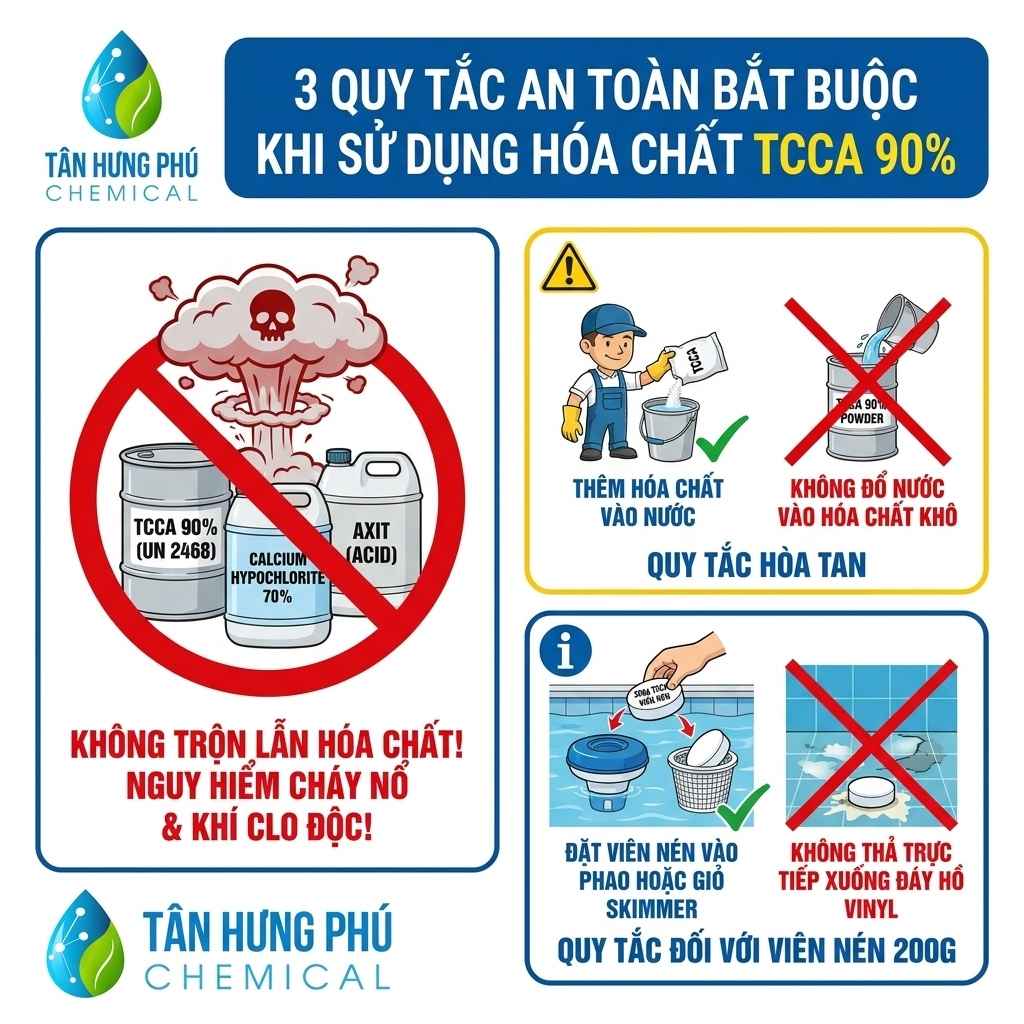
1. NEVER mix TCCA 90% (Organic Chlorine) with Calcium Hypochlorite 70% (Inorganic Chlorine) or Concentrated Acids: Direct contact between TCCA and Calcium Hypochlorite, sodium hypochlorite, liquid acids (HCl, H2SO4), or ammonium/urea compounds initiates an explosive exothermic redox reaction, releasing toxic chlorine gas (Cl2) and highly shock-sensitive Nitrogen Trichloride (NCl3) that will rupture closed chemical feeders.
2. Never pour water into dry TCCA powder: When preparing TCCA Powder or Granular, always add the chemical incrementally into a bucket pre-filled with ample clean water and stir smoothly. Splashing small amounts of water into a drum of dry TCCA causes rapid self-heating and noxious fumes.
3. Do not drop concentrated TCCA tablets directly onto vinyl-lined or painted pool floors: Always house 200g TCCA tablets in floating dispensers or skimmer baskets. Allowing resting tablets on vinyl liners or mosaic tiles causes bleaching, embrittlement, and structural perforation at contact points.
- Personal Protective Equipment (PPE): When unsealing 50 kg drums, operators must stand upwind, wear activated-carbon respirators or acid/chlorine gas masks, sealed chemical splash goggles, and heavy-duty nitrile/rubber gloves.
- Warehouse Storage Protocol: Palletize HDPE drums in dry, well-ventilated indoor facilities below 30°C, shielded from direct sunlight and strictly segregated from oils, organic solvents, ammonium fertilizers, and acids. Fasten drum lids and rubber gasket seals immediately after use.
6. Where to Buy TCCA 90? B2B Wholesale Pricing for 50kg Drums in HCMC
When aquaculture distributors, pool maintenance service companies, resort engineers, and industrial operators evaluate suppliers to purchase TCCA 90, bulk pricing for 50kg drums across the B2B market is driven by three main factors:
- Form Factor & Manufacturing Origin: Between imported brands in the market, officially declared TCCA 90% delivering confirmed active chlorine ≥ 90.0% Min (batch COA analyses consistently exceeding 90.1%) remains the benchmark for performance and cost efficiency. Slight fabrication premiums apply across Powder (THP8), Granular (THP13), 20g Tablets (THP38), and 200g Tablets (THP15).
- Order Volume (MOQ): Tiered commercial pricing applies for multi-drum purchases, full pallets, or full 20’FCL container loads procured directly from direct importer Tan Hung Phu Chemical.
- Full Documentation & Prompt Logistics: Every shipment includes authentic batch Certificates of Analysis (COA), Safety Data Sheets (MSDS / SDS), and VAT commercial invoices, backed by fleet trucking across Ho Chi Minh City, the Mekong Delta, Southeastern, and Central provinces.
REQUEST WHOLESALE QUOTATION FOR TCCA 90% 50KG DRUMS (POWDER, GRANULAR, 20G, 200G TABLETS)
To receive current B2B wholesale pricing for TCCA 90% 50kg drums (Codes: THP8, THP13, THP15, THP38) scaled to your distribution, resort, or farm requirements, contact Tan Hung Phu sales engineering:
Tan Hung Phu Chemical Co., Ltd. (THP Chemical)
• Technical Support & Wholesale Hotline / Zalo: 0913 711 647
• RFQ Inquiries: tanhungphu@thpchemical.com
• Main Facility & Warehousing: 878B Ta Quang Buu, Binh Dong Ward, Ho Chi Minh City, Vietnam & regional transit depots (Rapid nationwide delivery via specialized trucks and shipping containers).
7. Frequently Asked Questions (FAQ) on TCCA 90% Chemical
How does TCCA 90% (Organic Chlorine) differ from Calcium Hypochlorite 70% (Inorganic Chlorine)?
TCCA 90% Chemical (Trichloroisocyanuric Acid – C3Cl3N3O3) is an organic chlorine compound with an active chlorine content of ≥ 90.0% Min (significantly higher than the ~70% of Calcium Hypochlorite). Upon aqueous dissolution, TCCA releases stabilizing Cyanuric Acid, protecting chlorine against solar ultraviolet decomposition. It possesses an acidic pH (2.6 – 3.2) and contains zero lime/calcium, eliminating scaling and water turbidity in hard-water pools.
When should operators select TCCA Powder / Granular versus 200g Slow-Release Tablets?
TCCA Powder (THP8) and TCCA Granular (THP13) dissolve rapidly, making them ideal when operators require an immediate chlorine spike to shock algae blooms in pools or fully sterilize reservoir waters before stocking shrimp. Conversely, 200g TCCA Tablets (THP15) dissolve slowly over 5 – 7 days within skimmers or floating chlorinators, making them optimal for automated daily maintenance of 1.0 – 3.0 ppm free chlorine in pools and cooling towers.
Does continuous use of 200g TCCA tablets require monitoring of Cyanuric Acid (CYA) levels?
Yes. During pool sanitation with TCCA, the released Cyanuric Acid (CYA) does not evaporate and accumulates over time. At an optimal level of 30 – 50 ppm CYA, it provides excellent solar UV stabilization; however, levels exceeding 100 ppm induce "Chlorine Lock," reducing sanitation kinetics. Operators should perform weekly sand filter backwashes and replenish 5% – 10% fresh water to keep CYA within ideal parameters.
How are 20g TCCA Tablets and TCCA Granular utilized in intensive shrimp aquaculture?
For aquaculture water disinfection with TCCA: Prior to post-larvae stocking, farms apply TCCA Granular (THP13) at 15 – 25 ppm (15 – 25 kg/1,000 m³) so heavy particles sink deeply to eradicate Vibrio, microsporidians (EHP), and benthic organic pathogens. During active rearing cycles when siphon pits accumulate waste, farmers broadcast 20g TCCA Tablets (THP38) at 0.5 – 1.0 kg/1,000 m² directly over bottom pits for targeted sludge disinfection without collapsing surface microalgae.
Why is it strictly forbidden to mix 90% TCCA tablets and 70% Calcium Hypochlorite in the same feeder?
TCCA 90% is an acidic organic chlorine (pH 2.6 – 3.2), whereas Calcium Hypochlorite 70% is an alkaline inorganic chlorine (pH ~ 11.5). Combining both compounds inside a shared bucket or enclosed feeder initiates a violent exothermic reaction, generating intense heat, toxic chlorine gas, and explosive Nitrogen Trichloride (NCl3), which will violently rupture the vessel.
What is the wholesale price for 50kg drums of TCCA 90%, and where can it be sourced in HCMC?
Wholesale pricing for TCCA 90% in 50kg HDPE drums depends on the physical form chosen (Powder THP8, Granular THP13, 200g Tablets THP15, or 20g Tablets THP38) and order tonnage. For genuine stock in Ho Chi Minh City complete with verified batch COAs and MSDS, contact Tan Hung Phu Chemical directly via Hotline/Zalo at 0913 711 647.
8. References & International Standards
Technical specifications, chlorine-cyanurate equilibrium kinetics, and hazardous transport requirements (UN 2468) cited herein are derived from authentic regulatory and scientific standards:
- Chemical Standard & Batch COA Records: Industrial Standard for Trichloroisocyanuric Acid (HG/T 3263 – Available chlorine ≥ 90% min, pH 1% solution: 2.6 – 3.2, Moisture: ≤ 0.5% max) and manufacturer batch analysis records.
- National Center for Biotechnology Information (PubChem – NCBI): PubChem Compound Summary for CID 6874: Symclosene / Trichloroisocyanuric Acid (C₃Cl₃N₃O₃ – CAS 87-90-1) – Molecular structure, physical solubility, and GHS classification (UN 2468, Class 5.1).
- World Health Organization (WHO): WHO Guidelines for Safe Recreational Water Environments – Volume 2: Swimming Pools and Similar Environments – Parameters for free chlorine maintenance (1.0 – 3.0 mg/L) and cyanuric acid stabilization limits.
- Food and Agriculture Organization (FAO): FAO Fisheries and Aquaculture Technical Guidelines – Technical guidance on biosecurity and chlorination sanitation protocols for intensive shrimp aquaculture ponds using organic chlorine sources.
Summary: This technical guide provides aquatic engineers, farm operators, and procurement specialists with an understanding of what is TCCA and the photostable chlorine release mechanism of organic chlorine TCCA 90 (TCCA 90% chemical – Trichloroisocyanuric Acid). Deploying fast-dissolving Powder/Granular for shock treatments alongside slow-dissolving 20g/200g Tablets for ongoing automated sanitization from verified warehouse stocks at Tan Hung Phu Chemical ensures stable biosecurity, crystal-clear water clarity, and optimal operational cost efficiency.
Other News
View detail- What Is Sodium Alginate (E401)? Brown Seaweed Origin & Calcium Gelation Mechanism
- What is Food Additive Xanthan Gum (INS 415 / E415)? Why is Xanthan Gum F200 Dubbed the "King of Anti-Separation" in Sauces and Beverages?
- Caustic Soda Flakes 98% (NaOH 98% Min & China): Wastewater pH Neutralizer, Textile Scouring, Pulp Digestion & Detergent Manufacturing
- What is MKP Fertilizer (Mono Potassium Phosphate 00-52-34)? Why is the 0% N – 52% P2O5 – 34% K2O Formula the Key to Off-Season Flowering?

