
News & Event
What Is Sodium Alginate (E401)? Brown Seaweed Origin & Calcium Gelation Mechanism
Compiled by Tan Hung Phu Technical Team · Updated:
In modern food and beverage (F&B) processing, from bursting popping boba pearls releasing vibrant fruit flavors in bubble tea and bake-stable fruit fillings that resist boil-out to smooth, ice-crystal-free textures in premium ice cream, an extraordinary marine biopolymer plays a pivotal role. When investigating what is alginate or what is sodium alginate, R&D food technologists frequently encounter Sodium Alginate (food additive code E401 / INS 401). Fundamentally different from Agar or Gelatin—which require heating followed by cooling to form a gel network—sodium alginate features an instantaneous ion-exchange mechanism with Calcium at ambient room temperature to form an impermeable gel membrane encapsulating liquid centers – a remarkable physicochemical property driving innovation in structured foods and specialty beverages.
Executive Summary
- Chemical Identity: Sodium Alginate (INS 401 / E401, CAS 9005-38-3, formula (C6H7O6Na)n), a natural hydrophilic polysaccharide extracted from marine brown seaweeds (Phaeophyceae).
- Unique Gelation Mechanism: Instantaneous ion exchange with Calcium ions (Ca2+) at ambient temperature according to the Egg-Box Model, creating a thermo-irreversible gel membrane (resists melting up to 100°C boiling or 200°C baking).
- Core Applications: Manufacturing Popping Boba (bursting pearls) via Spherification, kelp noodles, bake-stable jam fillings, restructured food matrices, and stabilization against ice crystallization in ice cream.
- Preparation Guidelines: Dissolve strictly in soft / RO demineralized water (free of multivalent Ca2+), maintain system pH ≥ 4.0, and dry-blend with sugar (1:5 to 1:10 ratio) to eliminate clump formation ("fish-eyes").
Table of Contents:
- 1. What Is Sodium Alginate (E401)? Brown Seaweed Origin & M-G Block Architecture
- 2. Key Functionalities: Calcium Gelation Mechanism & The Egg-Box Model
- 3. F&B Applications: Spherification for Popping Boba & E401 Stabilizer
- 4. Industrial Dissolution Protocol (Lump-Free) & Dosage Guidelines
- 5. Regulatory Compliance (FCC/Codex) & Sodium Alginate 25kg (Code THP46) at Tan Hung Phu
- 6. Where to Buy Sodium Alginate? Wholesale B2B Pricing for 25kg Bags in HCMC
- 7. Frequently Asked Questions (FAQ) on Food Grade Sodium Alginate E401
- 8. References & International Food Safety Standards
1. What Is Sodium Alginate (E401)? Brown Seaweed Origin & M-G Block Architecture
To define what is alginate and what is sodium alginate with technical precision: Sodium Alginate (general molecular formula: (C6H7O6Na)n, CAS Registry Number: 9005-38-3, International Additive Code: INS 401 / E401) is the purified sodium salt of alginic acid – a natural structural polysaccharide found within the cell walls and intercellular matrix of brown seaweeds (class Phaeophyceae, such as Laminaria hyperborea, Macrocystis pyrifera, and Ascophyllum nodosum). Through dilute alkaline extraction, rigorous multi-stage filtration, purification, and neutralization into soluble sodium salt, food grade sodium alginate is obtained as an off-white to pale yellowish-cream powder or fine granules, completely odorless and neutral in flavor.
Block Copolymer Structure: Mannuronic Acid (M) & Guluronic Acid (G) Blocks
At the macromolecular level, the linear backbone of sodium alginate consists of two uronic acid monomer residues linked by (1→4) glycosidic bonds: β-D-mannuronic acid (M-blocks) and α-L-guluronic acid (G-blocks). The ratio between M-blocks and G-blocks (M/G ratio) along the polymer chain directly governs the rheological and mechanical behavior of the resulting gel:
- High-G Alginate Fractions: Molecular chains exhibit pronounced buckled, zigzag spatial conformations that react instantaneously with calcium ions to form crisp, rigid, and high-tensile gels. This type is ideal for burst-in-the-mouth Popping Boba pearls, crisp simulated noodles, and structured plant-based matrices.
- High-M Alginate Fractions: Chains feature extended, ribbon-like flat conformations that cross-link more gradually with calcium to yield pliable, elastic, and flexible gels with superior water-holding capacity and minimal syneresis. These are preferred for thickening pourable sauces, stabilizing ice cream, and maintaining crumb moisture in bakery goods and noodles.
| Technical Parameter & Classification | Specification Standard (Food Grade – E401) |
|---|---|
| Additive Name & Regulatory Codes | Sodium Alginate – INS 401 / E401 | CAS: 9005-38-3 |
| Chemical Formula & Botanical Source | (C6H7O6Na)n – Natural marine polysaccharide derived from Brown Seaweed (Phaeophyceae) |
| Appearance & Solubility | White to yellowish-brown fine powder or granules; fully soluble in both cold and hot water yielding a viscous colloidal solution |
| Commercial Viscosity Range (1% solution) | Customizable by formulation: 100 – 200 cps | 200 – 600 cps | 600 – 800 cps | 800 – 1,000 cps | ≥ 1,000 cps |
| Standard Particle Mesh Size | Granular and fine powder grades: 60 / 80 / 100 / 120 / 170 / 200 mesh (Most common for F&B: 80 mesh – 170 mesh) |
| pH (1% Solution) & Moisture Content | pH: 6.0 – 8.0 | Loss on drying: ≤ 15.0% Max |
| Quantitative Assay (Dry Basis) | 90.8% – 106.0% (Fully conforms to FCC / Codex / JECFA / E401 purity criteria) |
| Food Safety & Quality Certifications | ISO 22000, BRC, HACCP, KOSHER, HALAL (100% Plant-Based / Vegan) |
2. Key Functionalities: Calcium Gelation Mechanism & The Egg-Box Model
When evaluating the functional capabilities of sodium alginate in food technology, the defining advantage distinguishing E401 from hydrocolloids such as Xanthan Gum, Guar Gum, or Gelatin is its capacity to undergo rapid cold-set gelation via ionic cross-linking with divalent calcium ions (Ca2+) without thermal input.
2.1. Ion Exchange Reaction Na+ ↔ Ca2+ and the Egg-Box Model
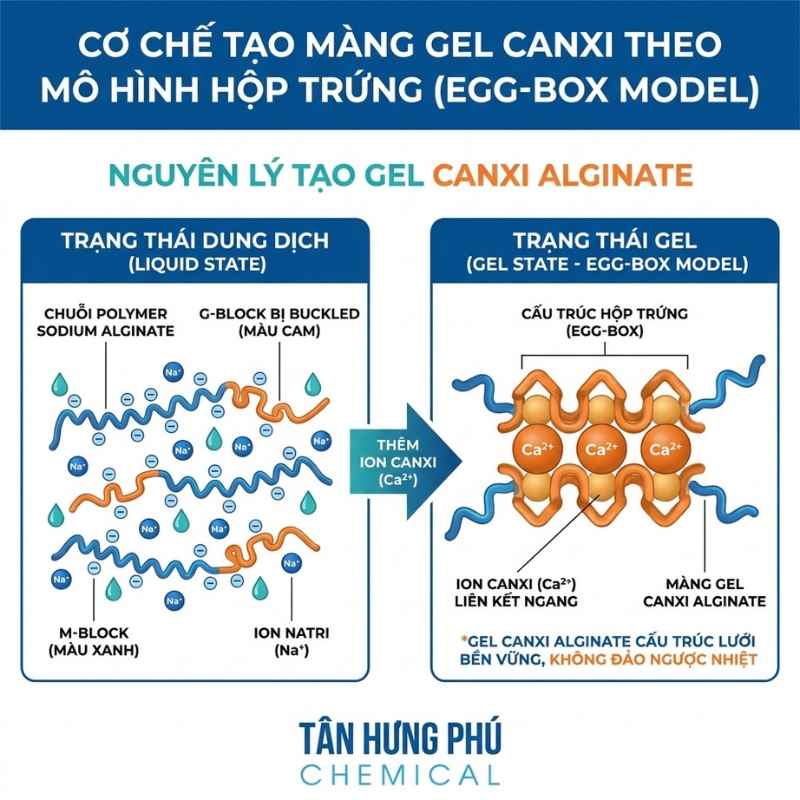
When dissolved in demineralized water, monovalent Na+ counterions dissociate, allowing the hydrated polymer chains to extend and form a viscous solution. The moment this solution contacts free divalent calcium ions (Ca2+) (supplied by salts such as Calcium Lactate – E327, Calcium Lactate Gluconate, Calcium Chloride – E509, or Calcium Sulfate – E516), stoichiometric ion exchange takes place instantaneously according to the equation:
2 [Na-Alginate] (Soluble fluid) + Ca2+ → [Ca-(Alginate)2]↓ (Insoluble Gel Membrane) + 2 Na+
This calcium gelation process is scientifically explained by the renowned Egg-Box Model:
- Each bivalent Ca2+ cation carries two positive charges, displacing two Na+ ions to chelate concurrently with carboxylate groups (–COO−) situated on opposing α-L-guluronic acid (G-block) chains.
- Because adjacent G-block segments possess corrugated, folded geometries reminiscent of egg-carton indentations, two facing chains form electronegative cavities that securely trap and coordinate Ca2+ ions like eggs resting within a carton.
- This three-dimensional cross-linking zipped network forms instantly at the liquid interface, producing a transparent, resilient, semi-permeable Calcium Alginate skin that holds the core liquid droplet intact.
2.2. Thermo-Irreversible Gel Matrix Resisting Cooking and Retort Retaining
A primary engineering advantage of calcium alginate gelation is its thermo-irreversibility: Unlike Gelatin gels that melt into liquid at body temperature (35°C) or Agar/Carrageenan networks that liquefy when heated above 85°C, a fully cross-linked Calcium Alginate network remains stable without melting under boiling water (100°C), retort autoclave sterilization, or commercial baking up to 200°C. Consequently, popping boba beads or pastry fruit fillings preserve their structural integrity throughout intense thermal processing.
3. F&B Applications: Spherification for Popping Boba & E401 Stabilizer
3.1. Spherification Technology: The Secret Behind Bursting Popping Boba Pearls
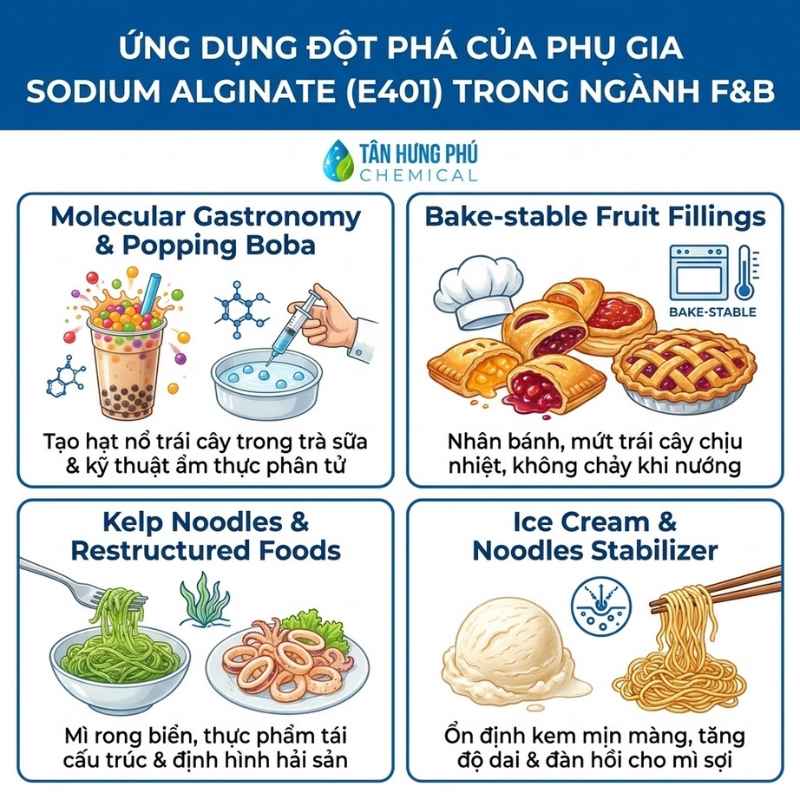
Within bubble tea manufacturing, commercial beverage formulation, and molecular gastronomy, the premier application of food grade sodium alginate is Spherification – the culinary encapsulation technique utilized to create Popping Boba (bursting pearls with fruit juice centers, as well as plant-based faux caviar). Depending on liquid composition, food processors deploy two primary spherification methods:
- Direct / Basic Spherification:
Dissolve 0.5% – 1.0% Sodium Alginate (E401) directly into the flavored fruit syrup (mango, strawberry, peach, lychee, or passion fruit without intrinsic calcium, buffered to pH > 4.0). Droplets released via multi-head dosing nozzles into an external bath containing 0.5% – 1.5% Calcium Chloride (CaCl2) or Calcium Lactate instantly form a delicate outer gel skin within 30 to 60 seconds. When bitten, the thin skin bursts, releasing the fresh internal juice. - Reverse Spherification (Industrial Standard for Extended Shelf Life):
In direct spherification, residual Ca2+ slowly diffuses inward over time, causing pearls to gel completely into solid beads. To manufacture shelf-stable Popping Boba with a 12-month ambient shelf life whose cores stay 100% liquid, or when formulating acidic/dairy-rich fillings, plants use reverse spherification: Mix Calcium Lactate Gluconate (1.5% – 2.5%) into the flavored liquid core, then drop the mixture into a 0.5% Sodium Alginate bath. Gelation occurs outward from the core surface into the bath. Rinsing the harvested pearls in clean water halts the reaction permanently, locking in a long-lasting burst effect.
3.2. Structured Foods: Kelp Noodles, Bake-Stable Jam Fillings & Restructured Matrices
- Kelp Noodles & Dual-Layer Jellies: Extruding aqueous alginate solutions through fine spinnerets into a calcium setting bath yields transparent, crunchy, zero-calorie keto-friendly kelp noodles, or flexible outer casings encapsulating cheese and fruit centers.
- Bake-Stable Fruit Fillings: In cookies, fruit pies, and croissants baked at 180°C – 220°C, incorporating 0.4% – 0.8% sodium alginate combined with controlled calcium and phosphate salts establishes a heat-stable gel network, preventing boil-out and keeping fillings intact.
- Restructured Meat & Seafood Alternatives: Functions as an effective cold-set binder for shaping coated onion/calamari rings, surimi crabsticks, plant-based vegan meats, sausages, and chunk-in-gravy pet foods that retain textural firmness during retort canning.
3.3. Role of E401 Stabilizer in Preventing Syneresis in Ice Cream, Sauces & Noodles
Even in the absence of exogenous calcium salts, stabilizer E401 provides functional thickening and water-binding properties across numerous food systems:
- Ice Cream & Cultured Dairy: At 0.15% – 0.40%, sodium alginate interacts mildly with endogenous calcium in milk to form a micro-gel matrix. This inhibits ice crystal formation during temperature fluctuations, delivering a creamy mouthfeel and slowing meltdown rates.
- Instant Noodles, Dried Noodles & Frozen Dumpling Wrappers: Adding 0.10% – 0.30% E401 to flour dough fortifies the gluten protein network, improving tensile elasticity, decreasing packaging breakages, shortening boiling rehydration time, and preventing freeze-thaw surface cracking.
- Salad Dressings, Chili Sauces, Syrups & Fruit Juices: Acts as a viscosity modifier and emulsion stabilizer, preventing phase separation (oil-water splitting) and maintaining uniform pulp suspension.
4. Industrial Dissolution Protocol (Lump-Free) & Dosage Guidelines
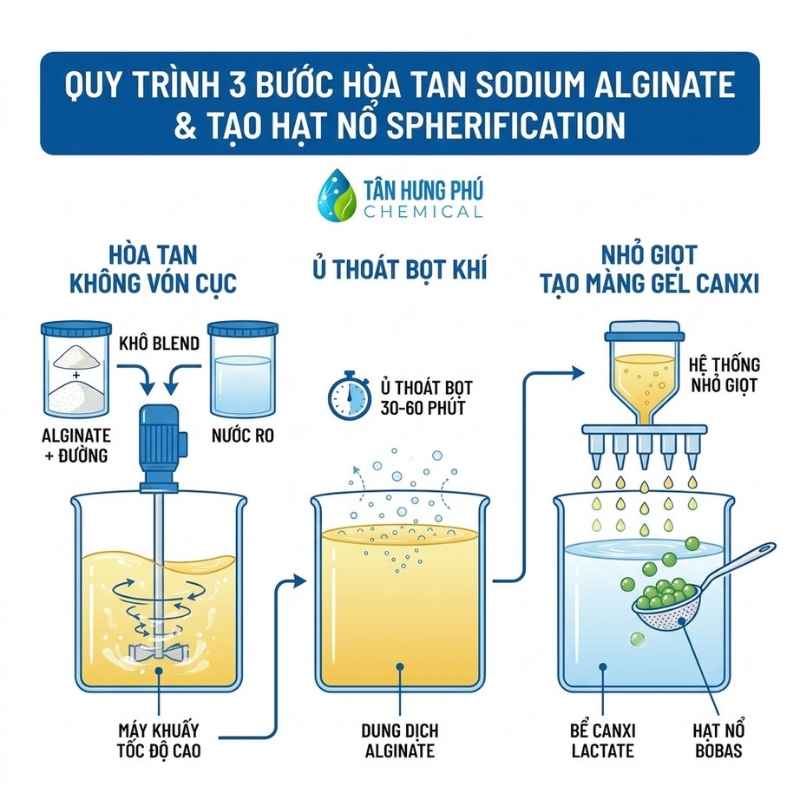
1. Use Soft or RO Demineralized Water Exclusively: Hard water containing dissolved Ca2+ and Mg2+ cations (> 100 ppm) causes localized premature gelation upon contact, leaving stubborn undispersed lumps. If water hardness is slightly elevated, sequestering agents like Sodium Citrate (E331) or Sodium Hexametaphosphate (SHMP, E452i) at 0.1% – 0.2% must be dosed prior to adding alginate.
2. Dry-Blending to Prevent "Fish-Eye" Clumping: Due to rapid surface hydration, dry-blend Sodium Alginate powder with crystalline sucrose at a 1:5 to 1:10 ratio before dispersing into the vortex created by a high-shear mixer.
3. Maintain System pH (> 4.0) and Allow De-aeration: Avoid dosing directly into high-acid juices (pH < 3.8); below pH 3.5, alginate precipitates as insoluble alginic acid gel. Buffer juice systems with Sodium Citrate to pH ≥ 4.2. After complete hydration, allow the batch to rest for 2 to 4 hours (or apply vacuum de-aeration) to liberate entrapped microbubbles for clear, bubble-free spherical pearls.
| Application Segment (F&B) | Recommended Ratio (%) | Dosage (g / kg or Liter) | Codex / Regulatory Limit |
|---|---|---|---|
| Popping Boba / Bursting Pearls (Spherification) | 0.50% – 1.00% | 5.0 – 10.0 g / L liquid | Quantum Satis (GMP) |
| Bake-Stable Fruit & Jam Fillings | 0.40% – 1.00% | 4.0 – 10.0 g / kg filling | Quantum Satis (GMP) |
| Kelp Noodles, Crisp Jelly Strips & Structured Foods | 0.80% – 1.50% | 8.0 – 15.0 g / kg batch | Quantum Satis (GMP) |
| Ice Cream, Sorbets & Drinkable Yogurts | 0.15% – 0.40% | 1.5 – 4.0 g / kg mix | Quantum Satis (GMP) |
| Instant Noodles, Dried Noodles, Frozen Dumpling Wrappers | 0.10% – 0.30% | 1.0 – 3.0 g / kg flour | Quantum Satis (GMP) |
| Salad Dressings, Table Sauces, Syrups & Beverages | 0.10% – 0.50% | 1.0 – 5.0 g / L sauce | Quantum Satis (GMP) |
5. Regulatory Compliance (FCC/Codex) & Sodium Alginate 25kg (Code THP46) at Tan Hung Phu
Meeting strict qualification criteria for beverage ingredient manufacturers, bakery chains, ice cream producers, noodle processors, and food exporters, Tan Hung Phu Chemical imports and distributes Food Grade Sodium Alginate (Item Code: THP46) under full official customs declarations:
- Product Details & Specifications (Code: THP46): Sodium Alginate (E401 / INS 401) – Food Grade Gelling & Thickening Agent (25kg Bag – Code: THP46)
• International Food Grade Standard (FCC / Codex / E401): Guaranteed high assay purity, free of insoluble contaminants, yielding transparent hydrocolloid solutions and dependable calcium gelation strength.
• Comprehensive QA/QC Dossier: Batch-specific Certificate of Analysis (COA), Safety Data Sheet (MSDS), official Vietnamese Food Safety Self-Declaration, and international third-party certifications (ISO 22000, BRC, Kosher, Halal).
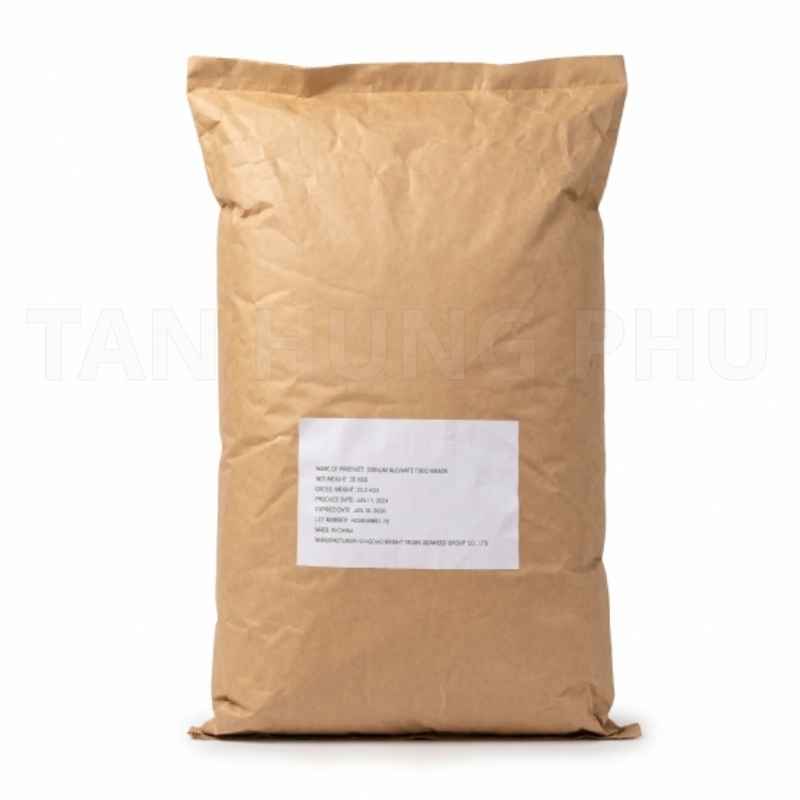
• Moisture-Proof Packaging: Packed in 25 kg net multi-wall Kraft paper / PP bags lined with a heat-sealed food-grade polyethylene (PE) inner liner, stored in humidity-controlled warehousing.
Alongside Sodium Alginate (THP46), manufacturers can explore our integrated functional ingredients including Carrageenan Marcel E407 (THP2), Xanthan Gum F200 E415 (THP45), Citric Acid E330 (THP18), and Potassium Sorbate E202 (THP19) within our online product catalog.
6. Where to Buy Sodium Alginate? Wholesale B2B Pricing for 25kg Bags in HCMC
When procurement departments evaluate commercial suppliers to purchase Sodium Alginate in bulk 25kg bags, pricing is determined by three key technical and commercial considerations:
- Viscosity Rating and Mesh Granularity: High-viscosity grades (600 – 1,000 cps), ultra-fine particle sizes (120 – 170 mesh), or customized High-G fractions tailored for popping boba carry specialized pricing compared to general thickening grades.
- Order Volume (MOQ): Tiered wholesale pricing applies for single bags, full pallets, or quarterly/annual supply agreements directly from direct importer Tan Hung Phu Chemical Co., Ltd.
- Complimentary R&D Lab Samples: Tan Hung Phu provides working testing samples with accompanying batch COAs for internal R&D pilot-scale validation prior to commercial volume contracts.
REQUEST WHOLESALE QUOTATION FOR SODIUM ALGINATE 25KG (FOOD GRADE E401 – CODE THP46) & R&D SAMPLES
To receive the most competitive B2B pricing for Sodium Alginate Food Grade 25kg bags (Item Code: THP46) along with COA, MSDS, and technical data sheets, contact Tan Hung Phu Chemical sales support directly:
Tan Hung Phu Chemical Co., Ltd. (THP Chemical)
• Technical Support & Sales Hotline / Zalo: 0913 711 647
• Request for Quotation (RFQ) Email: tanhungphu@thpchemical.com
• Head Office & Warehouse: 878B Ta Quang Buu, Binh Dong Ward, Ho Chi Minh City, Vietnam (Nationwide logistics via dedicated freight carriers and container shipments).
7. Frequently Asked Questions (FAQ) on Food Grade Sodium Alginate E401
What is Sodium Alginate, and is food additive E401 suitable for vegan and vegetarian diets?
Sodium Alginate (additive code E401 / INS 401) is the sodium salt of alginic acid obtained by extracting marine brown algae (seaweed). Derived entirely from plant sources, this soluble dietary fiber contains zero animal derivatives, holds Kosher and Halal compliance, and is 100% suitable for vegetarian, vegan, and keto formulations.
How does Sodium Alginate differ functionally from Agar-Agar (E406) and Carrageenan (E407)?
The primary difference lies in the gelation mechanism: Agar and Carrageenan require thermal activation (boiling above 75°C – 90°C) followed by cooling to form a gel, which subsequently re-melts upon reheating. In contrast, food grade sodium alginate dissolves in cold water and forms an instantaneous gel at room temperature upon exposure to divalent Ca2+ ions. Crucially, calcium alginate creates a thermo-irreversible matrix that will not melt when boiled at 100°C or baked at 200°C.
Which calcium salt should be used in spherification to prevent off-flavors or bitterness in Popping Boba?
While Calcium Chloride (CaCl2) cross-links rapidly in direct spherification, prolonged immersion or insufficient rinsing can impart a slightly bitter or metallic taste to thin membranes. For clean, pristine flavor profiles (especially in reverse spherification for dessert and beverage pearls), industrial processors prioritize Calcium Lactate (E327) or Calcium Lactate Gluconate due to their high solubility and neutral, non-bitter sensory profile.
Why does Sodium Alginate powder form lumps or fail to hydrate fully, and how can this be resolved?
Two root causes typically account for this: First, dumping powder rapidly into water causes rapid surface hydration, encapsulating dry powder inside insoluble clumps ("fish-eyes"); second, using hard tap water high in Ca2+ or dispersing into highly acidic liquids (pH < 3.8) precipitates insoluble alginic acid. Solution: use demineralized RO water (pH ≥ 4.2), pre-blend dry alginate powder with granulated sugar at a 1:5 to 1:10 ratio, and add slowly into a high-shear mechanical vortex.
What are the permitted regulatory limits for Stabilizer E401 according to Codex Alimentarius?
Under Codex Alimentarius (GSFA) and global regulatory bodies, stabilizer E401 (INS 401) is assigned an Acceptable Daily Intake (ADI) of "Not specified" due to its recognized safety. It is authorized under Good Manufacturing Practice (GMP / Quantum Satis) across virtually all food categories, with typical functional inclusion rates spanning 0.1% to 1.0%.
Where can manufacturers buy wholesale Food Grade Sodium Alginate (Item Code: THP46) in Vietnam?
Food manufacturers can procure authentic, documented Food Grade Sodium Alginate (Item Code: THP46) directly from Tan Hung Phu Chemical Co., Ltd. Wholesale pricing for 25kg bags includes tiered discounts based on volume, complete with COA, MSDS, and statutory food safety filings. Contact our sales department via Hotline/Zalo at 0913 711 647 for quotes and R&D trial samples.
8. References & International Food Safety Standards
The physicochemical parameters, egg-box ionic cross-linking mechanisms, and international regulatory criteria for Sodium Alginate (INS 401 / E401) cited herein are referenced from primary regulatory and scientific authorities:
- Joint FAO/WHO Expert Committee on Food Additives (JECFA): Monograph & Specifications for Sodium Alginate (INS 401) – FAO/WHO JECFA – Chemical purity criteria (Assay 90.8% – 106.0%) and ADI "Not specified" status.
- U.S. Food and Drug Administration (FDA): Code of Federal Regulations Title 21 (21 CFR § 184.1724 – Sodium Alginate) – Affirmed as Generally Recognized as Safe (GRAS) for use as a stabilizer, thickener, and gelling agent.
- Codex Alimentarius (GSFA Online): Codex General Standard for Food Additives – Sodium Alginate (INS 401) – Functional food categories permitted under Good Manufacturing Practice (GMP).
- Vietnam Ministry of Health Food Additive Regulations: Circular No. 24/2019/TT-BYT (and amending Circular No. 17/2023/TT-BYT) governing the management and utilization of food additives (Permitted listing for Sodium Alginate INS 401).
Summary: This technical review provides food engineers and R&D professionals with a clear overview of what is alginate, what is sodium alginate, and the unique calcium gelation mechanism defined by the Egg-Box Model for food additive E401. Whether implemented in Spherification for popping boba pearls, structured kelp noodles, bake-stable fruit fillings, or ice cream cryoprotection, sourcing certified Food Grade Sodium Alginate (Item Code: THP46) from Tan Hung Phu Chemical ensures batch-to-batch consistency and total food safety compliance.
Other News
View detail- What is Food Additive Xanthan Gum (INS 415 / E415)? Why is Xanthan Gum F200 Dubbed the "King of Anti-Separation" in Sauces and Beverages?
- Caustic Soda Flakes 98% (NaOH 98% Min & China): Wastewater pH Neutralizer, Textile Scouring, Pulp Digestion & Detergent Manufacturing
- What is MKP Fertilizer (Mono Potassium Phosphate 00-52-34)? Why is the 0% N – 52% P2O5 – 34% K2O Formula the Key to Off-Season Flowering?
- What is Citric Acid (E330 / INS 330)? Natural Origin, Refreshing Sour Taste and Metal Chelating Antioxidant Properties

