
News & Event
Xanthan Gum F200 (E415 200 Mesh): Thickener for Chili Sauce & Sauces
Compiled by Tan Hung Phu Technical Team · Updated:
In modern processing of dipping sauces, chili sauces, salad dressings, beverages, and baked goods, water separation at the neck of chili sauce bottles (syneresis), settling of minced chili or garlic particulates, and dry, crumbly gluten-free baked goods are top technical challenges for R&D teams. When food technologists search for what is xanthan gum or what is xanthan gum powder, they consistently point to Xanthan Gum F200 (international additive code INS 415 / E415, ultra-fine 200 Mesh particle size). Thanks to its distinctive pseudoplastic rheology, remarkable stability in acidic vinegar and citrus environments, and impressive thermal resilience, xanthan gum food additive (Xanthan Gum F200 powder) has become an indispensable thickening benchmark across the F&B industry.
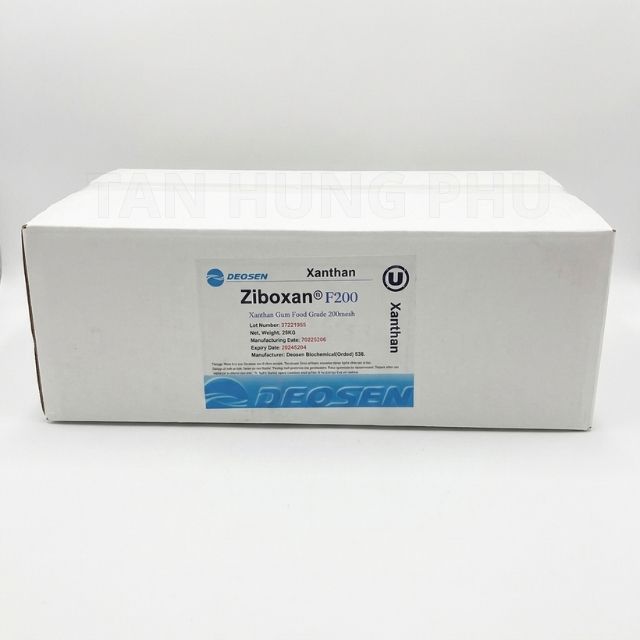
Quick Summary
- Product Identity & Meaning of F200: Xanthan Gum F200 (INS 415 / E415, CAS 11138-66-2) is a bio-fermented polysaccharide produced by Xanthomonas campestris, featuring an ultra-fine 200 Mesh (≤ 75 μm) particle size for rapid hydration and viscosity development (1,200 – 1,600 cps in 1% KCl) even in cold water.
- 3 Core Rheological Attributes: Shear-thinning (pseudoplastic) viscosity that prevents phase separation at rest yet pours smoothly under shear; broad pH stability (2.0 – 12.0) and thermal stability (V1/V2 = 1.02 – 1.45 at 24°C/65°C per FDA); strong viscosity synergy with Guar Gum (70:30) and elastic co-gelling with LBG / Konjac (50:50).
- Standard R&D Dosage Rates: 0.15% – 0.40% for chili sauce, ketchup, and salad dressings; 0.20% – 0.80% for gluten-free baked goods; and 0.05% – 0.15% for ice cream, plant-based milks, and pulp beverages.
- Anti-Lumping (“Fish-Eye”) Tip: Pre-blend dry with sugar or salt (1:5 – 1:10) or disperse in vegetable oil/glycerin (1:3 – 1:5), then sift slowly into a high-agitation water vortex.
Table of Contents:
- 1. What Is Xanthan Gum F200 (E415)? Meaning of Ultra-Fine 200 Mesh & Technical Specs
- 2. Uses of Xanthan Gum: Pseudoplasticity, pH/Heat Stability & Guar Gum Synergy
- 3. R&D Techniques: Xanthan Gum in Chili Sauce, Gluten-Free Baking & Ice Cream
- 4. Lumping-Free (“Fish-Eye”) Xanthan Gum F200 Dispersion Guide & Dosage Chart
- 5. Where to Buy Xanthan Gum? 25kg Carton Xanthan Gum F200 (Code THP45) at Tan Hung Phu
- 6. Frequently Asked Questions About Xanthan Gum F200 Powder (FAQ)
- 7. References & International Food Safety Standards
1. What Is Xanthan Gum F200 (E415)? Meaning of Ultra-Fine 200 Mesh & Technical Specs
In concise terms, Xanthan Gum (additive code INS 415 / E415, CAS No.: 11138-66-2) is a high-molecular-weight extracellular polysaccharide of natural microbial origin, produced via aerobic fermentation of glucose or sucrose (derived from corn starch or cane sugar) by the bacterium Xanthomonas campestris. Following fermentation, the gum broth is purified by alcohol precipitation, dried, and milled into a free-flowing xanthan gum powder ranging from off-white to light cream, odorless, and neutral in flavor.
Technical Meaning of F200 (200 Mesh ≤ 75 Microns vs. 80 Mesh)
On product packaging, “F” denotes Food Grade, while “200” specifies a 200 Mesh sieve fineness (ultra-fine particles ≤ 75 microns, with at least 92% passing through a 200 Mesh screen). Compared with standard F80 grades (80 Mesh ≈ 180 microns, coarser particles requiring prolonged mixing to hydrate fully), Xanthan Gum F200 provides a much greater surface-area-to-mass ratio, enabling rapid hydration and near-instant viscosity build even in cold water—making it ideal for high-speed sauce lines and dry seasoning premixes.
| Technical & Analytical Parameter (Specification) | Xanthan Gum F200 Standard (Product Code: THP45) |
|---|---|
| Product Name & International Code | Xanthan Gum Food Grade F200 – Code INS 415 / E415 | CAS: 11138-66-2 |
| Appearance & Standard Mesh Size | Light cream fine powder | 100% through 80 Mesh; ≥ 92% through 200 Mesh (≤ 75 μm) |
| Assay & Viscosity (1% in 1% KCl) | Assay (CO2 evolution per JECFA/FCC): 91% – 108% | Viscosity (25°C, LV #3, 60 rpm): 1,200 – 1,600 cps |
| Thermal Viscosity Ratio (V1/V2 – 24°C / 65°C) & Pyruvic Acid | V1/V2 (per FDA 21 CFR 172.695): 1.02 – 1.45 | Pyruvic acid: ≥ 1.5% Min |
| 1% Solution pH & Moisture Content | pH: 6.0 – 8.0 | Moisture: ≤ 15.0% Max | Total Ash: ≤ 13.0% Max |
| Heavy Metal & Microbiological Limits (FCC / JECFA) | Lead (Pb) ≤ 2 mg/kg | Arsenic (As) ≤ 3 mg/kg | TPC ≤ 2,000 cfu/g | E. coli / Salmonella: Not detected |
| Packaging & Shelf Life | 25 kg Net Carton (with moisture-barrier PE inner liner) | Shelf Life: 24 months |
2. Uses of Xanthan Gum: Pseudoplasticity, pH/Heat Stability & Guar Gum Synergy
To leverage the full functional value of xanthan gum as a premier food thickening agent, R&D formulators should master three defining rheological characteristics:
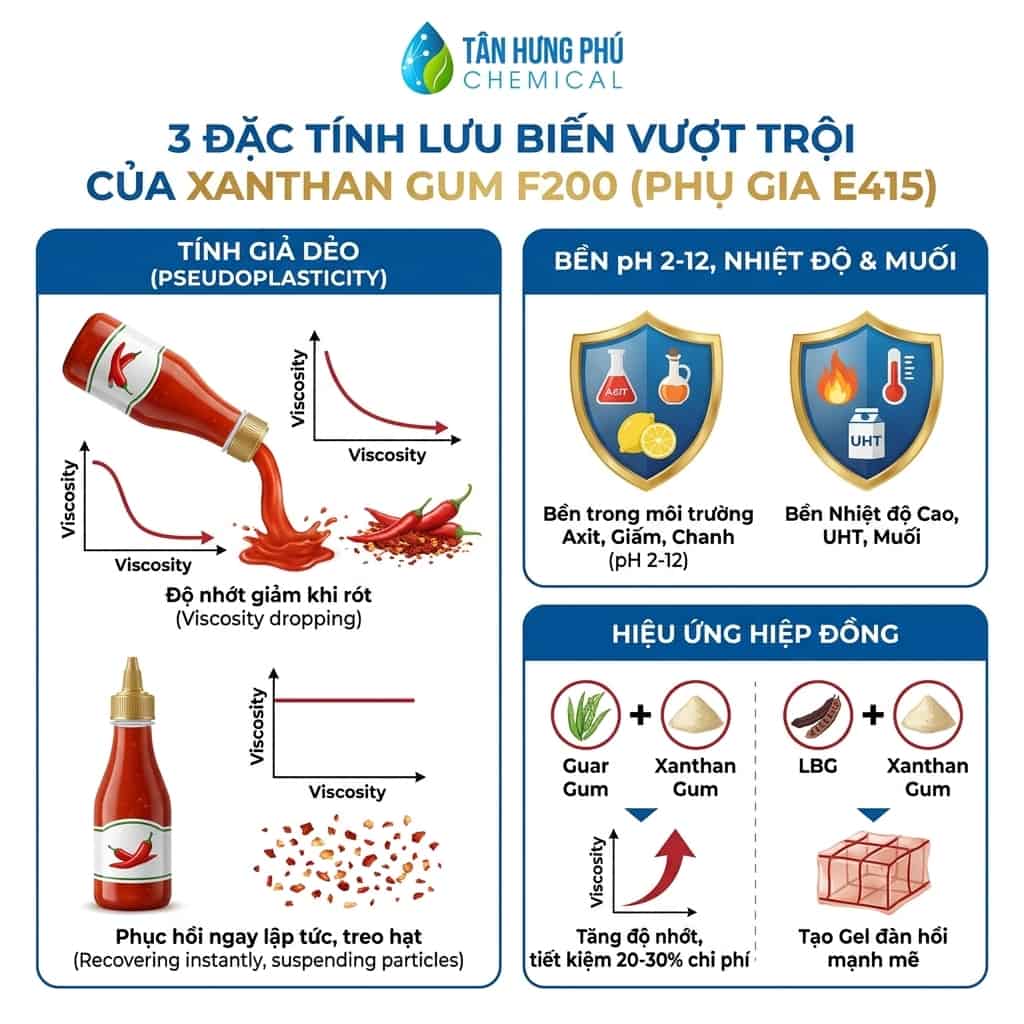
- 1. Pronounced Pseudoplasticity (Shear-Thinning Behavior): When a bottle of chili sauce or salad dressing sits stationary on a shelf (zero shear rate), entangled xanthan gum macromolecules form a structured network with high resting viscosity and yield stress—suspending chili flakes, minced garlic, peppercorn, and oil droplets without settling or phase separation. Under shear stress—such as pumping through filling nozzles, shaking a bottle, or chewing in the mouth—polymer chains align rapidly so viscosity drops, allowing smooth pouring and clean flavor release without slimy throat coating; once shear stops, viscosity recovers immediately so sauce clings evenly to food.
- 2. Superior Stability Across Acid (pH 2.0 – 12.0), Heat & Salt: Protected by its rigid helical conformation and anionic side chains, additive E415 maintains steady viscosity across wide temperatures (thermal viscosity ratio V1/V2 = 1.02 – 1.45 at 24°C/65°C), withstands hot-fill or UHT pasteurization (with even greater thermal stability when 0.1% – 1% salt electrolytes stabilize the double-stranded conformation), resists acid thinning in vinegar/citrus sauces (pH 3.0 – 3.8), tolerates 10% – 15% salt levels, and survives freeze-thaw cycles.
- 3. Gelling Behavior of Xanthan Gum & Synergistic Interactions (Guar Gum & Xanthan Gum):
• Used alone: Xanthan gum gelling behavior creates a “weak viscoelastic gel” that strongly resists syneresis rather than setting into a rigid, brittle gel.
• Blended with Guar Gum (typical 70:30 or 80:20 Guar Gum : Xanthan Gum ratio): Intermolecular synergy generates significantly higher viscosity than either gum alone, helping sauce manufacturers cut gum costs by 20% – 30%.
• Blended with Locust Bean Gum (LBG) or Konjac Gum (typically 50:50 ratio): Unsubstituted mannan chains lock onto xanthan helices to act as a true gelling additive, forming a cohesive, thermoreversible elastic gel with minimal water weeping.
3. R&D Techniques: Xanthan Gum in Chili Sauce, Gluten-Free Baking & Ice Cream
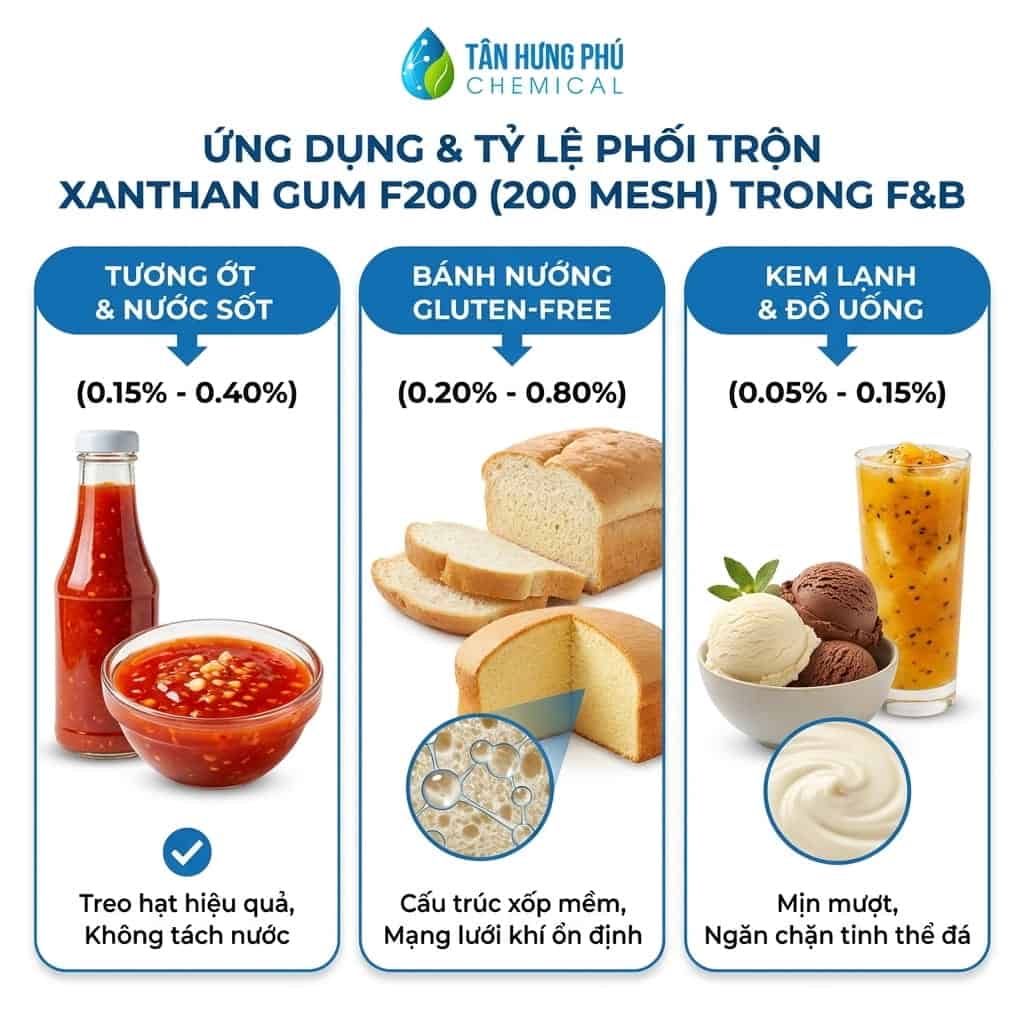
3.1. Xanthan Gum in Chili Sauce, Ketchup, Salad Dressings & Dipping Sauces (0.15% – 0.40%)
In commercial chili sauce production, relying solely on modified starch for body often leads to starch retrogradation after 1 – 2 months of storage or refrigeration, expelling free liquid as an unsightly clear layer at the bottle neck (syneresis). Incorporating 0.15% – 0.40% xanthan gum in chili sauce (1.5 – 4.0 g/kg sauce) binds free water tightly, prevents oil-water separation in salad dressings/mayonnaise, suspends chili and garlic bits evenly throughout the bottle, and imparts a glossy, appetizing appearance.
3.2. Xanthan Gum in Gluten-Free Baked Goods (0.20% – 0.80%)
Gluten-free flours (rice flour, corn flour, almond flour, tapioca starch) lack an elastic gluten protein network to trap leavening CO2 gas, causing gluten-free breads and cakes to collapse, turn dense, or dry out and crumble rapidly. Using xanthan gum in baking acts as a “gluten network substitute” that binds flour particles, retains CO2 for better loaf volume, keeps crumb moisture soft for days, and improves clean slicing without crumbling (Cookies: 0.2% – 0.3%; Sponge cakes/Muffins: 0.3% – 0.5%; Gluten-free bread/Pizza crust: 0.6% – 0.8% on dry flour weight).
3.3. Xanthan Gum Powder in Ice Cream & Plant-Based Milks / Beverages (0.05% – 0.15%)
In ice cream, gelato, and sorbet manufacturing, adding 0.05% – 0.15% xanthan gum powder (often paired with Guar Gum or Carrageenan) immobilizes free water and inhibits coarse ice crystal growth during freezer temperature fluctuations, producing a smooth, creamy body, slower melt-down, and stable overrun. In fruit pulp drinks and plant-based milks, E415 suspends pulp or cocoa evenly from top to bottom without heavy gumminess.
4. Lumping-Free (“Fish-Eye”) Xanthan Gum F200 Dispersion Guide & Dosage Chart
| Food & Beverage Product Category | Recommended Rate (% w/w) | Dosage (g / kg finished product) | Primary Function of F200 |
|---|---|---|---|
| Chili Sauce, Ketchup, Salad Dressings, Mayonnaise, Dipping Sauces | 0.15% – 0.40% | 1.5 – 4.0 g / kg sauce | Glossy thickening, suspends chili/garlic bits, prevents syneresis & oil separation. |
| Gluten-Free Breads, Cakes & Cookies | 0.20% – 0.80% | 2.0 – 8.0 g / kg dry flour | Replaces gluten network to trap CO2 for volume & prevent crumbling. |
| Ice Cream, Plant-Based Milks & Pulp Beverages | 0.05% – 0.15% | 0.5 – 1.5 g / kg product | Inhibits ice crystals in ice cream, suspends fruit pulp & rounds mouthfeel. |
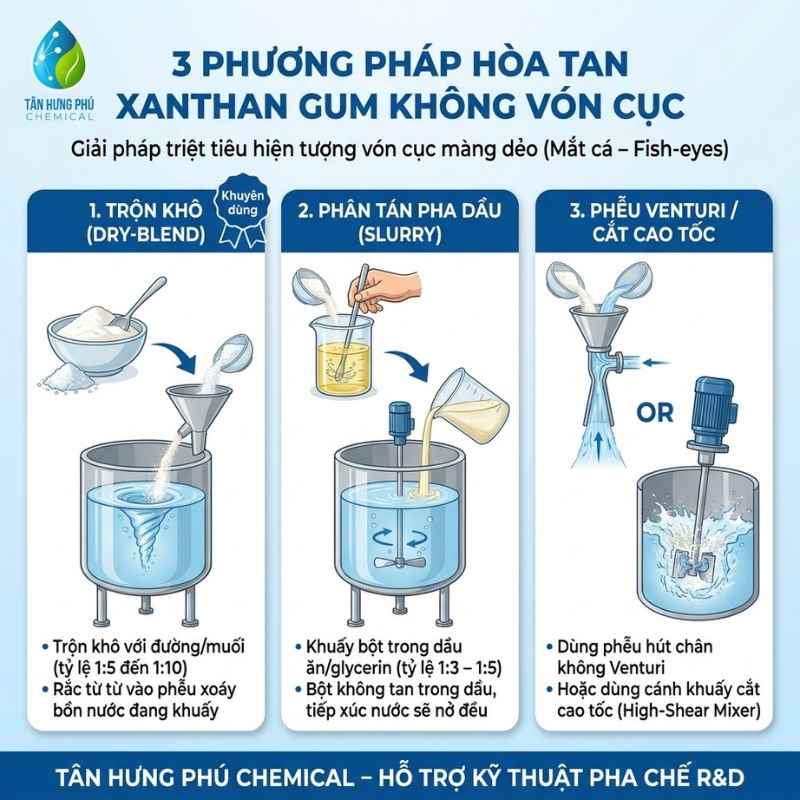
Because Xanthan Gum F200 has a 75-micron particle size that hydrates rapidly, never dump a clump of powder straight into slowly stirred water (which forms a hydrated gel skin trapping dry powder inside, known as “fish-eye” lumps). Use one of three standard R&D dispersion methods:
• Method 1 – Dry Carrier Blending: Thoroughly dry-blend Xanthan Gum F200 powder with granulated sugar, fine salt, or dry seasoning spices from your recipe (minimum ratio of 1 part gum : 5 – 10 parts sugar/salt), then sift slowly into a high-agitation water vortex.
• Method 2 – Non-Aqueous Slurry (Oil / Glycerin): Disperse the gum powder into a portion of vegetable oil or food-grade glycerin (1 part gum : 3 – 5 parts oil/glycerin) until particles separate evenly, then stir into the agitated aqueous tank.
• Method 3 – Venturi Eductor / High-Shear Mixer: Feed through a high-velocity eductor or high-shear mixer to wet out individual particles cleanly on large production lines.
*Floor Slip & Dust Safety Note: Spilled Xanthan Gum powder mixed with water creates an extreme slip hazard on plant floors; always sweep or vacuum dry powder up first before wet mopping. Operators weighing 200 Mesh powder should wear fine-particulate dust masks to avoid respiratory irritation.
5. Where to Buy Xanthan Gum? 25kg Carton Xanthan Gum F200 (Code THP45) at Tan Hung Phu
If your procurement and R&D teams are looking for where to buy xanthan gum with verified 200 Mesh Food Grade quality in sealed factory packaging (meeting FCC / JECFA / EU E415 specifications), Tan Hung Phu Chemical’s food ingredients division is a reliable B2B supplier in Ho Chi Minh City:
View Official Product Page (Code: THP45): Xanthan Gum F200 (Food Additive INS 415 / E415 – 200 Mesh) – 25kg Carton (Code: THP45)
When ordering 25kg cartons of Xanthan Gum F200 (25 kg Net cartons with moisture-barrier PE inner liners) from Tan Hung Phu, every batch comes with original Certificates of Analysis (COA), Safety Data Sheets (MSDS), valid Vietnamese Food Safety Self-Declaration dossiers, Kosher/Halal certifications, and VAT invoices. Alongside Xanthan Gum F200 (THP45), sauce, beverage, and bakery plants can consolidate orders with complementary ingredients such as Food-Grade Acetic Acid E260 (Codes THP6, THP47), Citric Acid E330 (Code THP18), Potassium Sorbate E202 (Code THP19), Carrageenan E407 (Code THP2), and Dextrose Monohydrate (Code THP20) via our food ingredients catalog.
REQUEST WHOLESALE XANTHAN GUM F200 QUOTES (25KG CARTON – CODE THP45) & R&D SAMPLES
To receive our best wholesale pricing when ordering 25kg cartons of Xanthan Gum F200 (Code: THP45) complete with COA, MSDS, and Food Safety Self-Declaration documents, please contact Tan Hung Phu’s B2B sales team:
Tan Hung Phu Chemical Co., Ltd. (THP Chemical)
• Technical Consultation & Wholesale Hotline / Zalo: +84 913 711 647
• RFQ Email: tanhungphu@thpchemical.com
• Office & Warehouse: 878B Ta Quang Buu, Binh Dong Ward, Ho Chi Minh City & regional transit hubs (Fast nationwide delivery via dedicated trucks and containers).
6. Frequently Asked Questions About Xanthan Gum F200 Powder (FAQ)
What is Xanthan Gum powder and why is the F200 (200 Mesh) grade preferred?
Xanthan gum powder (additive E415) is a bio-fermented thickener produced from sugar fermentation by Xanthomonas campestris. The Xanthan Gum F200 grade features an ultra-fine 200 Mesh (≤ 75 microns) particle size that hydrates and builds viscosity in cold water faster than 80 Mesh grades, making it ideal for chili sauces, condiments, and instant seasoning mixes.
How many grams per kg of Xanthan Gum should be used in chili sauce to prevent separation and syneresis?
When formulating xanthan gum in chili sauce, ketchup, and salad dressings (often paired with modified starch), standard R&D usage is 0.15% – 0.40% (1.5 – 4.0 grams per 1 kg of finished sauce). This keeps chili sauce glossy and thick, suspends chili and garlic particulates evenly, and minimizes bottle-neck syneresis.
What benefits do food manufacturers gain from blending Guar Gum and Xanthan Gum?
Blending Guar Gum and Xanthan Gum (typically at a 70:30 or 80:20 Guar Gum : Xanthan Gum ratio) produces a synergistic viscosity boost well above either gum used individually, allowing food plants to maintain shear-thinning anti-separation stability while cutting total thickener costs by 20% – 30%.
What dosage rates apply to Xanthan Gum in gluten-free baking and ice cream?
For xanthan gum in gluten-free baking (replacing the gluten network to trap CO2), standard usage is 0.2% – 0.8% on dry flour weight (2 – 8 g/kg flour). For xanthan gum powder in ice cream to inhibit ice crystals and improve creaminess and melt resistance, just 0.05% – 0.15% (0.5 – 1.5 g/kg mix) is typically needed.
How do I dissolve Xanthan Gum F200 in water without forming “fish-eye” lumps?
Following standard xanthan gum usage guidelines, dry-blend the gum powder with sugar or salt at a 1:5 to 1:10 ratio (or disperse it into vegetable oil or glycerin at 1:3 – 1:5) before sifting slowly into a vigorously stirred water vortex so it hydrates uniformly without lumping.
Where can I buy reliable Xanthan Gum F200 in 25kg cartons in Ho Chi Minh City?
Manufacturers seeking authentic Xanthan Gum F200 in 25kg cartons can order directly from Tan Hung Phu Chemical Co., Ltd. (Code: THP45). Ready stock in Ho Chi Minh City includes full COA, MSDS, Kosher/Halal certificates, and Food Safety Self-Declaration dossiers; contact Hotline/Zalo at +84 913 711 647 for wholesale pricing and R&D samples.
7. References & International Food Safety Standards
Viscosity specifications, thermal viscosity ratios (V1/V2), hydrocolloid synergy, and food safety evaluations for Food Additive E415 / INS 415 in this article are referenced from recognized international authorities:
- Joint FAO/WHO Expert Committee on Food Additives (JECFA): WHO / JECFA Database – Evaluations & Specifications for Xanthan Gum (INS 415, CAS 11138-66-2) – Safety evaluation with ADI “Not specified” under Good Manufacturing Practice (GMP).
- US Food and Drug Administration (U.S. FDA): 21 CFR § 172.695 – Xanthan Gum – Specifications for pyruvic acid (≥ 1.5%), thermal viscosity ratio V1/V2 at 24°C/65°C (1.02 – 1.45), and food stabilizing/thickening functions.
- European Food Safety Authority (EFSA): Re-evaluation of Xanthan Gum (E 415) as a Food Additive – EFSA Journal (2017).
- Vietnamese Food Additive Regulations: Ministry of Health Circular No. 24/2019/TT-BYT (and Amending Circular No. 17/2023/TT-BYT) on the management and use of food additives (INS 415 permitted under GMP except where specific restrictions apply).
Conclusion: Through this technical breakdown, readers and R&D engineers now have a clear grasp of what xanthan gum is and what xanthan gum powder is, as well as why Xanthan Gum F200 (additive E415 – 200 Mesh) remains a go-to xanthan gum food additive for thickening chili sauces, preventing sauce separation, replacing gluten structure in baked goods, and inhibiting ice crystals in ice cream. Sourcing officially imported 25kg cartons of Xanthan Gum F200 (Code: THP45) with full COA, MSDS, and Food Safety Self-Declaration records from Tan Hung Phu Chemical helps food plants stabilize sensory quality and optimize production costs.
Technical Disclaimer: Viscosity figures and formulation dosage rates presented in this article serve as technical guidance per FDA/JECFA standards under laboratory conditions (25°C). Operators must strictly distinguish Food-Grade Xanthan Gum (F200 – INS 415) covered by Food Safety Self-Declaration records from Industrial / Oil Drilling Grade xanthan gum. Per EFSA and FDA guidance, do not use xanthan gum to thicken milk or food products for infants under 12 weeks of age or preterm infants unless specifically directed by a clinician. R&D and QA teams should verify batch-specific COA documents and run bench trials on actual formulations prior to full-scale production.

