
News & Event
What Is SLES? Understanding Sodium Laureth Sulfate (SLES 70 / Texapon N70)
Compiled by the Tan Hung Phu Technical Team · Updated:
From nourishing shampoos, gentle foaming body washes, and hand soaps to dishwashing liquids and concentrated laundry detergents in every household, SLES (short for Sodium Laureth Sulfate or Sodium Lauryl Ether Sulfate, commercially standardized as SLES 70) consistently serves as the primary foundational surfactant by formulation weight. When exploring what SLES is or what kind of substance SLES is from an R&D perspective, manufacturing plants must master its ethoxylation mechanism (standard 2EO) delivering superior skin mildness, its exceptional hard water tolerance, the salt thickening curve (Salt Curve), and standard dilution protocols to prevent clumping in the hexagonal gel phase.
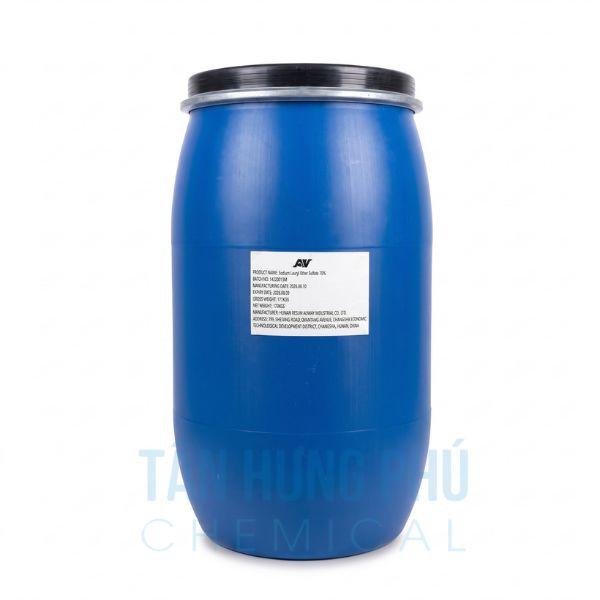
Quick Summary
- Chemical Identity: SLES 70% is Sodium Laureth Sulfate (standard 2EO, chemical formula CH3(CH2)11(OCH2CH2)2OSO3Na, CAS 68585-34-2 / 9004-82-4 / 68891-38-3), with an active matter content of 70.0% ± 2.0% in viscous paste form.
- 3 Key Advantages of the Ethoxylate Group: Significantly gentler on skin and eyes compared to SLS; outstanding tolerance to hard water (Ca2+, Mg2+) without foam collapse; and powerful viscosity response to table salt (NaCl, 0.5% – 2.5%) through the formation of worm-like micelles (Salt Curve).
- Core Applications: Shampoos, body washes, liquid hand soaps (8% – 18%); dishwashing detergents formulated with LAS (4% – 12%); concentrated liquid laundry detergents and touchless snow-foam car wash detergents (6% – 15%).
- Clump-Free Dilution Technique: Always add SLES 70% paste gradually into a tank containing 70% – 80% warm water (40°C – 50°C) under low-speed agitation (30 – 60 rpm) to bypass the hexagonal gel phase (35% – 55%), adding NaCl salt only as the final step.
Table of Contents:
- 1. What is SLES? Chemical Nature of Sodium Laureth Sulfate (SLES 70% – 2EO) & Technical Specifications
- 2. Three Key Advantages of the Ethoxylate Group: Mildness, Hard Water Resistance & NaCl Salt Thickening
- 3. Detailed SLES vs. SLS Comparison Across 5 Technical Criteria
- 4. Practical Applications (Cosmetics, Dishwashing Liquid, Laundry Detergent) & Clump-Free Dilution Guide
- 5. SLES 70 in 170kg Drum Packaging (Code THP53) & B2B Wholesale Pricing at Tan Hung Phu
- 6. Frequently Asked Questions about SLES 70% (FAQ)
- 7. References & International Standards
1. What is SLES? Chemical Nature of Sodium Laureth Sulfate (SLES 70% – 2EO) & Technical Specifications
To clearly define what SLES is (or what kind of substance SLES is): SLES stands for Sodium Laureth Sulfate (full chemical name: Sodium Lauryl Ether Sulfate), an extremely common anionic surfactant with the general formula CH3(CH2)11(OCH2CH2)nOSO3Na (where the average ethoxylation degree is n = 2 for standard commercial SLES 2EO grades; CAS numbers: 68585-34-2 / 9004-82-4 / 68891-38-3).
The critical distinction in synthesizing SLES is that prior to sulfation with SO3 gas and neutralization with Caustic Soda (NaOH), natural lauryl fatty alcohol (derived from coconut oil or palm kernel oil) undergoes an Ethoxylation reaction. This reaction inserts an Ethylene Oxide (–OCH2CH2–)n oligomer chain between the hydrophobic alkyl tail and the hydrophilic sulfate head group. This ethoxylation step delivers a significant upgrade in mildness, skin compatibility, and aqueous solubility compared to SLS.
Technical Significance of Commercial Grade SLES 70% (2EO) in Industrial Manufacturing
In the global chemical market, SLES 70 (70% active matter, 2 moles of Ethylene Oxide) is the most preferred commercial standard for two fundamental physicochemical reasons: First, at 2EO, the molecule achieves the optimal balance between dense foam generation, cutaneous mildness, and high salt-thickening responsiveness with table salt (increasing to 3EO results in lower foam volume and greater difficulty in thickening). Second, at 70% active concentration, SLES exists in a pliable Lamellar liquid crystalline phase that can be readily scooped or pumped, possesses intrinsic microbial self-preservation due to high osmotic pressure, and minimizes shipping costs and storage footprint compared to purchasing diluted 28% solutions (which consist of 72% water).
| Physicochemical & Safety Parameter (Test Item) | Standard Specification of SLES 70% (Product Code: THP53) |
|---|---|
| INCI / Chemical Name & Formula | Sodium Laureth Sulfate (SLES 2EO) – CH3(CH2)11(OCH2CH2)2OSO3Na |
| CAS Numbers & Appearance | CAS: 68585-34-2 / 9004-82-4 / 68891-38-3 | White to light yellowish translucent paste / gel |
| Active Matter Content | 70.0% ± 2.0% (68.0% – 72.0%) |
| Unsulfated Matter | ≤ 2.0% – 2.5% Max |
| Sodium Sulfate (Na2SO4) & Color (Klett 5%) | Na2SO4: ≤ 1.0% – 1.5% Max | Klett Color (5% Active): ≤ 10 – 15 Max |
| pH Value (1% – 2% aq. sol. at 25°C) | 7.0 – 9.5 (Neutral to mildly alkaline; skin-compatible upon formulation) |
| 1,4-Dioxane Impurity Control | Strictly vacuum-stripped per batch COA (≤ 10 – 30 ppm for cosmetic grade; ≤ 50 ppm for detergent grade) |
| Packaging & Shelf Life | 170 kg Net plastic drum (hermetically sealed) | Standard shelf life: 24 months |
2. Three Key Advantages of the Ethoxylate Group: Mildness, Hard Water Resistance & NaCl Salt Thickening
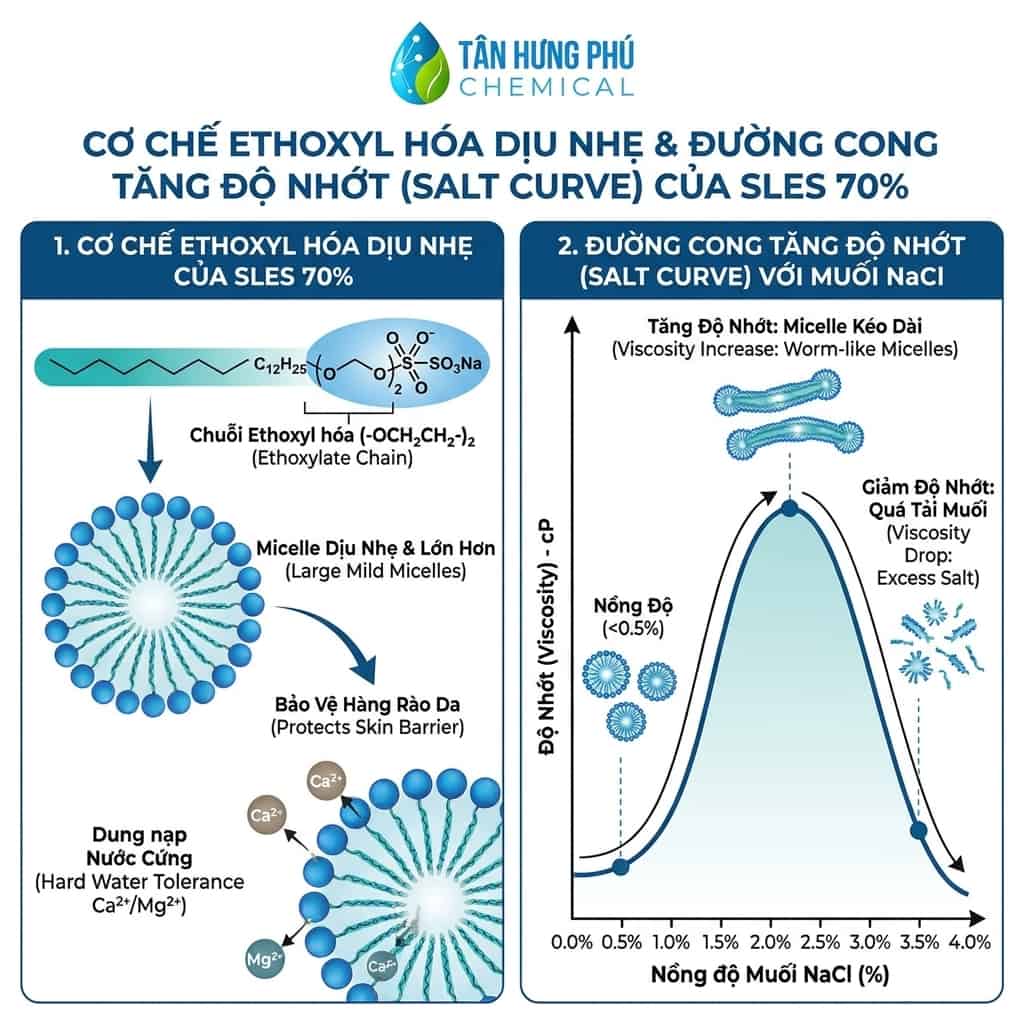
- 1. Superior Mildness on Skin & Ocular Mucosa vs. SLS: The insertion of the ethoxylate chain (–OCH2CH2–)n expands the geometric volume of the hydrophilic head group, lowers surface charge density, and enlarges the spherical micelle diameter. Consequently, SLES surfactant minimizes penetration into the stratum corneum, reducing lipid dissolution and protein denaturation. It delivers a rich, creamy lather while dramatically decreasing dryness, flaking, or stinging sensations compared to SLS.
- 2. Outstanding Hard Water Tolerance (Ca2+, Mg2+): The ether oxygen atoms within the ethoxylate chain help stabilize the hydration shell around the surfactant monomer, forming calcium and magnesium salts that retain strong aqueous solubility. As a result, SLES 70 resists lime soap precipitation and foam collapse when formulated with municipal tap water or deep well water containing high levels of calcium and magnesium hardness.
- 3. SLES Viscosity Building via NaCl (The Salt Curve Effect): This property enables personal care and dishwashing liquid manufacturers to substantially cut costs on synthetic thickeners. In plain water, negatively charged spherical SLES micelles repel one another, resulting in low solution viscosity. When incremental amounts of pure vacuum table salt NaCl (0.5% – 2.5%) are introduced—especially in the presence of 2% – 4% secondary surfactants like CAPB or CDEA—Na+ counterions screen the electrostatic repulsion. This drives spherical micelles to transition and entangle into elongated worm-like / cylindrical micelles (Worm-like Micelles), causing viscosity to surge into a rich, silky gel. (R&D Advisory: A Salt Curve must be empirically determined for each formula; adding salt past the peak threshold of > 3.5% – 4.0% leads to micelle branching and structural collapse, resulting in a sudden drop in viscosity and phase clouding).
3. Detailed SLES vs. SLS Comparison Across 5 Technical Criteria
To assist R&D and procurement teams in accurately determining when to select SLES (Code THP53) versus SLS (Code THP54), the SLES vs. SLS comparison table below outlines 5 core technical parameters:
| Evaluation Criteria | SLES 70% (Sodium Laureth Sulfate) (Product Code: THP53 – SLES 2EO) |
SLS 92% – 95% (Sodium Lauryl Sulfate) (Product Code: THP54 – K12 Needles / Powder) |
|---|---|---|
| 1. Physical State & Packaging | Viscous gel/paste, translucent white to pale yellow – 170 kg plastic drums. | Solid (Needles or fine powder), off-white – 25 kg bags. |
| 2. Active Matter Content | 70.0% ± 2.0% (Contains 2EO ethoxylate chain). | ≥ 92.0% – 95.0% Min (Non-ethoxylated). |
| 3. Skin & Eye Irritation Potential | Low (Significantly gentler): Low skin drying tendency; non-stripping on hands during frequent manual dishwashing. | Higher: Intense degreasing power; prone to inducing cutaneous dryness if used at high concentrations in leave-on or prolonged-contact formulas. |
| 4. Hard Water Tolerance & Salt Thickening | Excellent: Maintains persistent foam in hard water; highly responsive to NaCl thickening (0.5% – 2.5%). | Moderate: Foam reduction in highly hard water; poor viscosity build with NaCl salt alone. |
| 5. Primary Applications | Aqueous liquid formats: Shampoos, body washes, dishwashing liquids, heavy-duty laundry liquids, floor cleaners, snow-foam car washes. | Dry/paste formats & industrial: Toothpastes, powdered laundry detergents, bath bombs, lightweight concrete air-entrainment, latex emulsion polymerization. |
4. Practical Applications (Cosmetics, Dishwashing Liquid, Laundry Detergent) & Clump-Free Dilution Guide
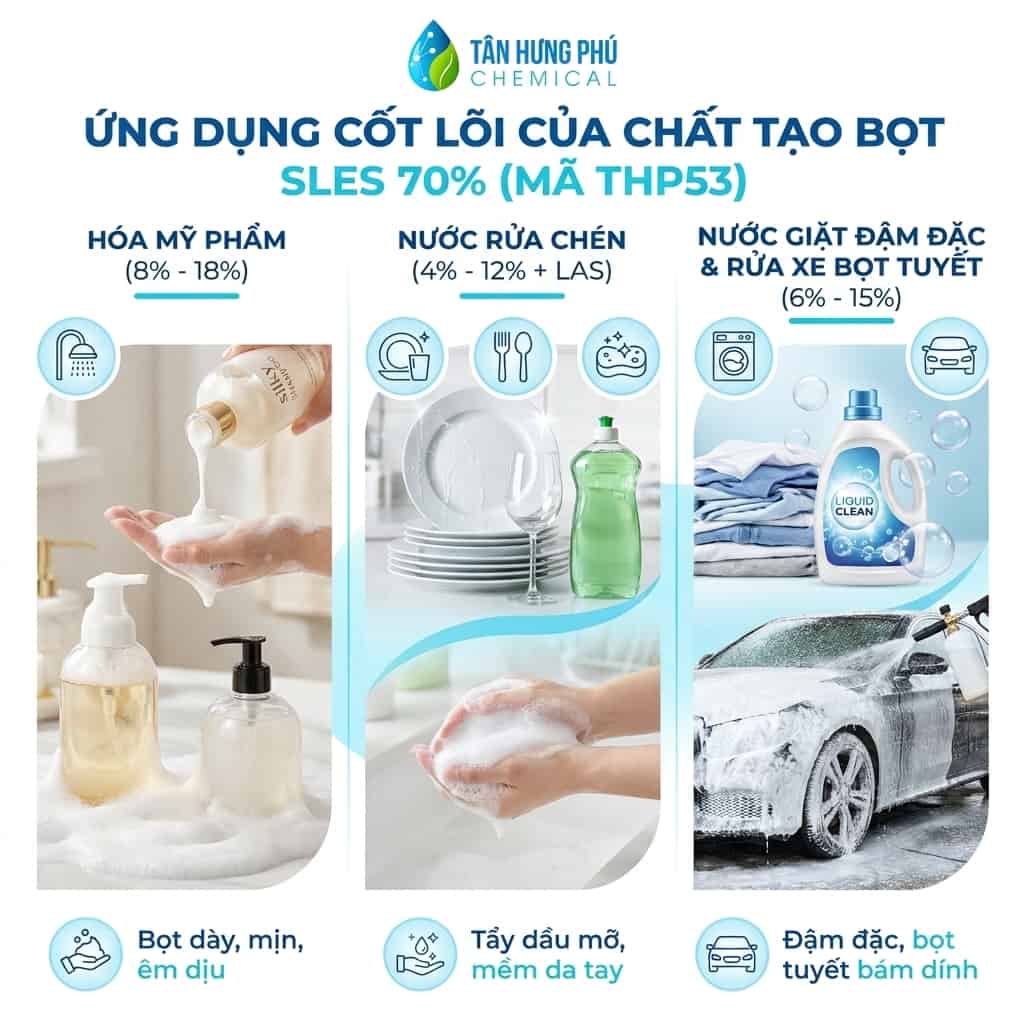
4.1. Practical Use of SLES Across Cosmetics, Dishwashing Liquids, and Laundry Detergents
- SLES in Cosmetics & Personal Care (Dosage: 8% – 18% SLES 70%): Acts as the primary surfactant in hair shampoos, body washes, liquid hand soaps, and facial cleansers (ensure cosmetic-grade quality with strict control over 1,4-Dioxane, heavy metals, and bioburden per Circular 06/2011/TT-BYT). When combined with Cocamidopropyl Betaine (CAPB 3% – 5%), moisturizing Glycerin (Product Code THP51), and NaCl salt, the base creates rich, creamy lather that gently purifies the scalp and skin while rinsing cleanly.
- SLES in Dishwashing Detergents (Dosage: 4% – 12% SLES 70%): In manual dishwashing formulation, the industry-standard benchmark pairs SLES 70% with LAS Acid (Linear Alkylbenzene Sulfonic Acid, neutralized with Caustic Soda NaOH to pH ~ 7) at a ratio of approximately 1 part SLES to 2 – 3 parts LAS. While LAS delivers powerful, low-cost grease cutting, SLES boosts hand mildness, generates flash foam, prevents lather suppression in hard water, and produces an appealing, clear gel texture upon salt addition.
- SLES in Concentrated Laundry Liquids & Industrial Cleaning (Dosage: 6% – 15%): In liquid laundry detergent manufacturing, hard surface floor cleaners, and touchless snow-foam vehicle washes, SLES works synergistically with nonionic surfactants (NP-9 / AEO-9) to emulsify oil, road grime, and particulate soil without causing fabric fading or damaging automotive clear coats.
4.2. R&D Guide: How to Dilute SLES 70 Paste Without Clumping (Overcoming the Hexagonal Gel Phase)
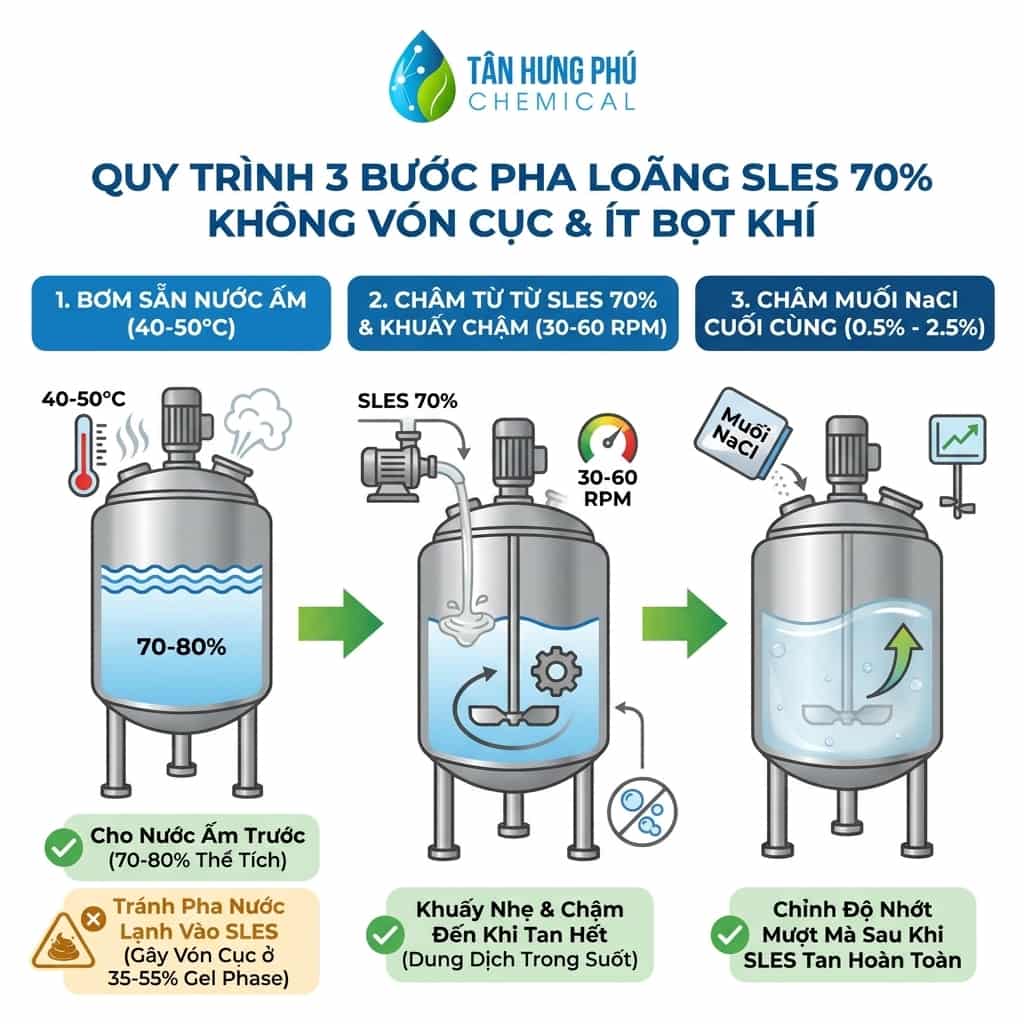
• The Hexagonal Gel Locking Phenomenon: Undiluted SLES 70% in drums exists in the relatively mobile lamellar phase. If water is poured directly on top of SLES 70%, locally dropping the surfactant concentration into the 35% – 55% range, SLES instantly shifts into the Hexagonal Gel Phase. This creates a rubber-like, highly intractable gel mass that binds to impeller blades and dissolves very slowly.
• Preventing Autohydrolysis & Incompatibilities: Avoid prolonged heating above 50°C – 60°C or exposure to strongly acidic conditions (< pH 4.5), which catalyze the self-hydrolysis of the alkyl sulfate ester bond (leading to pH drops and batch spoiling); never mix directly with cationic surfactants (which cause immediate precipitation and phase hazing).
• PPE & Storage Safety (H318, H315, H412): Concentrated SLES 70% causes serious eye damage and skin irritation; operators must wear safety goggles and chemical-resistant gloves during transfer. Do not discharge concentrated washings directly into natural watercourses. Keep drum bungs tightly sealed to prevent surface skinning, and avoid unpreserved standing dilutions below 30% active matter (which are vulnerable to rapid microbial contamination).
To completely avoid clumping and gel-locking, processing plants should adhere to this standardized 3-step SLES 70 dilution method:
- Step 1 – Pre-charge the vessel with warm water (40°C – 50°C): Charge 70% – 80% of the batch's total formulated water into the mixing tank. Maintaining the water temperature at 40°C – 50°C speeds up dissolution threefold and ensures the surfactant concentration stays below 28%, completely bypassing the hexagonal gel zone.
- Step 2 – Slowly charge SLES 70% under low-shear mixing: Gradually feed the SLES 70 paste into the warm water with the agitator running at low speed (30 – 60 rpm). This achieves clear, homogeneous dissolution without entraining excessive air bubbles into the bulk product. Maintain finished batch pH steadily within 5.5 – 8.0.
- Step 3 – Add table salt (NaCl) only in the final processing step: Never dissolve salt in the water prior to full SLES solubilization (Na+ counterions will immediately lock up the SLES paste). Pre-dissolve NaCl into a clean brine solution and titrate it slowly into the tank only after SLES, secondary surfactants, fragrances, and preservatives have achieved complete clarity and homogeneity.
5. SLES 70 in 170kg Drum Packaging (Code THP53) & B2B Wholesale Pricing at Tan Hung Phu
To ensure a reliable, steady supply chain for contract manufacturers (OEM/ODM) of cosmetics, dishwashing detergents, laundry liquids, and industrial cleaners, Tan Hung Phu Chemical Co., Ltd. (THP Chemical) imports and stocks bulk quantities of SLES 70 in 170kg drums meeting international manufacturing standards:
View Product Details (Product Code: THP53): SLES 70% Foaming Surfactant (Sodium Laureth Sulfate) – Raw Material for Detergents & Cosmetics – 170kg Drum (Code: THP53)
When sourcing SLES 70 from Tan Hung Phu, clients receive transparent tiered wholesale pricing for SLES 70 scaled to drum counts, pallet loads, or full container loads (FCL). We guarantee active matter content at 70.0% ± 2.0%, compliant 1,4-Dioxane limits, and full documentation including original manufacturer COA, 16-section SDS, and VAT invoices. Alongside SLES 70% (THP53), manufacturers can procure a comprehensive raw material bundle including SLS 92% K12 Needles (Code THP54), Glycerin 99.7% USP (Code THP51), Propylene Glycol USP (Code THP52), Caustic Soda Flakes NaOH 98%–99% (Codes THP12, THP9), and Citric Acid pH adjuster (Code THP18) in our product directory.
REQUEST B2B WHOLESALE QUOTE FOR SLES 70% IN 170KG DRUMS (CODE THP53) PER DRUM / CONTAINER (WITH COA & SDS)
To obtain the latest SLES 70 pricing (packaging: 170kg drum – Product Code: THP53) along with full COA, SDS, and technical R&D sample support for your personal care, dishwashing, or laundry detergent facility, please contact our B2B commercial department:
Tan Hung Phu Chemical Co., Ltd. (THP Chemical)
• Technical Support & Wholesale Hotline / Zalo: 0913 711 647
• Request for Quote (RFQ) Email: tanhungphu@thpchemical.com
• Headquarters & Warehouse: 878B Ta Quang Buu Street, Binh Dong Ward, Ho Chi Minh City & regional transit hubs (Prompt nationwide delivery via dedicated truck fleet and container logistics).
6. Frequently Asked Questions about SLES 70% – Sodium Laureth Sulfate (FAQ)
Why is commercial SLES standardly supplied at 70% (2EO) rather than 50% or 100%?
In the phase diagram of Sodium Laureth Sulfate, the 35% – 55% concentration range forms a rigid hexagonal gel phase that is virtually impossible to pump, handle, or dissolve. A 28% concentration contains excessive water, significantly increasing transport and handling overhead. Conversely, at 70% (SLES 70), the surfactant exists in a flowable, pliable lamellar liquid crystalline phase that optimizes freight costs while allowing straightforward scooping and pumping during manufacturing.
Why is SLES significantly gentler on skin and eyes compared to SLS in cosmetic formulations?
When comparing SLES and SLS, the key difference lies in the ethoxylation process of SLES (incorporating two –OCH2CH2– units). This ethoxylate linkage increases the steric bulk of the hydrophilic head group and enlarges the micellar radius. Consequently, SLES in cosmetics is less able to penetrate the epidermal lipid barrier, significantly reducing the risks of skin dryness, scalp irritation, or ocular stinging.
How can SLES viscosity be increased with NaCl salt without causing the system to thin out again?
To build viscosity with NaCl salt effectively, ensure that SLES 70% (and secondary foam boosters such as CAPB and CDEA) are fully dissolved first. Then, titrate a clean NaCl brine into the batch at a final level of 0.5% – 2.5%, verifying viscosity after each 0.2% increment. Never add excessive salt beyond the peak of the Salt Curve (> 3.5% – 4.0%), as this disrupts the cylindrical micellar network and causes an irreversible drop in viscosity accompanied by haze.
What is the best procedure to dilute SLES 70 paste without clumping or excessive foam generation?
According to standard technical SLES 70 dilution protocols: Always charge 70% – 80% of warm water (40°C – 50°C) into the mixing tank before gradually feeding in the SLES 70% paste, keeping the agitator operating at low shear (30 – 60 rpm). This sequence successfully bypasses the hexagonal gel region (35% – 55%), yielding a transparent, uniform solution without unmixed lumps or excessive micro-aeration.
Is the 1,4-Dioxane byproduct in SLES 70% a significant concern?
During the ethoxylation and sulfation stages of SLES manufacturing, trace amounts of 1,4-Dioxane may form. However, genuine SLES 70 supplied by Tan Hung Phu (Code THP53) undergoes rigorous vacuum stripping to control 1,4-Dioxane at trace residual levels verified on every batch COA (≤ 10 – 30 ppm for cosmetic grade; ≤ 50 ppm for detergent grade), ensuring finished formulations comply with domestic standards and strict international export limits.
What is the wholesale price for SLES 70 in 170kg drums (Code THP53) and where can it be sourced reliably in Ho Chi Minh City?
The wholesale price of SLES 70 varies based on the purity grade (cosmetic grade vs. industrial detergent grade) and the total order volume (by drum, pallet, or full container load). Enterprises looking to buy authentic SLES 70 in stock in Ho Chi Minh City with complete COA and SDS documentation are invited to contact Tan Hung Phu Chemical directly via Hotline/Zalo at 0913 711 647.
7. References & International Standards
The physicochemical specifications, Salt Curve kinetics, hexagonal gel phase data, and cosmetic safety evaluations for Sodium Laureth Sulfate discussed in this article are referenced from authoritative scientific bodies:
- National Center for Biotechnology Information (PubChem – NCBI): PubChem Compound Summary for CID 23665884: Sodium Laureth Sulfate (SLES 2EO – CAS 68585-34-2 / 9004-82-4).
- Cosmetic Ingredient Review (CIR): Final Report of the Safety Assessment of Sodium Laureth Sulfate and Related Ethoxylated Sulfates (International Journal of Toxicology, 2010, Vol. 29(4 Suppl), pp. 151S–161S) – Confirming higher mildness over SLS and recommending controls for 1,4-Dioxane.
- European Chemicals Agency (ECHA): ECHA Substance Information – Alcohols, C12-14, ethoxylated, sulfates, sodium salts (CAS 68891-38-3, EC 500-234-8) – Data on rapid biodegradability, GHS classification, and environmental safety.
- Cosmetic Management Regulations in Vietnam: Circular No. 06/2011/TT-BYT of the Ministry of Health on the management of cosmetics (harmonized with the ASEAN Cosmetic Directive).
Summary: Through this comprehensive technical guide, R&D chemists and plant managers can gain a thorough understanding of what SLES is, what kind of substance SLES is, and the entire physicochemical profile of Sodium Laureth Sulfate (SLES 70). Thanks to its skin-mild ethoxylate backbone, superior hard water tolerance, and cost-effective salt-thickening capability, selecting genuine SLES in 170kg drums (Product Code: THP53) backed by comprehensive COA and SDS documentation from Tan Hung Phu Chemical provides a solid foundation for optimizing shampoos, body washes, dishwashing liquids, and concentrated laundry detergents.
Technical Disclaimer: Physicochemical parameters, blending ratios, and salt curve characteristics described herein serve as technical guidelines under standard conditions (25°C). Manufacturers must clearly distinguish between Cosmetic Grade (strictly controlled for 1,4-Dioxane, heavy metals, and microbiological criteria per domestic standards or specific export limits, such as ≤ 1 ppm 1,4-Dioxane in finished cosmetics across select US states) and Industrial Detergent Grade. Before commercial-scale production, R&D/QC teams must review batch-specific COAs and SDSs and perform benchtop Salt Curve trials tailored to their proprietary formulations.
Other News
View detail- What Is SLS (Sodium Lauryl Sulfate)? Properties, Purity & Industrial Uses
- Citric Acid E330 vs Acetic Acid E260: Which Food Acidulant Is Best?
- What Is SDIC 60% (Sodium Dichloroisocyanurate)? Why Do SDIC 60 & SDIC 56 Dissolve 100% Scale-Free?
- Marcel Carrageenan (E407 Philippines): Texturizer for Sausages, Meat, Jelly & Dairy

