
News & Event
What Is SLS (Sodium Lauryl Sulfate)? Molecular Structure & Cleansing Power
Compiled by Tan Hung Phu Technical Team · Updated:
Why can’t pure water wash away grease on mechanical parts or sebum on skin, yet adding a small dose of Sodium Lauryl Sulfate (abbreviated as SLS; known in biochemistry as Sodium Dodecyl Sulfate – SDS) immediately dislodges and rinses away hydrophobic grime? The answer lies in the amphiphilic molecular design of SLS (molecular formula C12H25NaO4S, CAS No.: 151-21-3). This technical article breaks down the molecular structure, key interfacial constants (CMC, HLB, Krafft point), and 4-step cleansing and foaming mechanism of SLS across cosmetics, detergents, and industrial applications.
Quick Summary
- Identity & Molecular Structure: Sodium Lauryl Sulfate (SLS) and Sodium Dodecyl Sulfate (SDS) refer to the exact same compound C12H25NaO4S (MW = 288.38 g/mol, CAS 151-21-3, UN 1325 – Class 4.1), comprising a 12-carbon hydrophobic tail (–C12H25) bonded to a negatively charged hydrophilic sulfate head (–OSO3−Na+).
- Standard Interfacial Constants (pure water, 25°C): Hydrophilic-Lipophilic Balance HLB ≈ 40 (Davies scale), Krafft point ~16°C, Critical Micelle Concentration CMC = 8.2 mM (~2.36 g/L), and micelle aggregation number Nagg ≈ 62.
- 4-Step Cleansing Mechanism: (1) Lowers water surface tension from 72 down to ~35 – 39 mN/m; (2) Detaches oil via the Roll-up mechanism; (3) Forms negatively charged spherical micelles that repel one another to prevent soil redeposition; (4) Generates dense, stable foam to lift and rinse away particulates.
- Grades & Compatibility: Available in SLS 92% and SLS 95% across Needle (dust-free) and Powder morphologies; never co-mix directly with cationic surfactants (causes precipitation) and control dust explosion risks when handling fine powder.
Table of Contents:
- 1. What Is Sodium Lauryl Sulfate (SLS)? Relationship With Sodium Dodecyl Sulfate (SDS)
- 2. Molecular Structure Analysis of SLS (C12H25NaO4S) – Why Is the 12-Carbon Chain Optimal?
- 3. 4-Step Cleansing Mechanism of SLS: Wetting, Roll-Up Detachment, Micellization & Foaming
- 4. Practical Applications & Technical Comparison Table (SLS 92 vs. SLS 95, Powder vs. Needle)
- 5. Where to Buy SLS? 25kg Bag Sodium Lauryl Sulfate Pricing (Code THP54) at Tan Hung Phu
- 6. Frequently Asked Questions About Sodium Lauryl Sulfate – SLS (FAQ)
- 7. References & International Scientific Databases
1. What Is Sodium Lauryl Sulfate (SLS)? Relationship With Sodium Dodecyl Sulfate (SDS)
Chemically, Sodium Lauryl Sulfate (abbreviated SLS, commercial industrial code K12) is a high-potency anionic surfactant with the molecular formula C12H25NaO4S, molecular weight 288.38 g/mol, and CAS Registry Number: 151-21-3. It is synthesized by sulfating natural lauryl alcohol (derived from coconut or palm kernel oil) with sulfur trioxide (SO3) or chlorosulfonic acid, followed by neutralization with Sodium Hydroxide (NaOH).
In technical literature, engineers frequently encounter both Sodium Lauryl Sulfate (SLS) and Sodium Dodecyl Sulfate (SDS). Both names denote the exact same molecule (C12H25NaO4S): “Lauryl” is the commercial name reflecting its coconut-derived lauric acid origin (widely used in cosmetics, detergents, and textiles), whereas “Dodecyl” is the systematic IUPAC name for a 12-carbon chain (widely used in biochemical laboratories, such as SDS-PAGE protein electrophoresis).
2. Molecular Structure Analysis of SLS (C12H25NaO4S) – Why Is the 12-Carbon Chain Optimal?
The driving force behind SLS’s cleansing efficiency is its amphiphilic molecular structure—possessing two opposing chemical affinities within a single molecule:
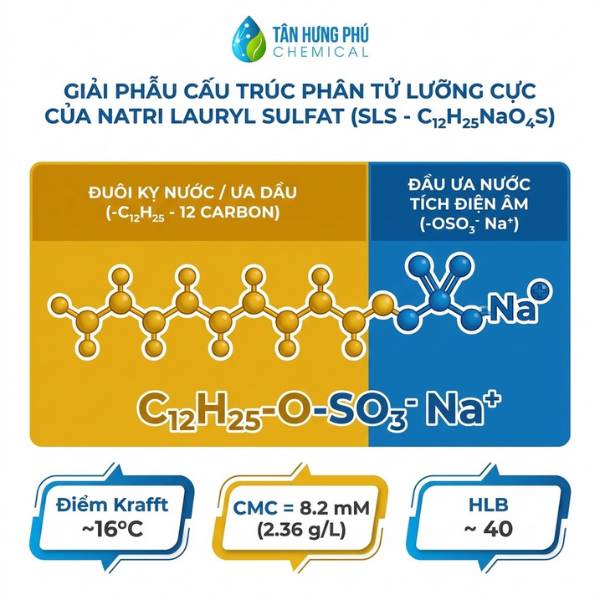
- 1. Hydrophobic / Lipophilic Tail (–C12H25 Chain): A linear, nonpolar hydrocarbon chain of 12 carbon atoms. Repelled by water, this tail exhibits strong van der Waals affinity for nonpolar oils, greases, sebum, and organic waxes.
- 2. Negatively Charged Hydrophilic Head (–OSO3−Na+ Group): Upon dissolution in water, the ionic bond dissociates to release Na+ cations, leaving an anionic sulfate ester head (–OSO3−). This highly polar head forms strong electrostatic interactions with water molecules, giving SLS an exceptionally high Hydrophilic-Lipophilic Balance (HLB ≈ 40 on the Davies scale).
• Chains that are too short (C8 – C10): Lipophilicity is too weak to lift heavy oils, and foam collapses rapidly.
• Chains that are too long (C16 – C18): The Krafft point (minimum temperature required for micelle formation) jumps above 45°C – 55°C, preventing dissolution and foaming in ambient water.
• At exactly 12 Carbons (C12), SLS hits the optimal equilibrium: a low Krafft point of ~16°C (dissolving and foaming readily in cool 20°C – 30°C water), a Critical Micelle Concentration CMC = 8.2 mM (~2.36 g/L in pure water at 25°C), and peak oil-emulsifying power. (Note: Adding electrolytes like NaCl or hard-water ions Ca2+/Mg2+ lowers CMC and can raise the Krafft temperature.)
3. 4-Step Cleansing Mechanism of SLS: Wetting, Roll-Up Detachment, Micellization & Foaming
When SLS surfactant is introduced into aqueous laundry, facial cleansing, or metal degreasing systems, its cleansing mechanism unfolds sequentially across four microscopic stages:
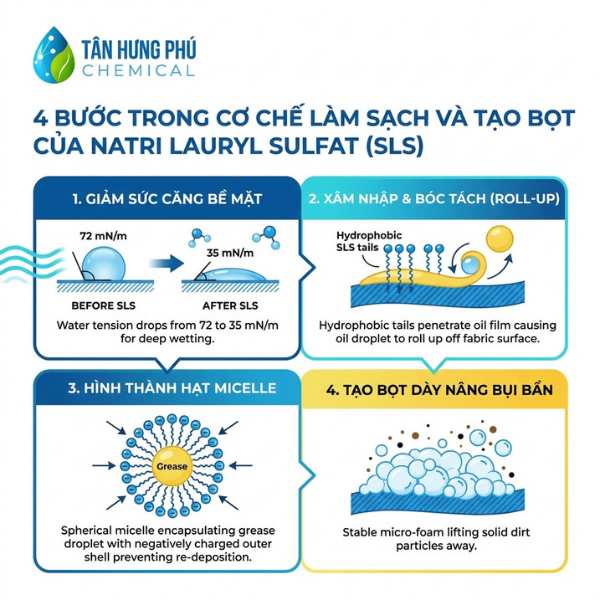
- Step 1 – Surface Tension Reduction & Deep Wetting: Pure water exhibits strong intermolecular hydrogen bonding and high surface tension (~72 mN/m at 25°C), causing water to bead up on oily textiles or metal surfaces. Dissolved SLS migrates immediately to the water-substrate interface, disrupting hydrogen-bond networks and cutting surface tension nearly in half to ~35 – 39 mN/m so wash liquor spreads and penetrates fabric weaves, skin pores, and metal crevices instantly.
- Step 2 – Penetration & Roll-Up Grease Detachment: Hydrophobic tails (–C12H25) embed into adherent grease or sebum films while anionic sulfate heads (–OSO3−) orient outward toward water. Hydration forces on the hydrophilic heads lower oil-substrate interfacial tension, forcing flat oil films to bead up (the Roll-up mechanism) and detach cleanly from the surface.
- Step 3 – Micellar Solubilization & Anti-Redeposition: Above the CMC (~2.36 g/L in pure water at 25°C), an average of 60 – 65 SLS molecules (aggregation number Nagg ≈ 62) self-assemble around detached oil droplets into spherical micelles (trapping oil inside the hydrophobic core while presenting a shell of negatively charged –OSO3− heads). Because neighboring micelles share negative surface charges (and textiles/skin also carry slight negative surface charges in water), strong electrostatic repulsion keeps emulsified oil dispersed, preventing soil redeposition during rinsing.
- Step 4 – Stable Foam Generation & Particulate Flotation: At the air-water interface, SLS foaming agent forms elastic bilayers around air bubbles, reducing bubble interfacial energy to create dense, creamy, long-lasting foam. Beyond sensory appeal, this rich lather mechanically lifts and carries insoluble solid particulates (soot, dental plaque, soil grit) away from surfaces.
4. Practical Applications & Technical Comparison Table (SLS 92 vs. SLS 95, Powder vs. Needle)
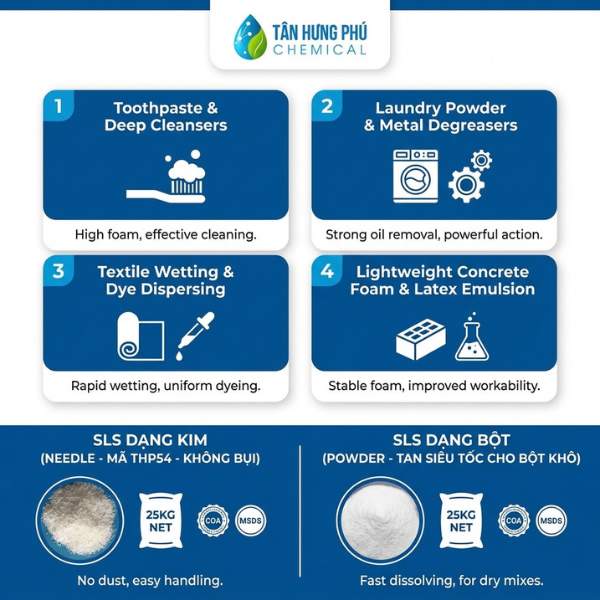
Backed by the vigorous degreasing and foaming power of its C12H25NaO4S structure, Sodium Lauryl Sulfate serves as a core raw material across four major manufacturing sectors:
- Deep-Cleansing Cosmetics & Oral Care: Used in verified Cosmetic / Oral Care / USP grades at 1% – 2% in toothpaste to generate plaque-lifting foam and disperse mint flavors; also formulated into oil-control facial cleansers, clarifying shampoos, syndet bars, and effervescent bath bombs in compliance with Vietnamese Circular 06/2011/TT-BYT cosmetic regulations.
- Household Detergents & Industrial Mechanical Degreasers: Base surfactant in laundry powders, detergent pods, touchless snow-foam car washes, engine degreasers, and heavy-duty factory floor cleaners.
- Textile Dyeing & Leather Processing: Functions as a deep fiber wetting agent, wool/raw cotton scouring degreaser, and dye leveling dispersant.
- Construction Materials & Emulsion Polymerization: Used as a foaming agent for lightweight cellular concrete blocks and gypsum boards, as well as a primary emulsifier in PVC and synthetic latex (SBR/NBR) polymerization.
| Specification & Grade Classification (COA) | SLS 92 (Active ≥ 92.0% Min) (Needle / Powder – Code THP54) |
SLS 95 (Active ≥ 95.0% Min) (High-Purity / Oral Care – USP) |
|---|---|---|
| Formula & CAS Registry Number | C12H25NaO4S (MW = 288.38 g/mol) | CAS: 151-21-3 | CMC: 8.2 mM | HLB ≈ 40 (Davies) | |
| Active Matter Content | ≥ 92.0% Min | ≥ 95.0% Min |
| Unsulfated Matter & Inorganic Salts | Unsulfated ≤ 2.5% | Na2SO4 ≤ 3.0% | NaCl ≤ 1.0% | Unsulfated ≤ 1.5% – 2.0% | Na2SO4 ≤ 2.0% | NaCl ≤ 0.5% |
| 1% Solution pH & Moisture | pH: 7.5 – 10.5 | Moisture: ≤ 3.0% Max | pH: 7.5 – 10.5 | Moisture: ≤ 2.0% Max |
| Morphology Selection & Best-Fit Uses | Cost-effective for laundry powders, industrial cleaners, textiles, and foamed concrete. Choose SLS Needles for liquid batching to eliminate airborne dust. | Lower inorganic salts and free alcohol; ideal for premium toothpaste (strict heavy metal/microbial limits) and personal care. Choose SLS Powder for dry-blend mixes. |
5. Where to Buy SLS? 25kg Bag Sodium Lauryl Sulfate Pricing (Code THP54) at Tan Hung Phu
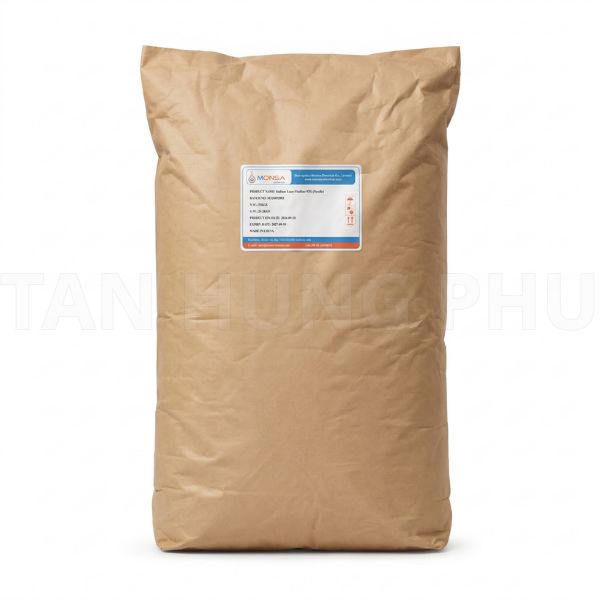
To ensure a reliable supply of high-performance foaming surfactants for personal care, industrial detergent, textile, and construction manufacturers, Tan Hung Phu Chemical Co., Ltd. (THP Chemical) directly imports and distributes Sodium Lauryl Sulfate (Product Code: THP54) meeting international technical standards, packed in 25 kg Net moisture-resistant double-lined PP/PE bags:
View Official Product Page (Code: THP54): SLS 92% Min Foaming Agent (Sodium Lauryl Sulfate / K12 Needles & Powder) – 25kg Bag (Code: THP54)
When purchasing SLS from Tan Hung Phu’s warehouse, Sodium Lauryl Sulfate pricing is discounted directly by metric ton or pallet volume, backed by batch Certificates of Analysis (COA), Safety Data Sheets (MSDS), and VAT invoices. Alongside SLS (THP54), manufacturers can source complementary detergent and personal care ingredients such as mild SLES 70% (Code THP53), Glycerin 99.7% USP (Code THP51), Propylene Glycol USP (Code THP52), and Caustic Soda / Potash Flakes (Codes THP12, THP16) via our chemical product catalog.
• Flammable Solid & Dust Explosion Hazard (H228): Dry SLS is classified as a flammable organic solid (UN 1325, Class 4.1, PG III); fine SLS powder poses a combustible dust hazard if dispersed in high concentrations near heat or ignition sources. Ground mixing vessels, use dust extraction, or specify dust-free SLS Needles.
• PPE & Environmental Protection (H318, H315, H335, H412): Concentrated SLS causes serious eye damage and strong skin/respiratory irritation upon direct contact; workers must wear sealed safety goggles, fine-particulate respirators, and chemical-resistant gloves. Never discharge concentrated SLS washdown water directly into storm drains due to aquatic toxicity.
• Chemical Incompatibilities: Do not mix directly with cationic surfactants (causes inactive precipitation) or strong oxidizers, and avoid prolonged heating in strongly acidic media (< pH 4.5), which hydrolyzes the sulfate ester bond.
REQUEST SODIUM LAURYL SULFATE QUOTES (SLS 92% – 95% 25KG BAG – CODE THP54) & R&D SAMPLES
To receive current Sodium Lauryl Sulfate pricing (SLS Needles & SLS Powder – Code: THP54) complete with batch COA and MSDS, please contact Tan Hung Phu’s B2B sales team:
Tan Hung Phu Chemical Co., Ltd. (THP Chemical)
• Technical Consultation & Wholesale Hotline / Zalo: +84 913 711 647
• RFQ Email: tanhungphu@thpchemical.com
• Office & Warehouse: 878B Ta Quang Buu, Binh Dong Ward, Ho Chi Minh City & regional transit hubs (Fast nationwide delivery via dedicated trucks and containers).
6. Frequently Asked Questions About Sodium Lauryl Sulfate – SLS (FAQ)
What makes the molecular structure of SLS capable of solubilizing water-insoluble grease?
The molecular structure of SLS (C12H25NaO4S) is amphiphilic: its hydrophobic 12-carbon tail (–C12H25) binds strongly to oils and grease, while its anionic sulfate head (–OSO3−) is highly water-soluble. Together, SLS molecules act as molecular bridges that encapsulate oil droplets into water-dispersible spherical micelles.
Why does SLS micelle formation prevent oil and dirt from redepositing onto fabrics?
When SLS forms micelles (roughly 60 – 65 molecules surrounding an oil droplet core), the entire outer shell is coated with negatively charged sulfate groups (–OSO3−). Because adjacent micelles repel one another electrostatically—and textile fibers or skin also carry slight negative surface charges in water—emulsified grease stays suspended in wash water instead of coagulating or redepositing.
What is the Critical Micelle Concentration (CMC) of Sodium Lauryl Sulfate?
In pure water at 25°C, the Critical Micelle Concentration (CMC) of Sodium Lauryl Sulfate is approximately 8.2 mM (equivalent to ~2.36 g/L or 0.24% w/v). Above this threshold, surface tension bottoms out (~35 – 39 mN/m) and micellar grease solubilization reaches peak efficiency.
Can Sodium Lauryl Sulfate (SLS) be mixed directly with cationic fabric softeners (such as Esterquat or Cetrimonium Chloride)?
No, they should not be co-formulated directly together. Because SLS is an anionic surfactant, combining it with positively charged cationic surfactants neutralizes their charges, forming an insoluble salt precipitate that clouds the solution and destroys the performance of both ingredients.
Should manufacturers choose SLS 92 Needles or SLS 95 Powder?
SLS 92 Needles (Code THP54) eliminate fine dust inhalation risks and optimize costs for laundry powders, industrial cleaners, textiles, and foamed concrete. Meanwhile, high-purity SLS 95 (lower inorganic salt and free alcohol levels) and SLS Powder are preferred for toothpaste formulations or dry-blended powders requiring rapid dissolution.
What is the price of a 25kg bag of Sodium Lauryl Sulfate and where can I buy authentic SLS in Ho Chi Minh City?
Sodium Lauryl Sulfate pricing depends on assay grade (SLS 92 vs. SLS 95), physical form (needles vs. powder), and order volume by bag, pallet, or metric ton. For ready-stock, officially imported SLS in Ho Chi Minh City complete with COA and MSDS, contact Tan Hung Phu Chemical Co., Ltd. via Hotline/Zalo at +84 913 711 647.
7. References & International Scientific Databases
Interfacial constants (CMC = 8.2 mM, aggregation number ~62, Krafft point ~16°C, Davies HLB ~40) and emulsification kinetics of Sodium Lauryl Sulfate (CAS 151-21-3) in this article are referenced from recognized colloid and surface chemistry authorities:
- US National Library of Medicine (PubChem – NCBI): PubChem Compound Summary for CID 3423265: Sodium Dodecyl Sulfate (C12H25NaO4S – CAS 151-21-3).
- International Colloid & Interface Chemistry Reference (Milton J. Rosen & Joy T. Kunjappu): Surfactants and Interfacial Phenomena (4th Edition, Wiley, 2012) – Roll-up wetting mechanism, micellization, and surface tension data for Sodium Dodecyl Sulfate.
- European Chemicals Agency (ECHA): ECHA Substance Information – Sodium dodecyl sulphate (EC 205-788-1) – Chemical safety profile, GHS classification, and rapid biodegradability data.
- Vietnamese Cosmetic Regulations: Ministry of Health Circular No. 06/2011/TT-BYT on cosmetic management (harmonized under the ASEAN Cosmetic Directive).
Conclusion: Combining an optimal 12-carbon hydrophobic tail with a negatively charged sulfate head makes Sodium Lauryl Sulfate (SLS / Sodium Dodecyl Sulfate) an industry benchmark for detergency and foaming via its four-stage cleansing mechanism. Sourcing officially imported SLS (92% – 95% Min in Needle or Powder form – Code: THP54) backed by complete COA and MSDS records from Tan Hung Phu Chemical helps manufacturers maximize cleaning efficacy and sustain consistent product quality.
Technical Disclaimer: Interfacial physicochemical constants (CMC = 8.2 mM, Nagg ≈ 62, Krafft point ~16°C, Davies HLB ≈ 40) presented in this article serve as technical guidance in pure water at 25°C and vary depending on electrolyte concentration, water hardness, and co-surfactants. Manufacturers must strictly separate Industrial grades (detergents, textiles, foamed concrete, polymers) from Cosmetic / Oral Care / USP grades, verifying batch-specific COA and MSDS records prior to full-scale production. Please contact Tan Hung Phu’s technical team for further consultation.

