
News & Event
What is Food Additive Xanthan Gum (INS 415 / E415)? Why is Xanthan Gum F200 Dubbed the "King of Anti-Separation" in Sauces and Beverages?
Compiled by Tan Hung Phu Technical Team · Updated:
In food rheology and formulation engineering, controlling syneresis (serum separation) in chili sauces, phase separation in oil-in-water salad dressings, and pulp sedimentation in ready-to-drink (RTD) beverages are persistent challenges for R&D formulators and QA/QC specialists. To reliably stabilize these multiphase food matrices without masking delicate natural flavor profiles, food additive xanthan gum (internationally designated as INS 415 / E415) remains the primary hydrocolloid of choice. In particular, the ultra-fine Xanthan Gum F200 (200 mesh) grade stands out due to its rapid cold-water hydration rate and outstanding emulsion-stabilizing efficiency across both cold-blended and thermally pasteurized production lines.
Executive Summary
- Additive Identity: Xanthan Gum (International code: INS 415 / E415, CAS 11138-66-2, chemical formula (C35H49O29)n), an extracellular polysaccharide biopolymer produced via pure-culture aerobic carbohydrate fermentation by Xanthomonas campestris.
- Core Rheological Behavior: Exhibits pronounced shear-thinning (pseudoplastic) flow behavior with a standardized V1/V2 ratio of 1.02 – 1.45 and solution viscosity of 1,200 – 1,600 mPa·s (1% in 1% KCl); provides high resting viscosity to prevent sedimentation and phase separation, but thins out rapidly under shear for effortless pouring, pumping, and swallowing.
- Technical Advantages of F200 (200 Mesh): Ultra-fine granulometry (≥ 92% passing through 200 mesh / 75 microns) facilitates instantaneous hydration in cold water without requiring heating or cooking.
- Lump-Free Dispersion Protocol: Always pre-blend dry with sugar or salt (1:5 to 1:10 ratio), pre-disperse in non-aqueous liquids (vegetable oil or concentrated syrup), or introduce via high-shear eductor/Venturi funnels to completely eliminate gelatinous “fish-eye” lumps.
Table of Contents:
- 1. What is Xanthan Gum (INS 415 / E415)? Origin & Molecular Structure
- 2. Demystifying Pseudoplasticity (V1/V2 Ratio) & Gel Network Mechanisms
- 3. Why Xanthan Gum F200 (200 Mesh) Excels in Anti-Separation
- 4. Technical Specifications Table of Xanthan Gum Ziboxan® F200
- 5. Functional Benefits & Applications in Food and Beverage Processing
- 6. Practical Guide: How to Dissolve Xanthan Gum F200 Without “Fish-Eye” Lumps
- 7. Genuine Xanthan Gum F200 Portfolio Distributed by Tan Hung Phu Chemical
- 8. Industrial Safety Protocols & Warehouse Storage Standards
- 9. Frequently Asked Questions (FAQ)
- 10. References & International Regulatory Compendia
1. What is Xanthan Gum (INS 415 / E415)? Origin & Molecular Structure
What is xanthan gum? Xanthan Gum (international additive code: INS 415 or E415 under European standards; CAS No.: 11138-66-2) is a high-molecular-weight extracellular polysaccharide biopolymer (empirical formula (C35H49O29)n) commercially manufactured by pure-culture submerged aerobic fermentation of carbohydrate feedstocks (such as glucose or corn starch) utilizing the non-pathogenic bacterium Xanthomonas campestris. Following fermentation, the broth is recovered by alcohol precipitation using isopropanol or ethanol, dried, micronized, and sieved into a free-flowing, cream-colored powder with a neutral odor and taste.
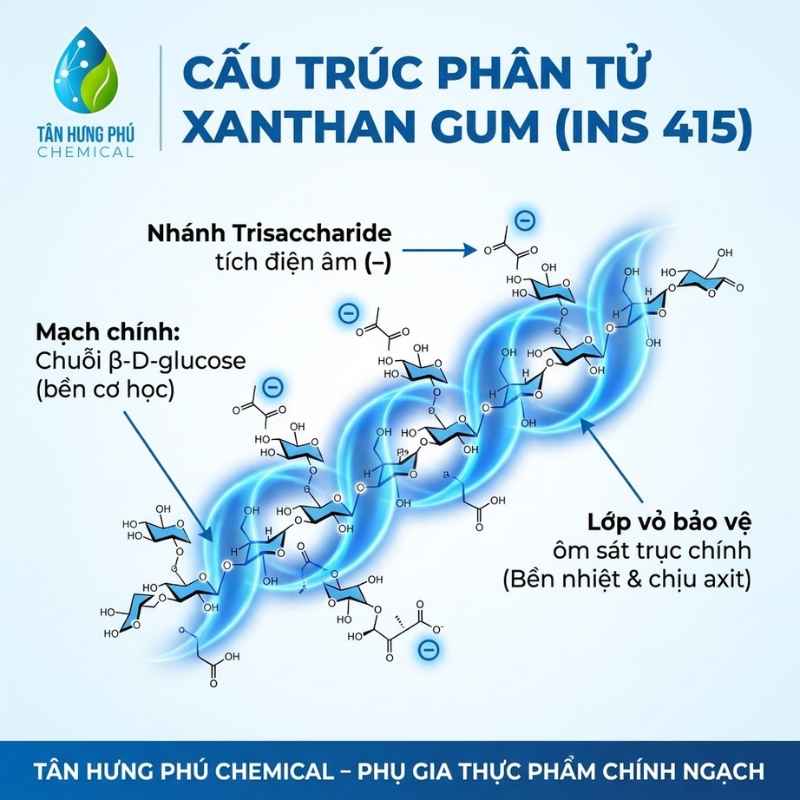
To understand why xanthan gum exhibits thermal and acid stability far superior to traditional modified starches or sodium carboxymethyl cellulose (CMC), we must examine its unique primary and secondary stereochemistry:
- Cellulosic Backbone (Main Chain): The polymer backbone consists of β-(1→4)-linked D-glucose units, chemically identical to cellulose, providing exceptional mechanical rigidity and chain integrity.
- Protective Trisaccharide Side Chains: Attached to alternating glucose residues at the C-3 position is a trisaccharide side chain consisting of an internal D-glucuronic acid unit flanked by two D-mannose residues. The terminal mannose residue carries an anionic pyruvic acid moiety (Pyruvic acid ≥ 1.5%), conferring a net negative electrostatic charge.
- Five-Fold Helical Conformation: In aqueous solutions, electrostatic repulsion among side chains drives the polymer to fold back and wrap snugly around the cellulosic backbone, adopting a rigid five-fold helical rod-like architecture. This steric shield protects internal glycosidic bonds from proton-catalyzed acid hydrolysis (H+), alkaline degradation (OH−), high salinity, and enzymatic attack, ensuring consistent working viscosity throughout demanding processing stages.
2. Demystifying Pseudoplasticity (V1/V2 Ratio) & Gel Network Mechanisms
2.1. Shear-Thinning (Pseudoplastic) Behavior and Yield Stress
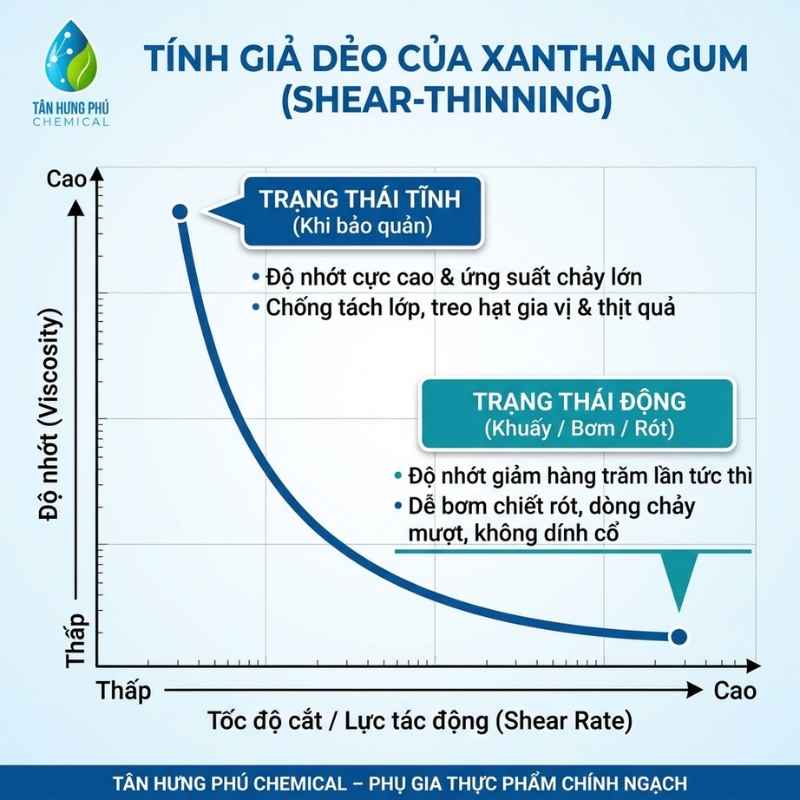
On the Certificate of Analysis (COA) of premium food grades such as Ziboxan® F200, QC laboratories evaluate the viscosity ratio V1/V2, strictly specified between 1.02 and 1.45. This parameter quantifies pseudoplasticity (shear-thinning) – the defining rheological trait that governs particle suspension, anti-separation performance, and clean sensory mouthfeel:
- At Rest (Zero / Low Shear Rate – Static Shelf Storage): Polymer chains entangle via hydrogen bonding and polymer-polymer interactions, creating an interconnected three-dimensional network with tremendous resting viscosity and high yield stress. This network acts like a microscopic structural web, immobilizing spice particulates, fruit pulp, insoluble solids, and emulsified oil droplets in place to prevent creaming or sedimentation over extended shelf lives.
- Under Dynamic Shear (High Shear Rate – Pumping, Squeezing, or Swallowing): As applied shear forces exceed the yield stress, intermolecular associations disengage instantaneously and polymer chains align parallel along streamlines. Viscosity drops by orders of magnitude within milliseconds. Sauces pour smoothly without clogging bottle orifices, pump effortlessly through transfer lines, and release clean flavors on the palate without the gummy, slimy mouthfeel characteristic of guar gum or standard CMC.
- Immediate Structural Recovery (Thixotropic Rebuilding): The instant shear stress is removed (e.g., when the consumer stops squeezing or pouring), the entangled molecular network recovers its baseline viscosity immediately, ensuring crisp droplet cut-off at bottle orifices and excellent clinging properties on hot food surfaces.
2.2. Gelation Mechanisms: Weak Gel Networks & Synergistic Gelation
Formulators frequently evaluate the gelling mechanism of xanthan gum when engineering texture and structure. Thermodynamically, INS 415 functions through two distinct gelation pathways:
- Stand-Alone “Weak Gel” Network: In water at 0.1% – 1.0% concentrations, xanthan gum alone does not form brittle, hard gel matrices like agar or carrageenan. Instead, it assembles into a continuous, viscoelastic weak gel capable of full structural self-repair following mechanical shear disruption.
- Synergistic Gelation with Galactomannans: When co-blended with plant galactomannans (such as Locust Bean Gum – LBG or Konjac Glucomannan) at optimal ratios (typically 50:50 or 40:60), the smooth, unsubstituted mannan regions of LBG lock into the rigid xanthan helices through cooperative intermolecular coupling. This synergy produces a substantial viscosity leap or forms a cohesive, thermo-reversible, elastic gel with superior moisture retention and virtually zero syneresis.
3. Why Xanthan Gum F200 (200 Mesh) Excels in Anti-Separation
In the commercial B2B ingredients trade, food-grade xanthan gum is predominantly categorized by mesh granulometry: standard 80 mesh (~180 microns) and ultra-fine 200 mesh (Ziboxan® F200, ~75 microns). Modern sauce, dressing, and beverage manufacturing facilities prioritize Xanthan Gum F200 due to four decisive operational advantages:
| Performance Parameter | Standard Xanthan Gum 80 Mesh | Xanthan Gum F200 (200 Mesh – Ultra-Fine) |
|---|---|---|
| Particle Granulometry | Coarser particles (~180 microns) | 100% through 80 mesh; ≥ 92% through 200 mesh (75 microns) |
| Hydration & Swelling Rate | Slower swelling rate; requires prolonged agitation to develop target viscosity | Rapid Hydration: Significantly higher specific surface area drives rapid water uptake and viscosity build in cold water |
| Immediate Emulsion Immobilization | Minor phase creaming can occur while waiting for coarse granules to fully hydrate | Rapidly locks oil droplets and suspended solids when properly dispersed, shortening batch cycle times |
| Dry Blending Formulations (Dry Mixes) | Prone to particle segregation and sluggish dissolution upon consumer rehydration | Ideal for instant soup sachets, dry seasoning rubs, and beverage powders requiring fast viscosity upon gentle stirring |
4. Technical Specifications Table of Xanthan Gum Ziboxan® F200
To assist plant R&D formulators and QA/QC departments in establishing incoming raw material specifications and internal verification standards, the standard analytical specifications from the official manufacturer COA of Ziboxan® F200 (Food Grade 200 Mesh) are presented below:
| Analytical Test Item | Guaranteed Standard Specification |
|---|---|
| Product Description & Brand | Xanthan Gum Food Grade – Brand: Ziboxan® F200 |
| International Additive & CAS Number | INS 415 / E415 (FCC / JECFA / EU) | CAS No.: 11138-66-2 |
| Physical Appearance | Cream-colored, free-flowing fine powder |
| Identification | Conforms to compendial identity tests |
| Assay | 91.0% – 108.0% |
| Viscosity (1% solution in 1% KCl) | 1,200 – 1,600 mPa·s (cps) |
| pH (1% aqueous solution) | 6.0 – 8.0 |
| Moisture / Total Ash | Loss on drying: Max 15.0% | Ash: Max 13.0% |
| Particle Size Granulometry | 100% through 80 mesh (180 μm); Min 92% through 200 mesh (75 μm) |
| Shear-Thinning Viscosity Ratio (V1/V2) | 1.02 – 1.45 |
| Pyruvic Acid / Total Nitrogen | Pyruvic acid: Min 1.5% | Total Nitrogen: Max 1.5% |
| Heavy Metal Impurity Limits | Total heavy metals: Max 20 ppm | Arsenic (As): Max 3 ppm | Lead (Pb): Max 2 ppm |
| Residual Solvents (Ethanol or Isopropanol) | Max 500 ppm |
| Microbiological Limits | Total plate count: ≤ 2,000 cfu/g | Yeast/mold: ≤ 100 cfu/g | E. coli: Negative / 25g | Salmonella: Negative / 25g |
5. Functional Benefits & Applications in Food and Beverage Processing
Demonstrating exceptional resilience across broad pH ranges (pH 2 – 12), high thermal tolerance under UHT/retort pasteurization, excellent salt stability, and outstanding freeze-thaw stability, xanthan gum provides primary functional value across four major food sectors:
5.1. Condiments, Dressings & Culinary Sauces
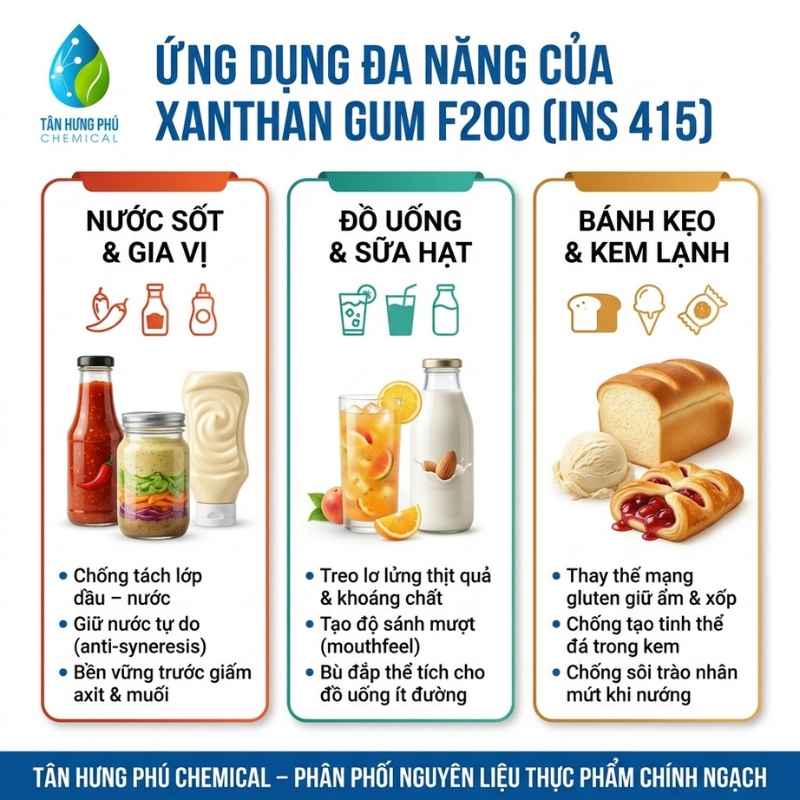
In the industrial production of chili sauces, tomato ketchup, mayonnaise, vinaigrette salad dressings, soy sauce blends, oyster sauces, and BBQ marinades, xanthan gum delivers three primary benefits:
- Syneresis Control (Anti-Separation): Firmly binds unbound free water within modified starch networks and pureed fruit/vegetable pulps (chili, tomato), preventing clear serum separation at the neck of sauce bottles during shelf storage.
- Emulsion Stabilization: While not a surface-active emulsifier itself, xanthan gum builds strong continuous aqueous phase viscosity around dispersed lipid droplets in mayonnaise and dressings, physically preventing droplet coalescence.
- Resistance to Acid (INS 260) and Electrolytes: Culinary sauces carry high salt contents (2% – 10%) and low pH levels (pH 3.2 – 4.2 from acetic or citric acids). Protected by its helical structure, INS 415 maintains uniform body without polymer chain cleavage or viscosity degradation common to native starches.
5.2. Fruit Beverages & Plant-Based Milks
Deployed as a stabilizing and suspending hydrocolloid in pulpy juices (citrus, passion fruit, aloe vera, soursop), plant-based dairy alternatives (cashew, walnut, almond, soy milk), and ready-to-mix powders:
- Particulate and Mineral Suspension: At modest inclusion rates (0.03% – 0.15%), the yield stress of INS 415 keeps fruit vesicles, aloe cubes, insoluble cocoa particles, and fortifying calcium carbonates homogeneously suspended throughout the container height.
- Mouthfeel Enhancement in Low-Sugar Systems: In reduced-sugar, diet, or zero-calorie beverages, removing sucrose leads to a thin, watery body. Low-dose E415 restores full, smooth, and rounded oral texture mimicking traditional sugar body.
5.3. Bakery Formulations, Gluten-Free Doughs & Frozen Desserts
Broadening its scope as an essential food thickener, xanthan gum contributes critical structure to:
- Gluten-Free Bread & Pasta Formulations: Rice and corn flours lack gluten proteins to entrap leavening CO2 gas bubbles. Xanthan gum functions as a structural gluten substitute, developing a cohesive network that retains gas, ensures dough expansion, and produces moist, elastic crumb textures without crumbly fragility.
- Ice Cream & Bakery Fruit Fillings: Inhibits ice crystal coarsening during frozen distribution cycles, while preventing fruit compote fillings from boiling out through pastry crusts under high-temperature baking.
6. Practical Guide: How to Dissolve Xanthan Gum F200 Without “Fish-Eye” Lumps
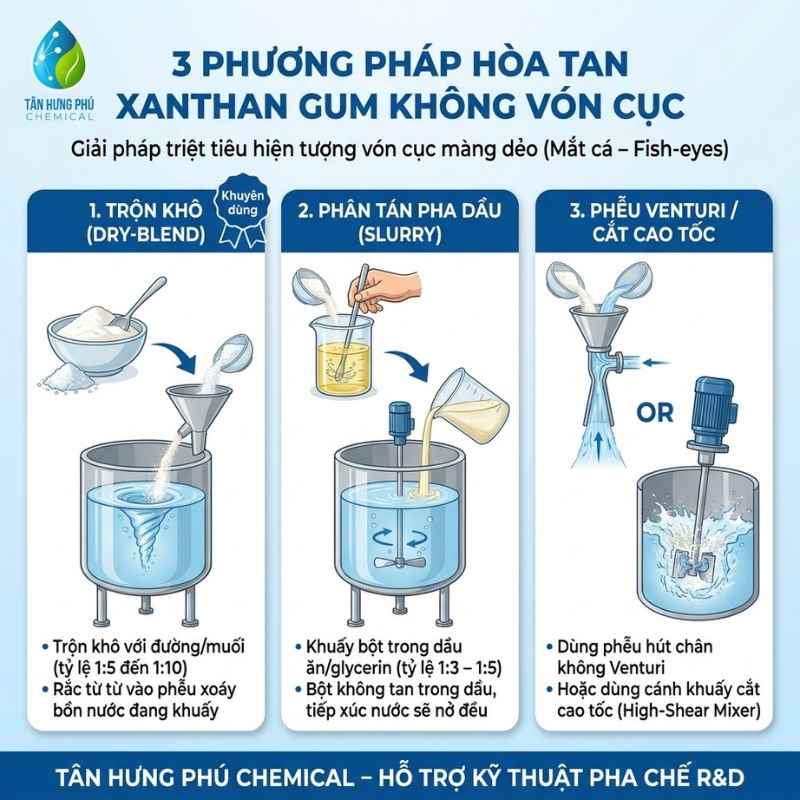
To achieve 100% hydration efficiency and recover theoretical batch viscosity, plant operators should implement one of three standardized industrial dispersion techniques alongside the guideline dosing rates below:
- Method 1 – Dry-Blending with Carrier Ingredients (Most Recommended): Thoroughly dry-blend Ziboxan® F200 powder with other granular recipe ingredients (such as crystalline sucrose, sodium chloride, monosodium glutamate, or maltodextrin) at a minimum ratio of 1 part Xanthan Gum : 5 to 10 parts dry carrier. The coarser carrier crystals isolate the fine gum particles. Then, generate a deep vortex in the mixing tank and slowly introduce the dry blend into the vortex wall.
- Method 2 – Pre-Dispersion in Non-Aqueous Liquids (Slurry Method): In mayonnaise or dressing processes, blend Ziboxan® F200 powder into a portion of the recipe's vegetable oil (or propylene glycol, glycerol, or high-Brix sugar syrup > 60°Brix) at a 1:3 to 1:5 ratio. Because xanthan gum is insoluble in oil, individual particles disperse completely without hydrating. When this slurry is introduced into the agitated water tank, the particles contact water evenly and hydrate instantly.
- Method 3 – Venturi In-Line Eductor or High-Shear Blending: Charge dry powder into an in-line vacuum Venturi eductor, where high-velocity water shears and wets incoming particles before discharging into the bulk blending tank.
| Food Application Category | Guideline Dosing Level (%) | Equivalent Addition Rate (g / kg or liter) |
|---|---|---|
| Pulpy RTD juices, plant-based milks, RTD teas | 0.03% – 0.15% | 0.3 – 1.5 g / liter finished beverage |
| Chili sauces, ketchup, mayonnaise, salad dressings | 0.20% – 0.50% | 2.0 – 5.0 g / kg finished sauce |
| Bakery goods, ice cream, frozen foods | 0.10% – 0.30% | 1.0 – 3.0 g / kg finished product |
| Gluten-free breads and bakery doughs | 0.50% – 1.00% | 5.0 – 10.0 g / kg dry flour |
*Regulatory Note: Utilizing Xanthan Gum (INS 415) in food processing in Vietnam must strictly comply with authorized food categories and maximum permitted levels (Good Manufacturing Practice – GMP) under Circular No. 24/2019/TT-BYT and its amendment Circular No. 17/2023/TT-BYT issued by the Ministry of Health.
7. Genuine Xanthan Gum F200 Portfolio Distributed by Tan Hung Phu Chemical
To provide consistent quality and high-efficiency hydrocolloids for food and beverage manufacturers, Tan Hung Phu Chemical Co., Ltd. (THP Chemical) directly imports and distributes the premier grade:
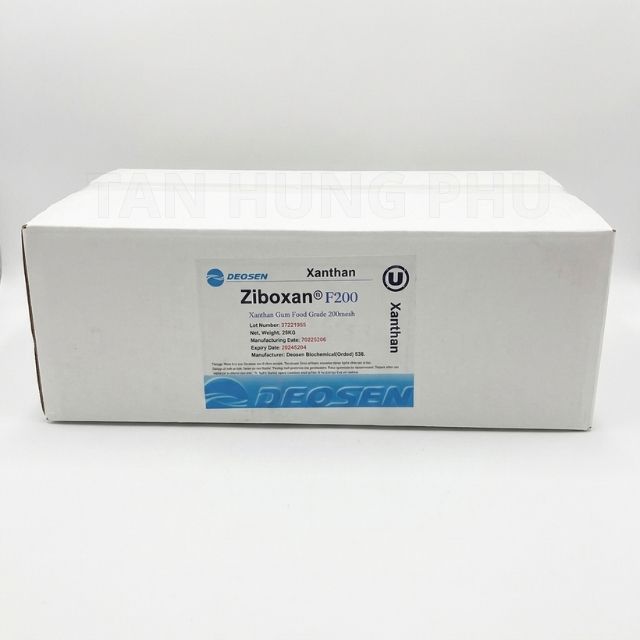
- Xanthan Gum F200 (200 Mesh – Food Grade): Xanthan Gum F200 (Ziboxan® F200 – INS 415 / E415) – 25kg Net Carton
Shipped in factory-sealed, heavy-duty 25 kg Net white cartons with internal multi-layer barrier PE liners, the material holds Kosher (OU), Halal, ISO 22000, and BRC food safety certifications. Procurement managers can access product details, download batch COAs, and view Material Safety Data Sheets (MSDS) via the link above.
Along with Xanthan Gum F200, industrial formulators can explore our portfolio of acidulants (such as Food-Grade Acetic Acid INS 260 and Citric Acid INS 330) and technical processing aids across our commercial product catalog.
8. Industrial Safety Protocols & Warehouse Storage Standards
While xanthan gum (E415) is non-toxic, safe for human consumption, and classified as a non-hazardous substance, its ultra-fine 200 mesh particle size and intense water affinity necessitate three workplace safety rules:
- Spill Management & Severe Slip Hazard: When dry xanthan gum powder contacts moisture on factory floors, it instantly forms an extremely slick, slippery hydrogel layer presenting high fall risks for personnel and forklifts. Mandatory protocol: Never wash dry powder spills directly with a water hose. First, collect all dry powder thoroughly using brooms or industrial vacuum units, post warning signs, and only then wash the residue using warm water and industrial detergent.
- Airborne Dust Mitigation in Weighing Suites: 75-micron powder particles are lightweight and easily aerosolized during dispensing or hopper charging. Operators should wear dust-filtering respirators (N95) and safety glasses, performing transfer operations within local exhaust ventilation zones.
- Hygroscopic Storage Controls: Store 25 kg cartons on pallets in a cool, well-ventilated, dry warehouse away from direct sunlight and odor-generating chemicals. Once a carton is opened, expel excess air, tightly tie the internal polyethylene liner, and reseal the outer carton lid to avoid atmospheric moisture absorption and cake formation.
REQUEST WHOLESALE B2B QUOTATION FOR XANTHAN GUM F200 (25KG CARTON) & LAB SAMPLES
To obtain competitive wholesale pricing for Xanthan Gum Ziboxan® F200 (25 kg Carton) tailored to your production schedules, accompanied by manufacturer COAs, MSDS, and food safety dossiers, contact Tan Hung Phu Chemical’s B2B Commercial Department directly:
Tan Hung Phu Chemical Co., Ltd. (THP Chemical)
• Technical Support & Wholesale Hotline: (+84) 913 711 647
• Commercial Inquiries (RFQ): tanhungphu@thpchemical.com
• Headquarters & Distribution Center: 878B Ta Quang Buu Street, Binh Dong Ward, Ho Chi Minh City & Regional Hubs (Prompt nationwide logistics via specialized commercial trucks and container haulage).
9. Frequently Asked Questions about Food Additive Xanthan Gum (FAQ)
Is Xanthan Gum (INS 415 / E415) natural or synthetic, and is it suitable for vegan diets?
Xanthan Gum (INS 415 / E415) is a naturally derived biological polysaccharide produced via bacterial fermentation of plant carbohydrates (corn starch, sugar) by Xanthomonas campestris. It contains no animal derivatives or gluten, making it fully suitable for vegan, Kosher, Halal, and gluten-free applications (subject to verification against batch-specific certifications).
Does water need to be heated for Xanthan Gum F200 to dissolve and build viscosity?
No heat is required. Unlike traditional native starches or agar-agar, which require thermal gelatinization, Xanthan Gum F200 (200 mesh) achieves complete hydration in both cold and hot aqueous systems to reach its specified viscosity (1,200 – 1,600 mPa·s for 1% in 1% KCl), delivering significant energy and processing time savings.
Why do transparent gelatinous lumps form when dissolving F200, and how can they be prevented?
This occurs due to “fish-eye” formation when fine 200-mesh particles hydrate too rapidly on their outer perimeter upon bulk addition into water. To prevent this, pre-blend the gum powder dry with sugar or salt (1 part gum to 5–10 parts sugar/salt) or pre-disperse it in vegetable oil before slowly introducing it into an actively vortexing tank under high shear.
What functional benefits does combining Xanthan Gum with modified starch provide in chili sauce?
In chili and tomato sauce formulations, modified starch provides low-cost bulk and pulp body, but is vulnerable to retrogradation and syneresis during long-term storage or chilling. Incorporating 0.15% – 0.30% Xanthan Gum F200 introduces a pseudoplastic framework that binds free water, stops serum separation, imparts sheen, and enhances surface cling on food.
Where can verified Xanthan Gum F200 be purchased with complete COA and MSDS dossiers in HCMC?
Industrial clients can source material directly from Tan Hung Phu Chemical Co., Ltd. via Hotline/Zalo at (+84) 913 711 647. We maintain verified local inventory of Ziboxan® F200 (200 mesh) in 25 kg cartons in Ho Chi Minh City, complete with manufacturer batch COAs, SDS sheets, and food safety self-declaration filings.
10. References & International Regulatory Compendia
Physicochemical properties, rheological mechanisms, purity criteria, and statutory food safety guidelines for INS 415 / E415 in this article reference international standards and scientific authorities:
- Joint FAO/WHO Expert Committee on Food Additives (JECFA): Monograph & Specifications for Xanthan Gum (INS 415) – Toxicological assessment affirming ADI “Not specified” (safe under Good Manufacturing Practice).
- U.S. Food and Drug Administration (FDA): 21 CFR § 172.695 – Xanthan Gum – Specifications governing molecular criteria, pyruvic acid thresholds (≥ 1.5%), and food stabilizer applications.
- European Food Safety Authority (EFSA): Re-evaluation of xanthan gum (E 415) as a food additive – EFSA Journal (2017) – Scientific opinion validating consumer biological safety and digestive tolerance.
- Regulatory Compliance for Food Additives in Vietnam & COA Specifications: Circular No. 24/2019/TT-BYT (and amending Circular No. 17/2023/TT-BYT) issued by the Ministry of Health regulating the management and use of food additives (Xanthan Gum INS 415), alongside the technical inspection records of Ziboxan® F200 (Xanthan Gum Food Grade 200 Mesh).
Summary: Featuring a robust helical architecture and characteristic pseudoplastic shear-thinning rheology (V1/V2 = 1.02 – 1.45), food additive xanthan gum (INS 415 / E415) serves as an indispensable thickener, emulsion stabilizer, and anti-separation agent across sauces, dressings, beverages, and bakery goods. Sourcing authentic Xanthan Gum F200 (200 mesh) complete with batch COAs, MSDS, and regulatory filings from Tan Hung Phu Chemical equips industrial food processors with rapid cold hydration, elevated sensory appeal, and reliable cost performance.
Other News
View detail- What Is Sodium Alginate (E401)? Brown Seaweed Origin & Calcium Gelation Mechanism
- Caustic Soda Flakes 98% (NaOH 98% Min & China): Wastewater pH Neutralizer, Textile Scouring, Pulp Digestion & Detergent Manufacturing
- What is MKP Fertilizer (Mono Potassium Phosphate 00-52-34)? Why is the 0% N – 52% P2O5 – 34% K2O Formula the Key to Off-Season Flowering?
- What is Citric Acid (E330 / INS 330)? Natural Origin, Refreshing Sour Taste and Metal Chelating Antioxidant Properties

