
News & Event
What is Citric Acid (E330 / INS 330)? Natural Origin, Refreshing Sour Taste and Metal Chelating Antioxidant Properties
Compiled by Tan Hung Phu Technical Team · Updated: November 2026
Citric acid (INS/E330; chemical formula C6H8O7) is a naturally occurring organic acid found in citrus fruits and commercially produced primarily via microbial fermentation. In food processing, it functions as an acidity regulator, acidulant, and metal chelating agent; its technological effectiveness and usage levels depend on product category, formulation, and applicable regulatory frameworks. This article outlines its fundamental properties, technical differences between Anhydrous and Monohydrate forms, and key verification criteria when sourcing food-grade raw materials.
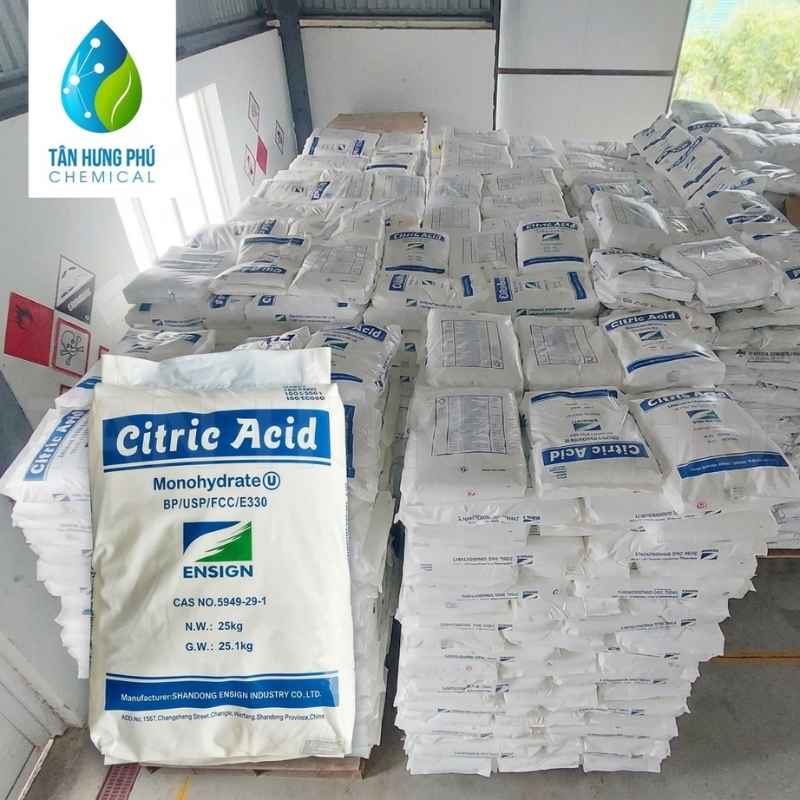
Table of Contents:
- 1. What is Citric Acid (E330)? Natural Origins and Microbial Fermentation Technology
- 2. Two Key Functional Mechanisms: E330 Acidulant & Antioxidant Metal Chelation
- 3. Technical Specification Table: Citric Acid Anhydrous vs. Citric Acid Monohydrate
- 4. Applications in Food & Beverage, Pharmaceuticals, and Eco-friendly Descaling
- 5. Food Safety Dossiers (FCC/Codex) and Citric Acid Product Portfolio (THP18) at Tan Hung Phu
- 6. Where to Buy Citric Acid? Wholesale B2B 25kg Bag Quotation in Ho Chi Minh City
- 7. Frequently Asked Questions (FAQ)
- 8. References & International Regulatory Standards
1. What is Citric Acid (E330)? Natural Origins and Microbial Fermentation Technology
From an organic chemistry perspective, Citric Acid (IUPAC nomenclature: 2-hydroxypropane-1,2,3-tricarboxylic acid) is a weak tricarboxylic organic acid. Structurally (molecular formula C6H8O7 or condensed formula HOOC-CH2-C(OH)(COOH)-CH2-COOH), each molecule features three carboxyl functional groups (–COOH) capable of stepwise proton (H+) dissociation and one hydroxyl group (–OH) bound to the central carbon atom.
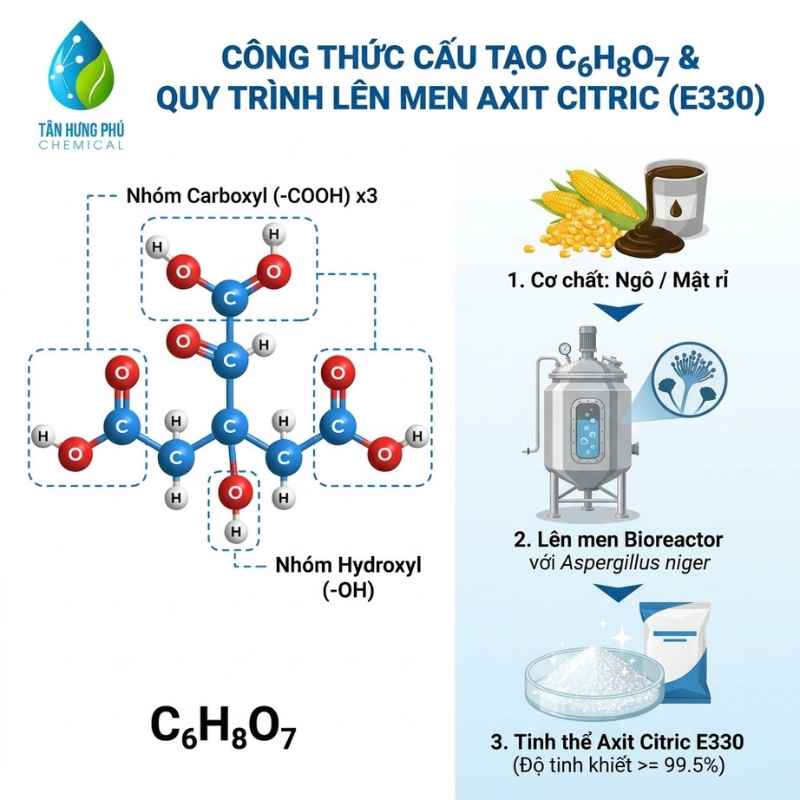
From Natural Occurrence (Citrus Acid) to Industrial Production via Aspergillus niger
Citric acid occurs naturally in various fruits, predominantly within citrus species. To ensure high yields and consistent commercial purity, the vast majority of food-grade citric acid is manufactured through submerged microbial fermentation. Specific production parameters may vary between manufacturers:
- Submerged Microbial Fermentation: In alignment with JECFA monographs, citric acid is produced by carbohydrate substrate fermentation utilizing non-toxigenic strains of Aspergillus niger or other approved microorganisms. Raw material sources and Non-GMO status must be verified against individual manufacturer documentation.
- Purification & Crystallization: The post-fermentation broth undergoes biomass separation, filtration, demineralization, and controlled crystallization. Compliance parameters and applicable pharmacopeial/food standards (e.g., FCC, Codex, USP, BP) must be verified via the specific product batch Specification/COA; generic compliance across all grades should not be assumed.
| Physicochemical Property & Identification | Standard Technical Specification of Citric Acid (E330) |
|---|---|
| Molecular Formula | C6H8O7 (Anhydrous) | C6H8O7·H2O (Monohydrate) |
| International Food Additive / CAS Number | INS 330 / E330 | CAS: 77-92-9 (Anhydrous) / 5949-29-1 (Monohydrate) |
| Physical Appearance | Colorless translucent crystals or white crystalline powder, odorless, with a clean and tart acidic taste |
| Acid Dissociation Constants (Three-stage pKa at 25°C) | pKa1 = 3.13 | pKa2 = 4.76 | pKa3 = 6.40 (Provides broad buffer capacity from pH 2.5 to 6.5) |
| Aqueous Solution pH (at 25°C) | 1% (w/v) solution: pH ~ 2.1 – 2.3 | 5% (w/v) solution: pH ~ 1.8 |
| Water & Solvent Solubility | Highly soluble in cold water (~59% – 65% w/w at 20°C); readily soluble in Ethanol |
| Melting & Decomposition Temperature | Melts at ~153°C; thermal decomposition initiates above 175°C |
2. Two Key Functional Mechanisms: E330 Acidulant & Antioxidant Metal Chelation
2.1. Acidulant E330: Clean, Crisp Tartness and pH Buffer Regulation
Citric acid is universally utilized to impart tartness in beverage and confectionery formulations. Sensory perception, matrix compatibility, and dosing thresholds must be evaluated based on recipe dynamics and target organoleptic profiles.
- Rapid-onset, Clean Sensory Profile: As a primary natural fruit acid, citric acid activates oral taste receptors with an immediate, bright, and refreshing burst of tartness that peaks within seconds and dissipates cleanly without lingering astringency or acrid off-notes. This characteristic elevates natural fruit flavorings (citrus, berries, stone fruits, tropical fruits) while masking the metallic or bitter aftertastes common in high-intensity sweeteners (Aspartame, Acesulfame-K, Sucralose).
- pH Adjustment & Buffering: Citric acid and its citrate salts (e.g., Sodium Citrate) are widely deployed to stabilize target pH bands. Microbial stability depends on equilibrium pH, water activity, thermal processing, and hurdle technology, and should be validated within the finished matrix.
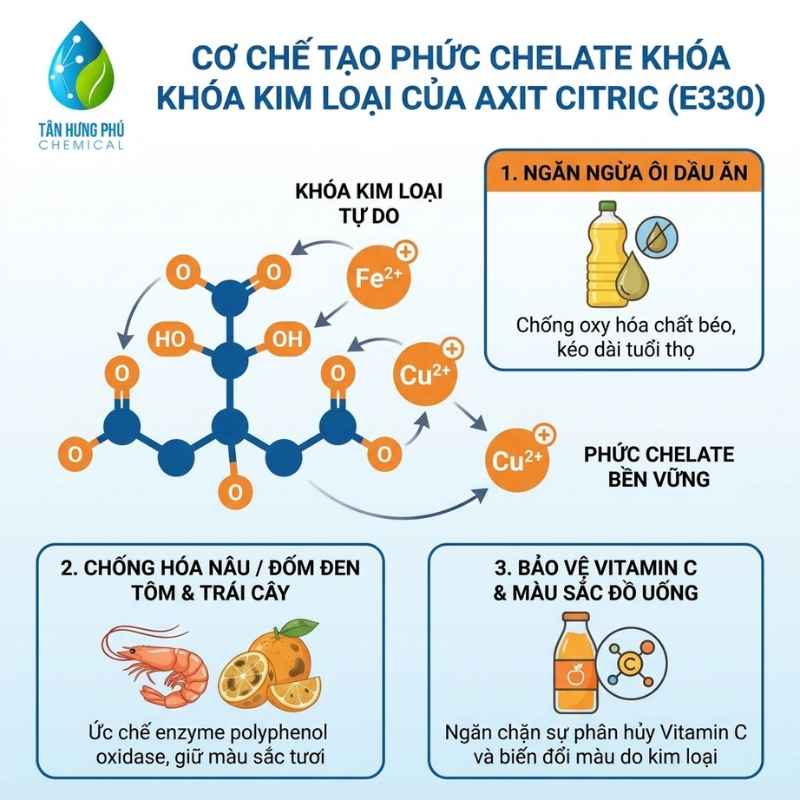
2.2. Metal Chelation Mechanism as an Antioxidant Synergist (Sequestrant)
Beyond pH regulation, citric acid functions as an effective multidentate sequestrant. In vulnerable food systems, this chelating capacity suppresses pro-oxidant metal activity; functional outcomes depend on processing parameters and formulation chemistry:
- Pro-oxidant Activity of Polyvalent Trace Metals: Process water, seafood, animal fats, and edible oils inevitably contain trace parts-per-million (ppm) levels of unbound polyvalent cations, primarily Iron (Fe2+ / Fe3+) and Copper (Cu2+). These free radicals act as potent catalysts accelerating lipid peroxidation (resulting in rancidity in frying oils, mayonnaise, and snack foods) while triggering Polyphenol Oxidase (PPO) activity that causes black spot formation (melanosis) in seafood and browning in cut produce.
- Multidentate Chelation Coordination: Possessing three negatively charged carboxylate moieties (–COO−) and an adjacent hydroxyl oxygen (–OH), the citric acid molecule acts as a multidentate chelating ligand. It coordinates tightly around Fe2+, Cu2+, Ca2+, and Mg2+, trapping them within stable, water-soluble ring coordination complexes (Citrate Chelates).
- Synergistic Protection of Color and Flavor Stability: While metal sequestration significantly attenuates metal-catalyzed degradation pathways, it does not unilaterally eliminate all oxidative risks. Long-term shelf-life validation remains essential under real-world packaging and storage conditions.
3. Technical Specification Table: Citric Acid Anhydrous vs. Citric Acid Monohydrate
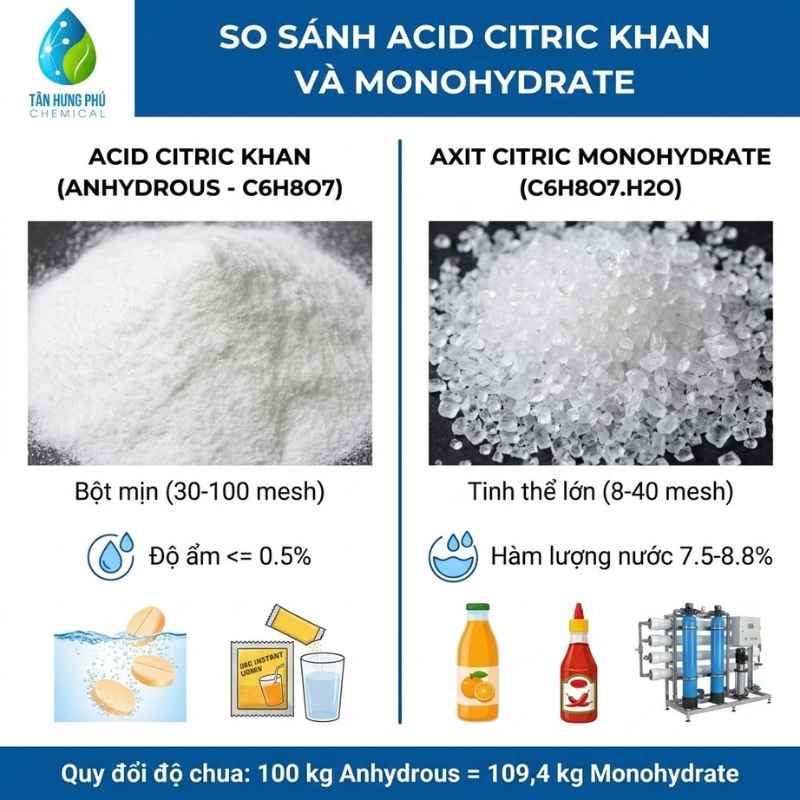
In commercial B2B ingredients trade, food-grade and industrial citric acid is supplied in two primary physical forms: Citric Acid Anhydrous (water-free crystal lattice) and Citric Acid Monohydrate (containing one molecule of crystallization water per molecular unit). Differentiating their physicochemical parameters enables R&D and Procurement to specify the exact grade for industrial processing lines:
| Comparative Parameter (BP / USP / FCC / Codex) | Citric Acid Anhydrous (Formula: C6H8O7) |
Citric Acid Monohydrate (Formula: C6H8O7·H2O) |
|---|---|---|
| CAS Registry & Molecular Weight | CAS: 77-92-9 | MW = 192.12 g/mol | CAS: 5949-29-1 | MW = 210.14 g/mol |
| Assay (Titration, on dry basis) | 99.5% – 100.5% | 99.5% – 100.5% |
| Moisture / Water of Crystallization | ≤ 0.5% Max (Standard COA: 0.05% – 0.2%, virtually moisture-free) | 7.5% – 8.8% (Bound lattice water, stoichiometric theory: 8.58%) |
| Equivalent Acidity Blending Ratio | 100 kg Anhydrous provides equivalent active acidity to 109.4 kg Monohydrate | 100 kg Monohydrate provides equivalent active acidity to 91.4 kg Anhydrous |
| Crystallization Temp & Standard Mesh Size | Crystallizes at elevated temperatures (> 36.6°C); fine granules 30 – 100 mesh or 100 mesh powder. | Crystallizes at lower temperatures (< 36.6°C); medium-to-coarse granules 8 – 40 mesh. |
| Heavy Metals & Impurities (Ensign / TTCA COA) | Lead (Pb) ≤ 0.5 ppm | Arsenic (As) ≤ 1.0 ppm | Oxalate ≤ 100 ppm | Sulfated Ash ≤ 0.05% | Lead (Pb) ≤ 0.5 ppm | Arsenic (As) ≤ 1.0 ppm | Oxalate ≤ 100 ppm | Sulfated Ash ≤ 0.05% |
| Recommended Application Scope | Essential for moisture-sensitive dry matrices: Effervescent tablets (prevents premature reaction with NaHCO3), instant beverage drink mixes, dry seasoning blends, and automatic dishwashing tablets. | Cost-optimized for liquid and wet processing: Carbonated soft drinks, RTD teas, fruit syrups, sauces, jams, seafood processing baths, and aqueous descaling solutions. |
4. Applications in Food & Beverage, Pharmaceuticals, and Eco-friendly Descaling
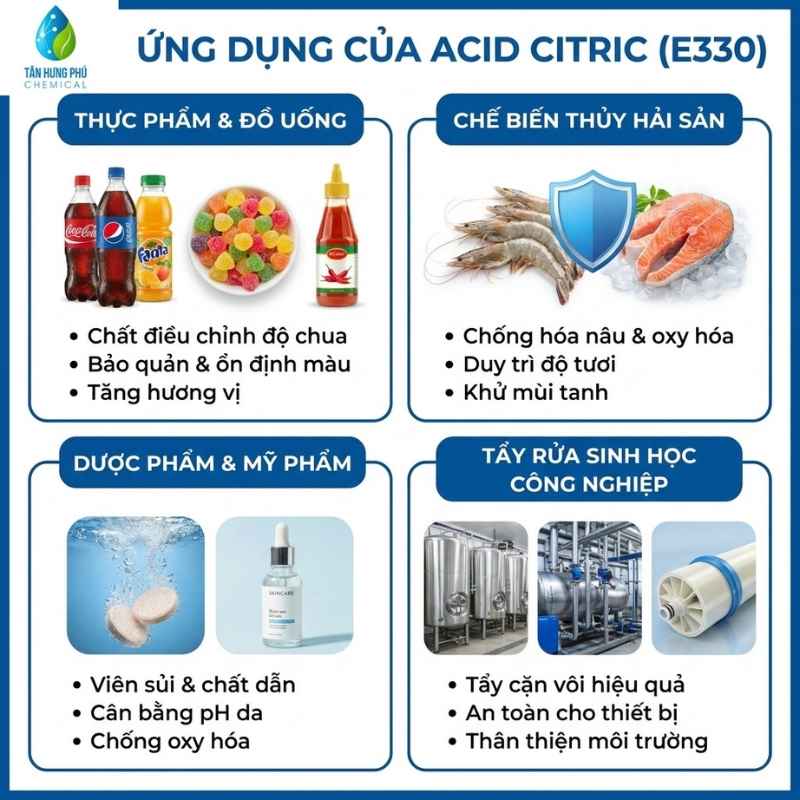
4.1. Food and Beverage (F&B) Processing
Dosage rates of citric acid depend strictly on food categories, technological objectives, and governing food safety regulations. Formulation trials should be conducted to establish targeted pH and sensory balances; standard dosing cannot be uniformly applied across all matrices.
- Carbonated Soft Drinks, Syrups, RTD Teas & Brewing: Calibrates the Brix/Acid balance, stabilizes vitamin pigments, and enhances microbiological preservation.
- Confectionery, Jellies & Fruit Preserves: Imparts the tart dusting on sour gummies, prevents sucrose graining/crystallization in hard candies, and establishes the optimal pH 3.0 – 3.3 for reliable pectin gel formation in jams.
- Canned Goods, Condiments, Sauces & Frozen Seafood: Balances round acidity in dressings and chili sauces; applied in washing baths for shrimp, squid, and fish fillets prior to freezing to sequester iron/copper, inhibit melanosis, and neutralize volatile amine odors.
- Dairy & Cheese Manufacturing: Serves as a direct acidification agent in the accelerated production of fresh mozzarella, ricotta, and cultured dairy drinks.
4.2. Eco-friendly Calcium Descaling & Industrial Engineering Applications
Beyond food manufacturing, demand for technical-grade citric acid continues to surge as heavy industries pivot toward green, 100% biodegradable, non-fuming, and non-corrosive chemical solutions:
- Limescale (CaCO3) and Metal Scale Removal for RO Membranes, Boilers & Sanitary Pipelines: Leveraging potent chelation against Ca2+, Mg2+, and Fe3+, aqueous citric acid solutions (1% – 3% w/v) represent standard CIP agents to clean reverse osmosis membranes, industrial steam generators, and commercial espresso machinery without pitting stainless steel like aggressive mineral acids (e.g., HCl).
- Stainless Steel Passivation (ASTM A967 Standard): Warm citric acid baths (4% – 10% concentration at 50°C – 65°C) selectively leach free surface iron from austenitic stainless steel (SS304/SS316L) weld zones, accelerating the formation of a dense, corrosion-resistant chromium oxide (Cr2O3) passive layer in pharmaceutical and food reactors.
- Aquaculture & Micronutrient Chelation: Safely buffers pond water alkalinity, complexes heavy metal runoff after rainfall, and serves as an organic chelator (Citrate complex) in agricultural micronutrient foliar fertilizers.
5. Food Safety Dossiers (FCC/Codex) and Citric Acid Product Portfolio (THP18) at Tan Hung Phú
For modern food processing facilities certified under ISO 22000, FSSC 22000, and HACCP standards, inbound raw materials must comply strictly with national and international food additive regulations. At Tan Hung Phu Chemical Co., Ltd. (THP Chemical), our Citric Acid inventory is directly imported from premier global manufacturers, including Weifang Ensign Industry and RZBC:
- Direct Product Information (Item Code: THP18): Citric Acid Monohydrate (Food Grade E330 – C6H8O7·H2O) – 25kg Bag
• Original Manufacturer Certificate of Analysis (COA): Strictly matches the specific batch/lot numbers printed on the 25kg bags, meeting global multi-compendial standards (BP / USP / FCC / E330 / Codex Alimentarius).
• Official Food Safety Self-Declaration Dossier: Complete regulatory compliance filings and ISO/IEC 17025 accredited laboratory test reports.
• Safety Data Sheets (SDS / MSDS) & Halal / Kosher / Non-GMO Certifications: Fully audited to satisfy strict export requirements to the US, EU, Japan, and Middle Eastern markets.
Alongside Citric Acid (THP18), manufacturers can explore our portfolio of officially imported food additives (such as Food-grade Acetic Acid E260 codes THP6 & THP47, Marcel Carrageenan code THP2, Xanthan Gum F200 code THP45, Potassium Sorbate code THP19, and Dextrose Monohydrate code THP20) across our commercial catalog.
6. Where to Buy Citric Acid? Wholesale B2B 25kg Bag Quotation in Ho Chi Minh City
When industrial procurement managers evaluate qualified citric acid suppliers for year-round volume stability, wholesale citric acid 25kg bag pricing is governed by four primary commercial factors:
- Product Form (Anhydrous vs. Monohydrate): Citric Acid Anhydrous features approximately ~9.4% higher active acid concentration per weight unit than Citric Acid Monohydrate; thus, unit bag pricing reflects this active substance differential.
- Grade Specifications & Brand Tier: Pharmacopeial compliance, manufacturer brand reputation, and assay purity correlate with specific product codes and order volumes. Technical parameters should always be audited against official COAs.
- Order Volume (MOQ & Delivery Terms): Commercial wholesale orders from single metric tons, full pallets, or full container loads (FCL 25 MT) receive tier-one contract pricing compared to spot ltl purchases.
- Packaging Integrity & Warehousing: Storage conditions and packaging seals must be validated at warehouse delivery to preserve original flowability and crystal morphology.
REQUEST WHOLESALE B2B QUOTATION FOR CITRIC ACID 25KG BAGS (CODE THP18 – ENSIGN / TTCA)
To receive the most competitive wholesale 25kg bag quotation for Citric Acid (Monohydrate and Anhydrous) along with technical COA, MSDS, and Food Safety dossiers, contact Tan Hung Phu Chemical’s B2B Commercial Department directly:
Tan Hung Phu Chemical Co., Ltd. (THP Chemical)
• Hotline / Zalo (Wholesale Sales): (+84) 913 711 647
• RFQ Email: tanhungphu@thpchemical.com
• Headquarters & Distribution Center: 878B Ta Quang Buu Street, Binh Dong Ward, Ho Chi Minh City & Regional Hubs (Prompt nationwide logistics by specialized freight and container haulage).
7. Frequently Asked Questions (FAQ)
1. What is Citric Acid, and is commercial food-grade powder directly extracted from lemons?
While chemically identical to natural lemon acid, the vast majority of commercial citric acid is produced via submerged microbial fermentation of carbohydrate feedstocks. Raw material substrates, microbial strains, and Non-GMO certifications are defined by individual manufacturer technical dossiers.
2. When should industrial plants choose Citric Acid Anhydrous over Citric Acid Monohydrate?
The anhydrous grade is preferred in moisture-sensitive dry formulations to avoid premature hydration or caking. However, raw material selection should always balance allowable formula moisture, dissolution economics, and supplier batch specifications.
3. How does the metal chelation mechanism of Citric Acid help prevent food oxidation?
Food systems routinely contain trace amounts of free polyvalent transition metals like Iron (Fe2+) and Copper (Cu2+) that catalyze lipid autoxidation and enzymatic discoloration. Citric acid acts as a multidentate chelator via its three carboxylate groups and central hydroxyl group, entrapping these pro-oxidant cations into stable, soluble coordination rings to synergize antioxidant defense.
4. What operating parameters must be considered when using Citric Acid for equipment descaling?
Citric acid effectively removes calcium and magnesium carbonate scale. Working concentrations, operating temperatures, circulation intervals, and metallurgy compatibility must strictly follow OEM equipment protocols and internal facility SOPs. Thorough neutral rinsing must be conducted prior to resuming operational processing.
5. Why do Citric Acid bags occasionally form hard lumps in storage, and how can this be prevented?
Citric acid can absorb ambient moisture and cake when exposed to high relative humidity or pressure compaction. Storage should follow SDS recommendations: store on dry pallets away from concrete walls in well-ventilated, humidity-controlled warehouses. Once opened, internal polyethylene liners must be resealed airtight immediately.
6. Where can businesses buy verified Citric Acid, and what is the current 25kg bag wholesale price in Ho Chi Minh City?
Tan Hung Phu Chemical Co., Ltd. is a licensed direct importer and master distributor of item code THP18 (Ensign / TTCA Citric Acid in 25 kg bags) in Ho Chi Minh City. Tiered wholesale pricing is structured based on pallet and container volumes with full batch COA, MSDS, and regulatory documentation. Contact our sales line directly at (+84) 913 711 647 for live quotations.
8. References & International Regulatory Standards
Physicochemical values, dissociation constants, chelation chemistry, and statutory food safety guidelines for INS 330 / E330 in this article reference international standards and scientific authorities:
- National Center for Biotechnology Information (NCBI – PubChem): PubChem Compound Summary for CID 311: Citric Acid (C₆H₈O₇ – CAS 77-92-9 / 5949-29-1) – Molecular structure, pKa dissociation constants, and physicochemical data.
- Joint FAO/WHO Expert Committee on Food Additives (JECFA): Monograph & Specifications for Citric Acid (INS 330) – Toxicological evaluation with ADI “Not specified” and technical functional classes (Acidity regulator, Antioxidant, Sequestrant).
- U.S. Food and Drug Administration (FDA): 21 CFR § 184.1033 – Citric Acid – Standards for microbial fermentation via Aspergillus niger and affirmation of Generally Recognized as Safe (GRAS) status.
- Vietnam Ministry of Health Food Additive Regulations: Circular No. 24/2019/TT-BYT (and amendment Circular No. 17/2023/TT-BYT) governing the management and use of food additives (Permitted usage under GMP – INS 330).
Summary: The comprehensive technical data presented above clarifies the foundational chemistry of citric acid (code E330 / C6H8O7), its crisp sensory modulation, and its multidentate metal-chelating antioxidant mechanism. Whether sourcing Anhydrous or Monohydrate grades for industrial food processing, pharmaceuticals, or high-efficiency eco-cleaning lines, partnering with direct importer Tan Hung Phu Chemical (Product Code: THP18) guarantees authentic manufacturer COAs, comprehensive regulatory dossiers, and cost-effective raw material security.
Other News
View detail- What Is Sodium Alginate (E401)? Brown Seaweed Origin & Calcium Gelation Mechanism
- What is Food Additive Xanthan Gum (INS 415 / E415)? Why is Xanthan Gum F200 Dubbed the "King of Anti-Separation" in Sauces and Beverages?
- Caustic Soda Flakes 98% (NaOH 98% Min & China): Wastewater pH Neutralizer, Textile Scouring, Pulp Digestion & Detergent Manufacturing
- What is MKP Fertilizer (Mono Potassium Phosphate 00-52-34)? Why is the 0% N – 52% P2O5 – 34% K2O Formula the Key to Off-Season Flowering?

