
News & Event
Formulation Techniques with Citric Acid E330 for Crisp Acidity Regulation and Enhanced Preservation in Beverages & Bottled Teas
Compiled by Tan Hung Phu Technical Team · Updated:
In Research & Development (R&D) across the non-alcoholic beverage industry (carbonated soft drinks, fruit juices, energy drinks, and ready-to-drink bottled teas), Citric Acid (international food additive code E330 / INS 330) never operates in isolation—it serves as the central conductor orchestrating the entire physicochemical matrix of the formulation. When applying Citric Acid in beverages, dosing it alone simply to force pH downward often creates a harsh, throat-burning tartness; conversely, failing to establish the target pH threshold with acidity regulator E330 causes antimicrobial preservatives to lose 80% – 90% of their yeast-inhibiting efficacy. This comprehensive technical guide examines the three core formulation synergies between E330, buffer salt Sodium Citrate (E331), Sodium Benzoate (E211), and Potassium Sorbate (E202) to help beverage plants standardize flavor profiles and extend shelf life sustainably.
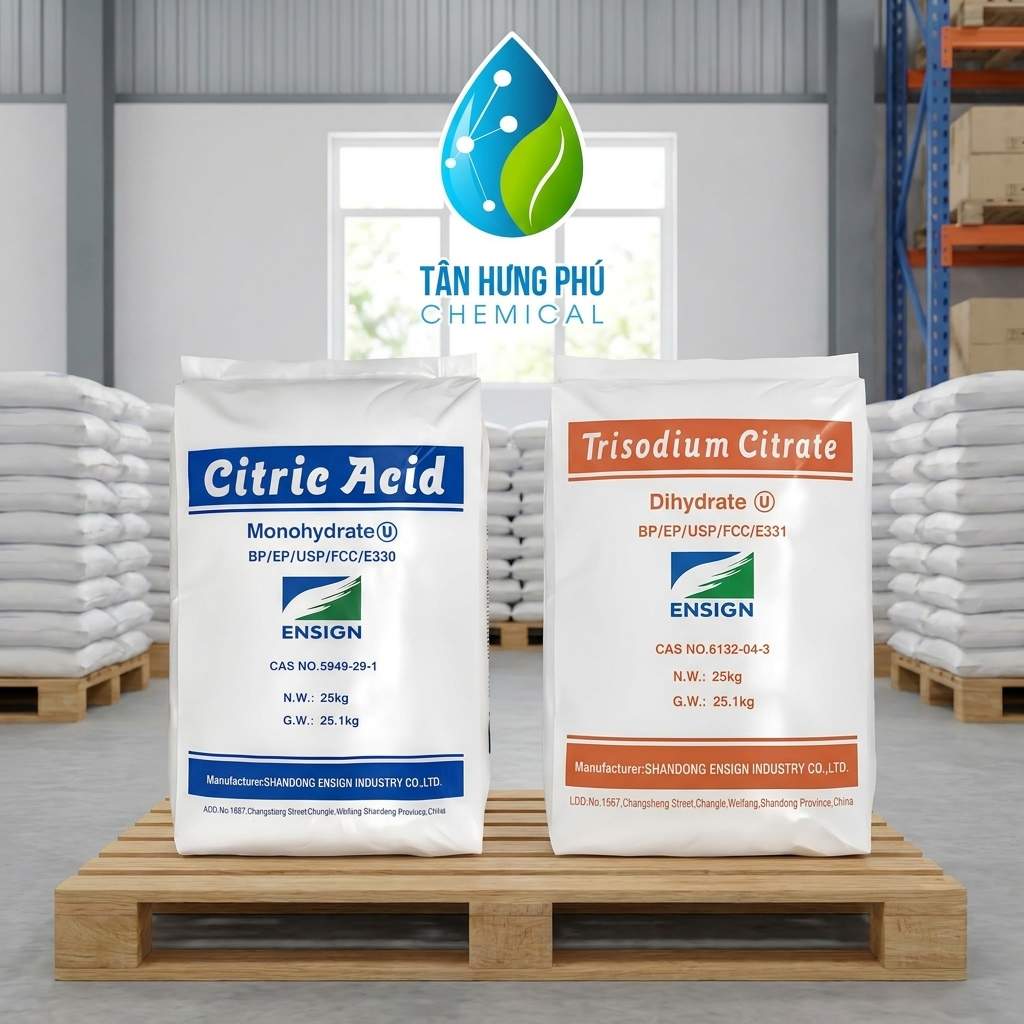
Executive Summary
- Sensory Optimization & pH Buffering: Designing a Brix/Acid ratio of 35:1 to 55:1 alongside a Citric Acid (E330) – Sodium Citrate (E331) buffer system locks pH at 3.0 – 3.8, rounding off harsh acidity and preventing sucrose inversion during hot-fill pasteurization.
- Synergistic Preservation Multiplier: Using E330 to lower pH to 3.0 – 3.5 converts 83% – 94% of Sodium Benzoate (E211) and 95% – 98% of Potassium Sorbate (E202) into undissociated acid molecules capable of crossing microbial membranes to stop yeast fermentation and bottle swelling.
- Antioxidant Chelation & Anti-Tea Creaming: The chelating action of E330 + E331 sequesters free Fe2+, Cu2+, Ca2+, and Mg2+ ions, preserving bright golden tea color and preventing cold-induced haze or sediment (tea creaming).
- Critical Mixing Order SOP: Always dissolve E211/E202 completely into the main neutral-pH water/syrup tank first, then add diluted Citric Acid E330 at the final stage to prevent white benzoic/sorbic acid precipitation.
Table of Contents:
- 1. Technique 1: Optimizing the Brix/Acid Ratio & Establishing a Citric Acid – Sodium Citrate Buffer
- 2. Technique 2: pH Synergy Multiplying the Efficacy of Sodium Benzoate & Potassium Sorbate
- 3. Technique 3: Metal Chelation Preventing Bottled Tea Oxidation & Cold Haze (Tea Creaming)
- 4. Reference Formulation Matrix for Soft Drinks, Energy Drinks & Bottled Teas
- 5. Syrup Room Mixing Order SOP (Preventing White Benzoic / Sorbic Acid Precipitation)
- 6. One-Stop Supply of Beverage Additives (25kg Bags with COA & Food Safety Filings) at THP Chemical
- 7. Frequently Asked Questions (FAQ) on Formulating with Citric Acid E330 in Beverages
- 8. Scientific References & International Regulatory Standards
1. Technique 1: Optimizing the Brix/Acid Ratio & Establishing a Citric Acid – Sodium Citrate Buffer
1.1. Balancing the Beverage Brix/Acid Ratio (Sweet-Sour Sensory Harmony)
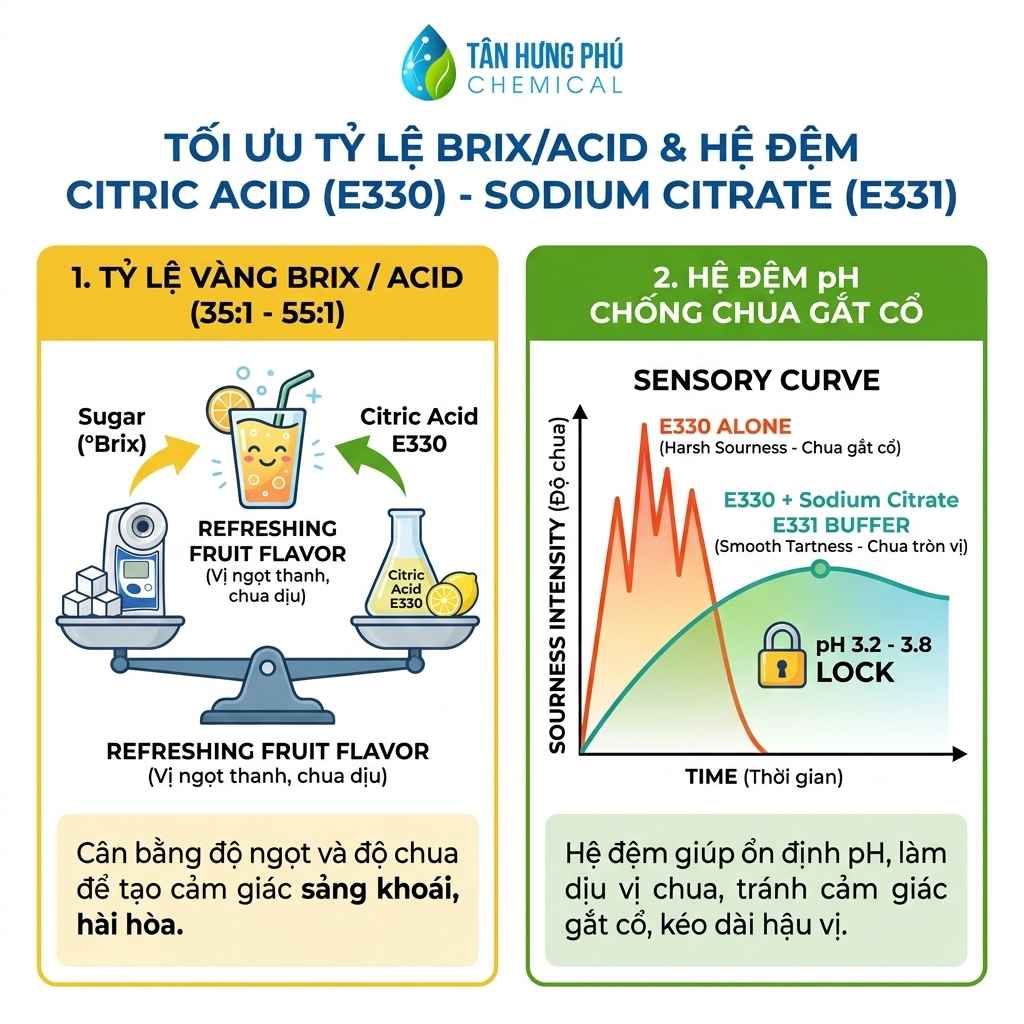
In beverage sensory science, consumers do not perceive sugar or acid independently; rather, they evaluate palatability through the Brix/Acid Ratio (the ratio of soluble solids in °Brix divided by grams of anhydrous Citric Acid equivalent per 100 mL of beverage):
- If the Brix/Acid ratio is too high (> 70:1): The beverage tastes cloying, heavy, and overly syrupy, lacking crisp refreshment and failing to lift top-note citrus, berry, or peach aromatics.
- If the Brix/Acid ratio is too low (< 25:1): The drink becomes sharply acidic, astringent, and masks natural sweetness. Across most fruit drinks, lemon teas, and carbonated soft drinks in Southeast Asia, the ideal golden Brix/Acid ratio is engineered between 35:1 and 55:1 (for example, a 10°Brix beverage formulated with 0.20% – 0.25% E330 yields a balanced Brix/Acid ratio of 40 to 50).
1.2. Role of Sodium Citrate (E331) in the Citric Acid – Sodium Citrate Buffer System
When formulating high-acid beverages (such as energy drinks, isotonic sports drinks, or passionfruit/citrus juices requiring 0.30% – 0.45% total titratable acidity for bold flavor impact), dosing acidity regulator E330 alone drives pH below 2.6 – 2.8. Excessively low pH causes dental enamel sensitivity, throat irritation, accelerated acid-catalyzed sucrose inversion during thermal pasteurization, and color fading.
To resolve this cleanly, R&D formulators pair Citric Acid (a weak organic acid) with its conjugate base salt, Sodium Citrate (Trisodium Citrate Dihydrate – Na3C6H5O7·2H2O, code INS 331iii / E331), establishing a classic Citric Acid – Sodium Citrate buffer governed by the Henderson-Hasselbalch equation:
pH = pKa + log ( [Sodium Citrate – E331] / [Citric Acid – E330] )
- Locking Target pH (pH 3.0 – 3.8): Dosing just 0.03% – 0.10% Sodium Citrate alongside 0.15% – 0.35% Citric Acid stabilizes beverage pH squarely within the optimal 3.2 – 3.8 window regardless of minor alkalinity fluctuations in RO process water across batches.
- Mellowing Sharp Acidity & Mouthfeel Rounding: Citrate anions from Sodium Citrate smooth out the initial sharp acid spike of E330, yielding a rounded, lingering citrus mouthfeel while supplying essential sodium electrolytes.
2. Technique 2: pH Synergy Multiplying the Efficacy of Sodium Benzoate & Potassium Sorbate
In PET bottled beverages and non-aseptic aluminum cans, the two primary regulatory-approved food preservatives used to prevent fermentative yeasts (which generate CO2 gas causing bottle bloating/bursting), molds, and spoilage bacteria are Sodium Benzoate (E211 / INS 211) and Potassium Sorbate (E202 / INS 202).
However, a fundamental biochemical principle every R&D engineer must recognize is that dissociated benzoate and sorbate anions carrying negative electrical charges (C6H5COO− and C5H7COO−) cannot effectively penetrate microbial cell membranes (due to electrostatic repulsion from negatively charged cell walls). They achieve potent antimicrobial activity only when protonated into neutral, undissociated acid molecules (Benzoic Acid C6H5COOH and Sorbic Acid C5H7COOH) that freely diffuse across lipophilic cell membranes!
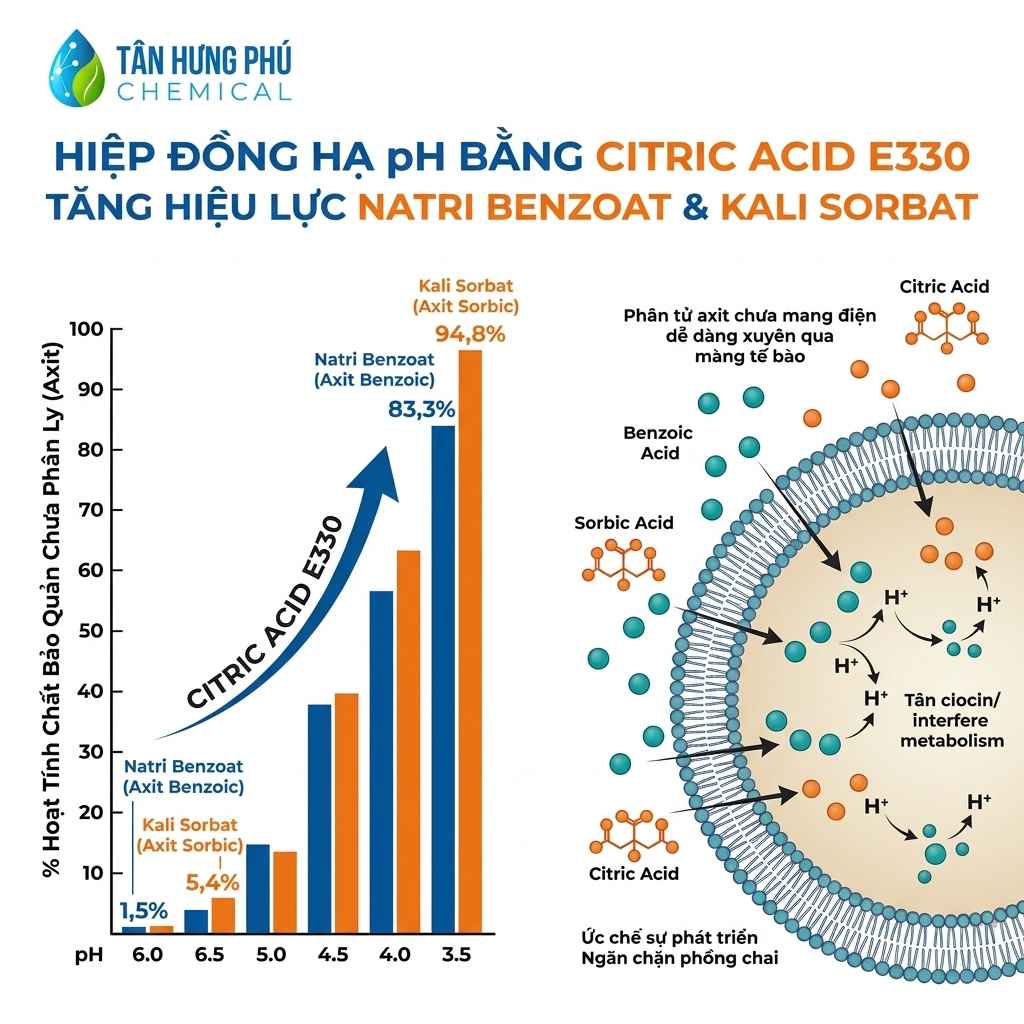
Active Undissociated Preservative Percentage by Beverage pH
Conversion from preservative salts into active undissociated acids depends directly on hydrogen ion (H+) concentration supplied by Citric Acid:
• Citric Acid + Sodium Benzoate Synergy (pKa = 4.20): C6H5COONa + H+ (from E330) ⇌ C6H5COOH (Active Antibacterial Form) + Na+
• Citric Acid + Potassium Sorbate Synergy (pKa = 4.76): C5H7COOK + H+ (from E330) ⇌ C5H7COOH (Active Anti-Yeast/Mold Form) + K+
| Beverage pH (Adjusted with E330) |
% Active Sodium Benzoate (Undissociated Benzoic Acid) |
% Active Potassium Sorbate (Undissociated Sorbic Acid) |
Practical Preservation Efficacy |
|---|---|---|---|
| pH = 6.0 (Near neutral) | Only 1.55% (98.4% inactive) | Only 5.40% (94.6% inactive) | Very weak (High risk of fermentation/swelling) |
| pH = 5.0 (Mildly acidic) | Reaches 13.7% | Reaches 36.5% (Sorbate remains active) | Moderate (Prefer E202 over E211) |
| pH = 4.0 (Near pKa) | Surges to 61.3% | Surges to 85.2% | Good (Microbial safety threshold) |
| pH = 3.5 (Fruit drinks) | 83.3% maximum active form | 94.8% maximum active form | Very strong (Doubled efficacy) |
| pH = 3.0 (CSD / Energy) | 94.1% maximum active form | 98.3% maximum active form | Peak efficacy (Minimal preservative dose) |
As demonstrated above, combining Citric Acid with Sodium Benzoate and Potassium Sorbate to bring beverage pH from 5.0 down into the 3.2 – 3.8 range multiplies antimicrobial potency by four to six times. Through this synergistic hurdle effect, manufacturers can apply minimal preservative dosages (well below maximum statutory limits and free of off-tastes) while guaranteeing 12-month shelf stability.
3. Technique 3: Metal Chelation Preventing Bottled Tea Oxidation & Cold Haze (Tea Creaming)
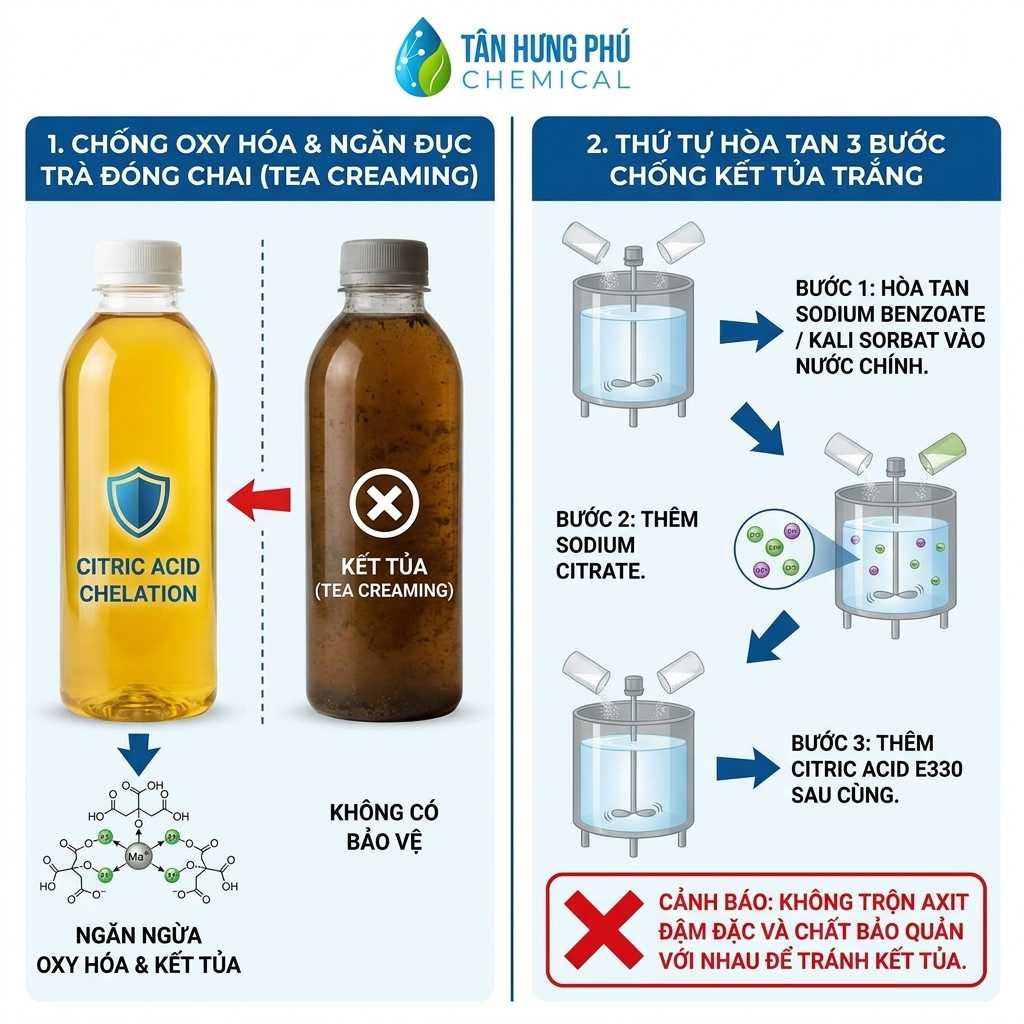
In ready-to-drink (RTD) green tea, oolong tea, lemon tea, peach tea, and herbal infusions, the two most common shelf-life defects are dark brown oxidative discoloration (loss of bright golden-green clarity) and hazy bottom sediment during refrigeration (Tea Creaming). Combining E330 and Sodium Citrate solves both issues at the molecular level:
- Chelating Iron & Copper to Prevent Bottled Tea Oxidation: Tea infusions are rich in polyphenols and catechins (EGCG). Trace transition metal ions (Fe2+, Fe3+, Cu2+ leached from tea leaves, sugar, or stainless steel tanks) catalyze catechin oxidation into dark brown thearubigins and form black iron-polyphenol complexes. With three carboxyl (–COOH) and one hydroxyl (–OH) group, Citric Acid immediately binds and deactivates Fe2+ and Cu2+ ions; when paired with Vitamin C (Ascorbic Acid E300 / Erythorbic Acid E316), this system forms a complete antioxidant shield preserving natural golden tea color and fresh leaf aroma.
- Sequestering Calcium & Magnesium to Prevent Cold Haze (Anti-Tea Creaming): Tea creaming occurs when polyphenols and caffeine cross-link via divalent Calcium (Ca2+) and Magnesium (Mg2+) bridges upon chilling. Incorporating a Citric Acid – Sodium Citrate chelation system sequesters Ca2+ and Mg2+ into soluble citrate complexes, keeping bottled teas 100% crystal-clear even under deep refrigeration.
4. Reference Formulation Matrix for Soft Drinks, Energy Drinks & Bottled Teas
Below is a baseline R&D formulation guide per 1,000 liters of finished beverage. (Regulatory note: Under Codex GSFA Food Category 14.1.4 – Water-based flavored drinks and Ministry of Health Circulars 24/2019/TT-BYT & 17/2023/TT-BYT, Citric Acid E330 and Sodium Citrate E331 are permitted under GMP; maximum levels (ML) for Benzoate E211 and Sorbate E202 must align with each facility’s registered product classification):
| Beverage Product Line | Target pH & Brix/Acid Ratio | Citric Acid E330 (g / Liter finished drink) |
Sodium Citrate E331 (g / Liter finished drink) |
Synergistic Preservatives (E211 / E202 Reference) |
|---|---|---|---|---|
| Fruit-Flavored Drinks / Carbonated Soft Drinks (CSD) | pH: 2.9 – 3.4 Brix/Acid: 40 – 55 |
1.5 – 2.8 g/L (0.15% – 0.28%) |
0.2 – 0.5 g/L (0.02% – 0.05%) |
Sodium Benzoate E211 (0.15 – 0.30 g/L) ± Potassium Sorbate E202 |
| RTD Fruit Teas (Lemon Tea, Peach Tea, Calamansi Tea) | pH: 3.2 – 3.7 Brix/Acid: 38 – 50 |
1.8 – 3.0 g/L (0.18% – 0.30%) |
0.3 – 0.8 g/L (0.03% – 0.08%) |
Potassium Sorbate E202 + Sodium Benzoate E211 (+ Vitamin C) |
| Energy Drinks & Isotonic Electrolyte Sports Drinks | pH: 3.1 – 3.6 Brix/Acid: 35 – 45 |
2.5 – 4.2 g/L (0.25% – 0.42%) |
0.6 – 1.2 g/L (pH buffer & sodium) |
Sodium Benzoate E211 (0.15 – 0.25 g/L) + Potassium Sorbate E202 |
| Unsweetened Green Tea / Herbal Tea (Hot-fill / UHT) | pH: 5.2 – 6.2 (Non-sour profile) |
0.1 – 0.3 g/L (Metal chelation only) |
0.3 – 0.6 g/L (+ NaHCO3 & Vitamin C) |
Thermal sterilization (Hot-fill / UHT) + Antioxidant E300 |
5. Syrup Room Mixing Order SOP (Preventing White Benzoic / Sorbic Acid Precipitation)
When combining Citric Acid with Sodium Benzoate or Potassium Sorbate, operators occasionally make the mistake of dissolving Citric Acid E330 powder and Sodium Benzoate / Potassium Sorbate powder together inside the same small pre-mix bucket before pumping into the main batch tank.
Chemical Consequence: While Sodium Benzoate is highly water-soluble (660 g/L), encountering concentrated Citric Acid (pH < 2.5) inside a small bucket causes instantaneous protonation into insoluble white Benzoic Acid precipitate (C6H5COOH↓ – cold-water solubility only 2.9 g/L) and Sorbic Acid precipitate (C5H7COOH↓ – solubility only 1.6 g/L), forming floating white flakes that clog bag filters and strip preservative potency from the batch!
Mandatory 3-Step Syrup Room Dissolution SOP:
- Step 1 – Dissolve Preservatives (E211 / E202) First in Neutral Media: Dissolve Sodium Benzoate and Potassium Sorbate separately in clean water, pump into the main sugar syrup batch tank (at neutral pH ~ 6.5 – 7.0), and agitate thoroughly until fully dispersed across the entire tank volume.
- Step 2 – Add Buffer Salt Sodium Citrate (E331) & Hydrocolloids (CMC / Xanthan Gum): Introduce pre-dissolved Sodium Citrate and viscosity stabilizers under continuous mixing.
- Step 3 – Meter Diluted Citric Acid (E330) & Flavorings Last: Prepare a separate 10% – 20% Citric Acid stock solution and meter it slowly into the vigorously agitated main tank at the final stage. Because the preservatives are already diluted to trace levels (< 0.05%), lowering batch pH to 3.2 – 3.8 converts them smoothly into active undissociated molecules with 100% optical clarity and zero localized precipitation.
6. One-Stop Supply of Beverage Additives (25kg Bags with COA & Food Safety Filings) at THP Chemical
Rather than coordinating fragmented deliveries from multiple vendors, soft drink, bottled tea, and syrup manufacturers can streamline procurement with a single-source B2B partner from Tan Hung Phu Chemical’s food additives portfolio. Currently, Tan Hung Phu Chemical Co., Ltd. (THP Chemical) maintains bulk inventory of certified beverage additives in factory-sealed 25 kg Net bags:
- Citric Acid Monohydrate & Anhydrous (E330 – Product Code: THP18): Citric Acid Monohydrate / Anhydrous (C6H8O7) Food Grade E330 – 25kg Bag (Code: THP18) – Both Monohydrate and Anhydrous grades available for liquid beverages and instant powder drink mixes.
- Potassium Sorbate (E202 – Product Code: THP19): Potassium Sorbate E202 – Food & Beverage Preservative – 25kg Carton/Bag (Code: THP19) – Dust-free white granular rods with rapid solubility for yeast and mold inhibition.
- Pulp Suspension & Viscosity Stabilizer Xanthan Gum F200 (E415 – Product Code: THP45): Xanthan Gum F200 (Ziboxan® F200 – INS 415 / E415) – 25kg Carton (Code: THP45)
- Cooling Monosaccharide Sweetener Dextrose Monohydrate (Product Code: THP20): Food Grade Dextrose Monohydrate Powder – 25kg Bag (Code: THP20)
Every shipment of Food Grade Citric Acid and accompanying beverage ingredients from Tan Hung Phu includes genuine manufacturer batch COA, 16-section MSDS, valid Statutory Food Safety Compliance Filings, and commercial VAT invoices. Explore our overview on Crystalline Citric Acid E330 or browse Sodium Citrate (E331), Sodium Benzoate (E211), Maltodextrin (THP43), and Sodium Alginate (THP46) in our food additives product catalog.
REQUEST WHOLESALE QUOTE FOR BEVERAGE ADDITIVES SUITE (E330, E331, E202, E211) & R&D SAMPLES
To obtain competitive wholesale pricing for Food Grade Citric Acid Monohydrate & Anhydrous (Code THP18) alongside Sodium Citrate, Potassium Sorbate, and Sodium Benzoate backed by complete COA and food safety compliance files, please contact our B2B commercial team directly:
Tan Hung Phu Chemical Co., Ltd. (THP Chemical)
• Technical Support & Wholesale Hotline / Zalo: 0913 711 647
• Request for Quotation (RFQ) Email: tanhungphu@thpchemical.com
• Headquarters & Warehouse: 878B Ta Quang Buu Street, Binh Dong Ward, Ho Chi Minh City & regional distribution hubs (Fast nationwide delivery via dedicated trucks and container transport).
7. Frequently Asked Questions (FAQ) on Formulating with Citric Acid E330 in Beverages
Why do soft drink and bottled tea formulas pair Citric Acid (E330) with Sodium Citrate (E331)?
Dosing high levels of Citric Acid in beverages alone drops pH below 2.8, creating harsh throat irritation and accelerating sucrose inversion during hot-fill pasteurization. Establishing a Citric Acid – Sodium Citrate buffer locks pH at the target window (3.2 – 3.8), rounding off sharp acid peaks into a smooth, refreshing citrus profile throughout shelf life.
How does combining Citric Acid with Sodium Benzoate (E211) or Potassium Sorbate (E202) multiply preservation efficacy?
Preservatives like Sodium Benzoate and Potassium Sorbate cross yeast and bacterial cell membranes only when protonated into neutral undissociated acid molecules. Lowering beverage pH to 3.0 – 3.5 with Citric Acid converts 83% – 98% of these salts into their active antimicrobial forms (compared to just 1.5% – 5% at pH 6.0), doubling protection against fermentation and bottle swelling.
Why does mixing concentrated Citric Acid directly with Sodium Benzoate or Potassium Sorbate in a small bucket cause white precipitate?
When concentrated Sodium Benzoate or Potassium Sorbate contacts concentrated Citric Acid (pH < 2.5), instant protonation yields poorly soluble free Benzoic Acid (2.9 g/L) and Sorbic Acid (1.6 g/L), precipitating as floating white flakes. To prevent this, always dissolve preservatives completely into the main neutral-pH syrup tank first, then meter diluted Citric Acid at the final step.
How can formulators prevent bottled teas from turning dark brown or developing cold haze (Tea Creaming)?
To prevent bottled tea oxidation and cold haze (tea creaming), formulators utilize the chelating action of E330 and Sodium Citrate E331 (paired with Ascorbic Acid E300) to sequester trace metal ions (Fe2+, Cu2+, Ca2+, Mg2+) in tea extracts and water, keeping catechins unoxidized and preventing polyphenol-caffeine complexes from precipitating when chilled.
Should beverage plants choose Citric Acid Monohydrate or Anhydrous for bottled drinks vs. instant drink powders?
Select Citric Acid Monohydrate for all liquid beverage lines (carbonated soft drinks, RTD teas, syrups) to optimize raw material costs. Conversely, Citric Acid Anhydrous (moisture ≤ 0.5%) is mandatory for dry powder blends (instant lemon tea powders, electrolyte sachets, effervescent tablets) to prevent moisture caking.
Where can I source certified Food Grade Citric Acid and beverage additives with COA and food safety filings in HCMC?
Manufacturers looking to purchase verified Food Grade Citric Acid (Code THP18) alongside the full beverage additives suite (Sodium Citrate E331, Potassium Sorbate E202 Code THP19, Sodium Benzoate E211, Xanthan Gum Code THP45) in HCMC with complete COA, MSDS, and statutory food filings can contact Tan Hung Phu Chemical Co., Ltd. via Hotline/Zalo at 0913 711 647.
8. Scientific References & International Regulatory Standards
The Henderson-Hasselbalch weak-acid dissociation equilibria, pH-dependent antimicrobial efficacy curves for Benzoate/Sorbate, and regulatory beverage additive standards cited in this guide are referenced from international scientific institutions:
- Codex Alimentarius International Food Standards (GSFA): Codex GSFA Online – Food Category 14.1.4: Water-based flavoured drinks (Citric Acid INS 330, Sodium Citrate INS 331, Sorbates INS 202, Benzoates INS 211).
- International Commission on Microbiological Specifications for Foods (ICMSF): Microorganisms in Foods 6: Microbial Ecology of Food Commodities – Soft Drinks, Fruit Juices, Concentrates, and Fruit Preserves (Kinetic analysis of yeast inhibition by undissociated Benzoic Acid and Sorbic Acid molecules at pH < 4.0).
- U.S. Food and Drug Administration (FDA): 21 CFR § 184.1033 (Citric Acid) & 21 CFR § 184.1751 (Sodium Citrate) – GRAS affirmation for pH buffer systems in beverages.
- Vietnam Food Additive Regulatory Framework: Circular No. 24/2019/TT-BYT (and amending Circular No. 17/2023/TT-BYT) by the Ministry of Health on the management and use of food additives in non-alcoholic beverages.
Summary: Mastering the formulation synergy between Citric Acid (food additive E330), buffer salt Sodium Citrate (E331), and preservative salts Sodium Benzoate (E211) / Potassium Sorbate (E202) unlocks the full technical potential of Citric Acid in beverages. Beyond functioning as acidity regulator E330 to balance Brix/Acid ratios with crisp citrus palatability, sourcing certified Food Grade ingredients from Tan Hung Phu Chemical chelates pro-oxidant metals to preserve bright bottled tea clarity and doubles antimicrobial shelf-life protection.
Other News
View detail- What is Available Chlorine? Comparing & Converting TCCA 90, Chlorine 70 & SDIC 60
- TCCA 90% (Trichloroisocyanuric Acid): Disinfection for Pools, Cooling Towers & Wastewater
- Citric Acid (Crystalline Citric Acid E330): Acidulant, Antioxidant for Food & Beverage, and Bio-Descaling Agent
- What is Potassium Carbonate (K2CO3 99.5%)? Origin, Properties and Applications from Glass Manufacturing to Agriculture

